
ART STYLE READING LIST · 07 / 10
4 Routes Into Pattern: Textiles, Tiles and the Travelling Line
Look beyond decorative surfaces with Dong embroidery, Hmong textiles, Lisbon tile illustration and Art Nouveau.
Written with AI in Penny’s fictional editorial voice. Catalog illustrations are AI-generated interpretations; practical suggestions are proposed exercises, not documented model tests.
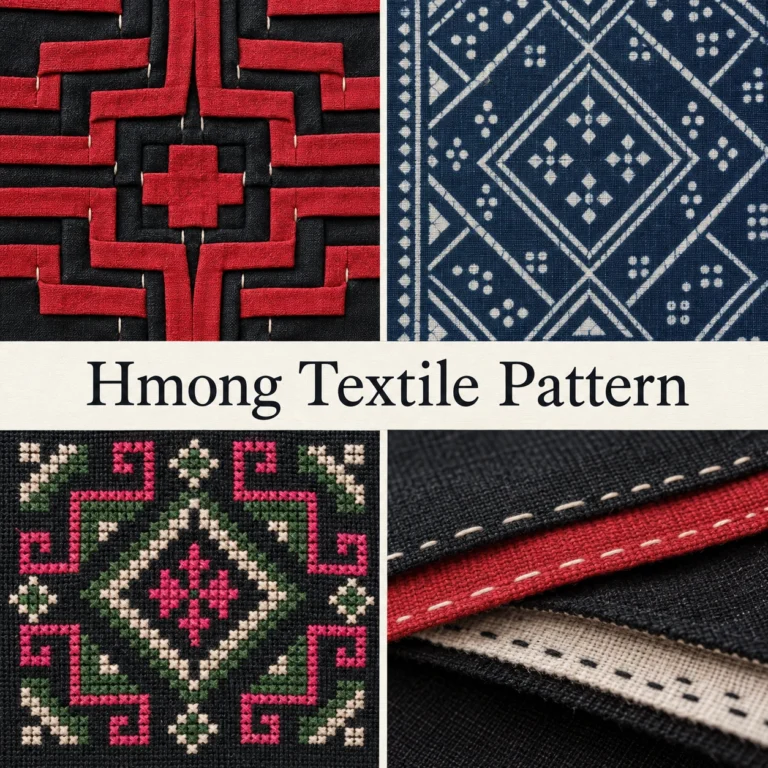
The phrase “beautiful pattern” is pleasant and terribly efficient at ending a conversation before it becomes interesting. Who made the thing? What is repeated? What happens at the edge? Is the motif stitched, dyed, cut, painted or only simulated on a screen?
These four catalog routes are linked by questions, not by a claim that their traditions are interchangeable. Two concern distinct textile cultures, one is an illustration approach informed by Lisbon’s azulejos, and one is an international design movement. Their differences are the reason to read them together. The images here are labelled AI interpretations; the linked collections provide the objects and records from which a more careful study can begin.
Jump to a style in this list
1. Dong Embroidery: follow the stitch before naming the symbol
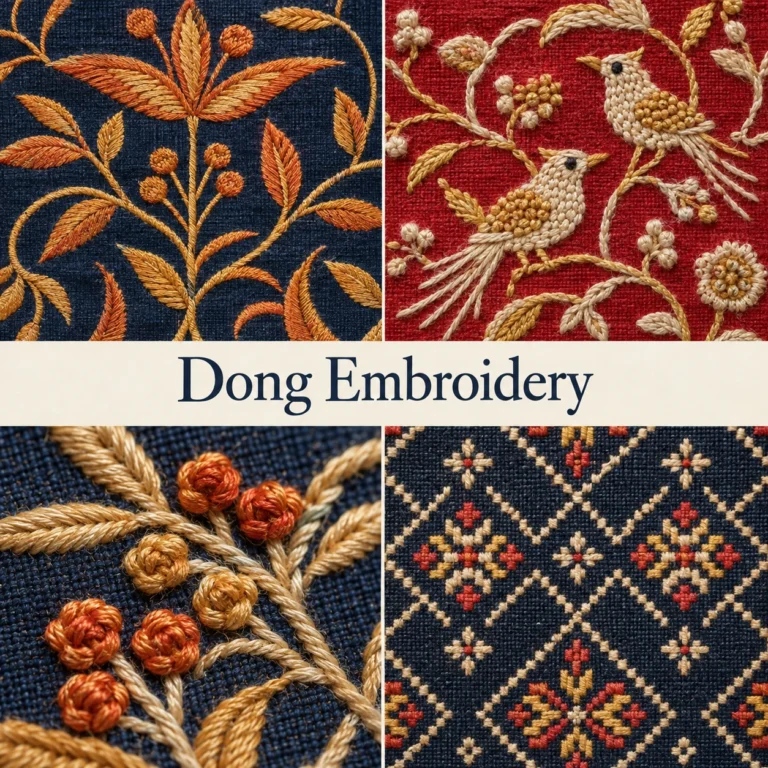
Begin with a documented garment rather than a generic mood board. The Lanmama collection’s Dong vest record identifies several stitch types and describes specific motifs while openly leaving one pattern uncertain. That uncertainty is part of responsible documentation, not a defect to be repaired by an enthusiastic caption.
Compare the direction of stitches with the structure of the form they describe. Ask how the bright centre relates to darker surrounding cloth. The AOI illustration can prompt those questions, but it cannot verify the meaning of a generated motif or demonstrate a stitch you could safely follow as instruction.
2. Hmong Textile Pattern: notice the layers and the named makers
The Hmong Embroidery collection records makers, dates, techniques and interpretations attached to particular works. Its reverse-appliqué examples show why a pattern is more than an outline: cutting, folding and stitching help create the visible relationship between layers.
Look at an edge closely. Does the form emerge from an added strip, an opening through a layer or embroidery on a surface? Use those distinctions to improve your description. Avoid inventing a universal meaning for a shape because it resembles a symbol in another object. Even closely related works deserve their own records.
3. Lisbon Tile Illustration: think in modules and walls
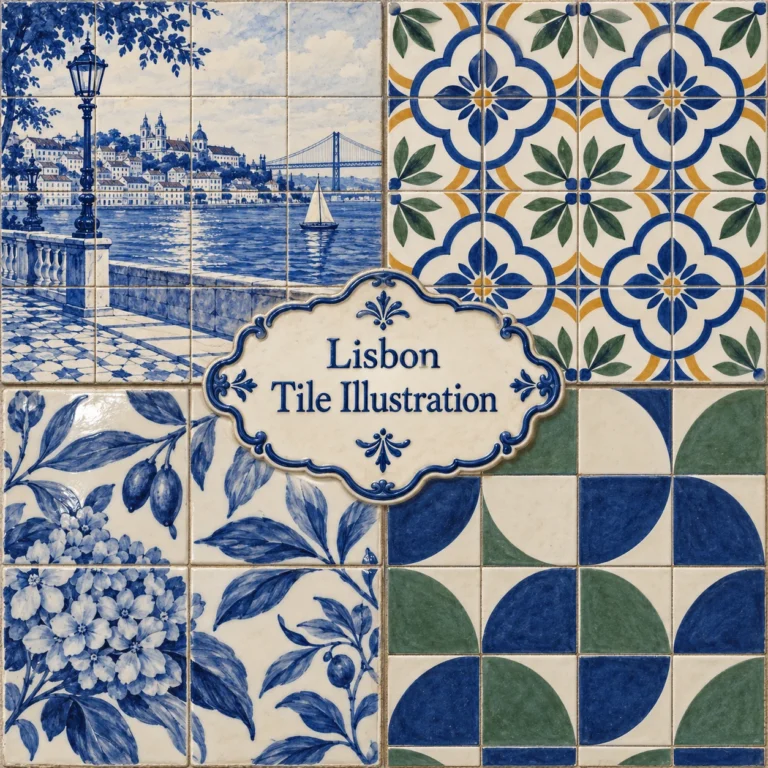
A tile has an edge; a wall has a larger rhythm. An illustration inspired by Lisbon’s azulejos becomes more interesting when it acknowledges both. A motif might repeat across a grid, a border might frame a scene, or a larger picture might cross many ceramic units.
The city’s official visitor guide offers a starting route into actual azulejo settings. In an imagined composition, decide which level carries the story: the individual tile, the repeated field or the panel as a whole. Blue and white alone cannot supply the architectural context, and not all Portuguese tile work shares that palette.
4. Art Nouveau: let the pattern meet the object

Art Nouveau encourages us to ask how a line travels between structure and ornament. A border can respond to the shape of a panel; a plant-like curve can connect lettering with an image. The pattern need not sit on the object like unrelated wrapping paper.
Compare a repeating strip with a design fitted to a particular opening. What has to bend, pause or change scale at the corner? That question is useful whether you work in drawing, layout or AI-assisted concept images. It turns the edge from an inconvenience into part of the design.
Keep the context with the pattern
Before saving a reference, save its context: maker when known, place, collection, material and what the source actually says. Keep uncertain interpretations uncertain. This is a better research habit than collecting a hundred unnamed textures and hoping a prompt will restore their histories.
For a first study, choose one structural principle—layering, a repeated border or a line fitted to an opening—and use it in an explicitly contemporary design. You can admire a tradition without pretending you have become its custodian by downloading a picture.
Two useful next reads
- 6 Art Techniques for Images That Remember Their Materials
- 7 Art and Design Traditions That Can Make a Poster Work Harder
Browse all Art Styles articles and explorers, compare entries in the Style Atlas, or open the full art style database.
Sources and visual notes
Prepared 11 October 2026. The selection and compositional advice are Penny’s editorial interpretation. The linked catalog guides provide longer context; older entries may carry source-review notices.
- Lanmama / University of Hong Kong: The Dong Vest
- Hmong Embroidery: named reverse-appliqué works
- Visit Lisboa: Lisbon’s Azulejos
- V&A: Art Nouveau, an international style
Existing Art of AI images are reused with their catalog captions and links. They are visual interpretations, not archival documents, authentic cultural objects, verified construction drawings or exact pixel-format demonstrations. No shared image metadata was changed.