
Textile traditions · documented Dong embroidery
Explore Dong embroidery through documented textiles, stitch variety, careful motif interpretation and clearly labeled AI-inspired visual studies.
A visual introduction
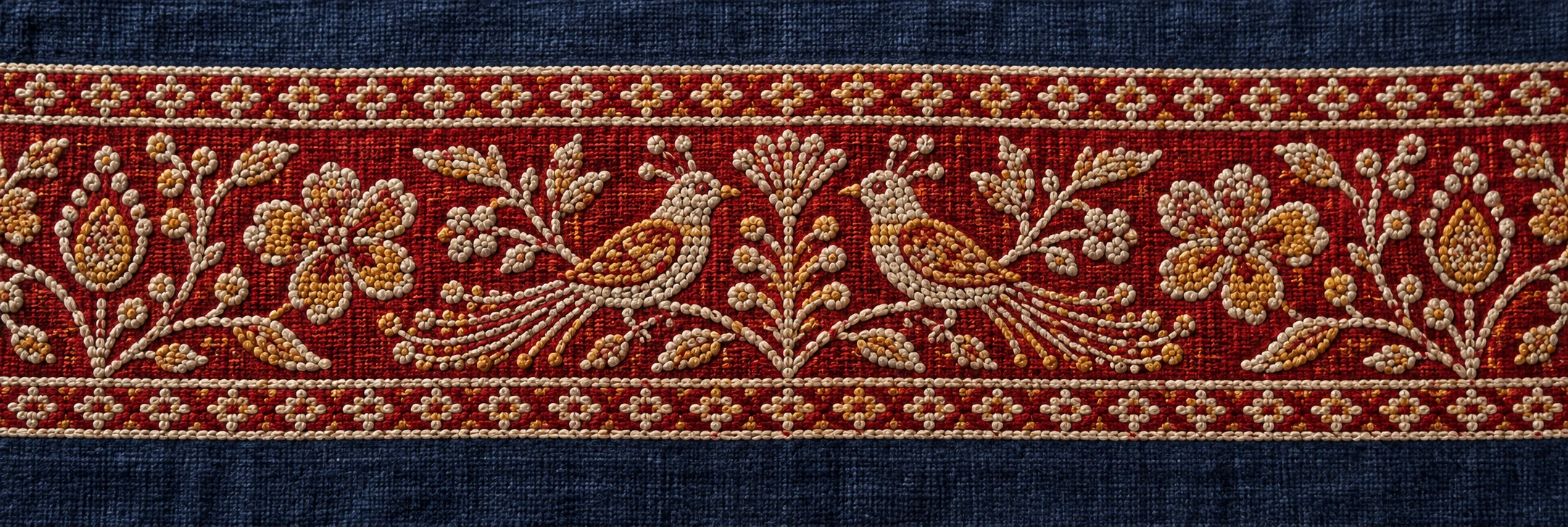
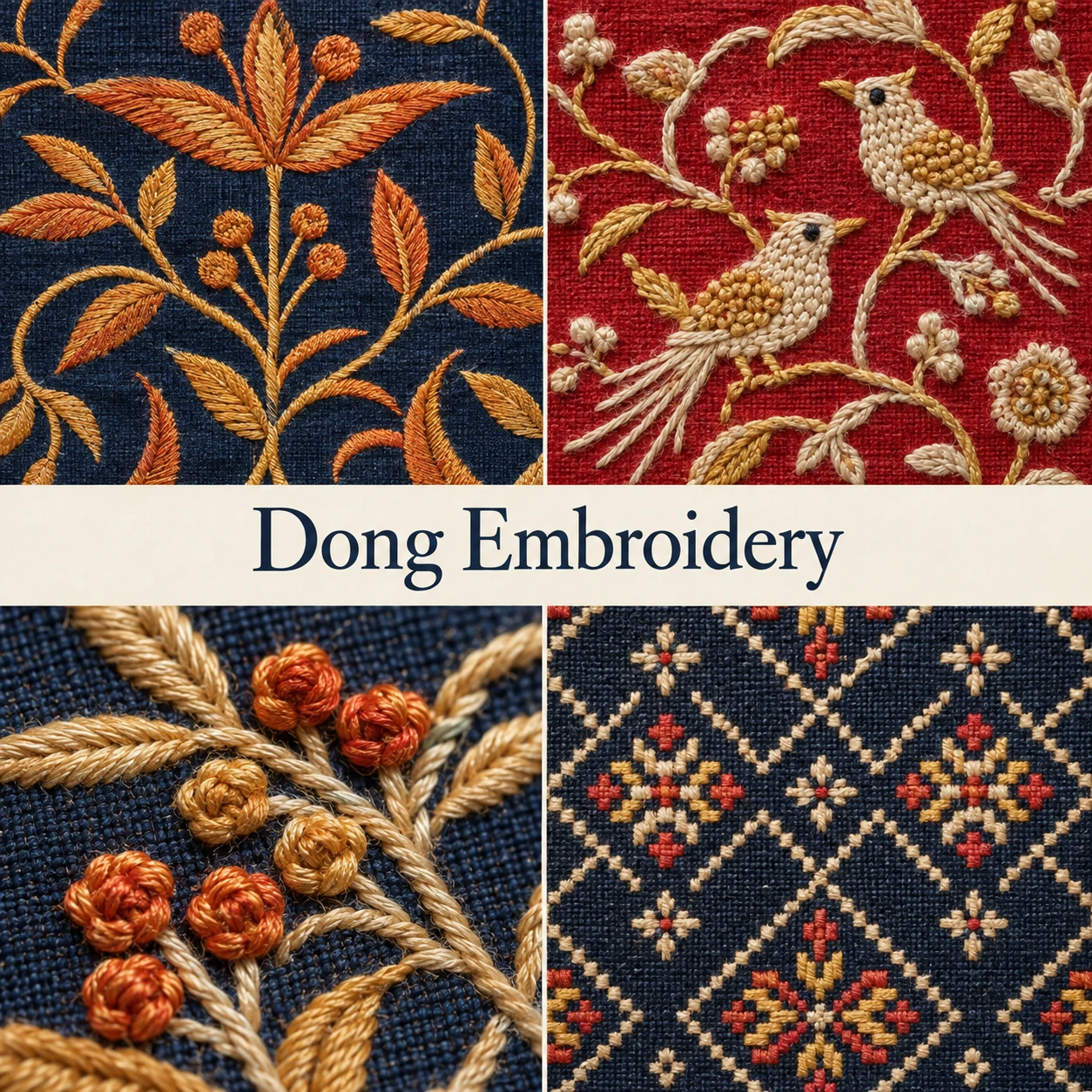
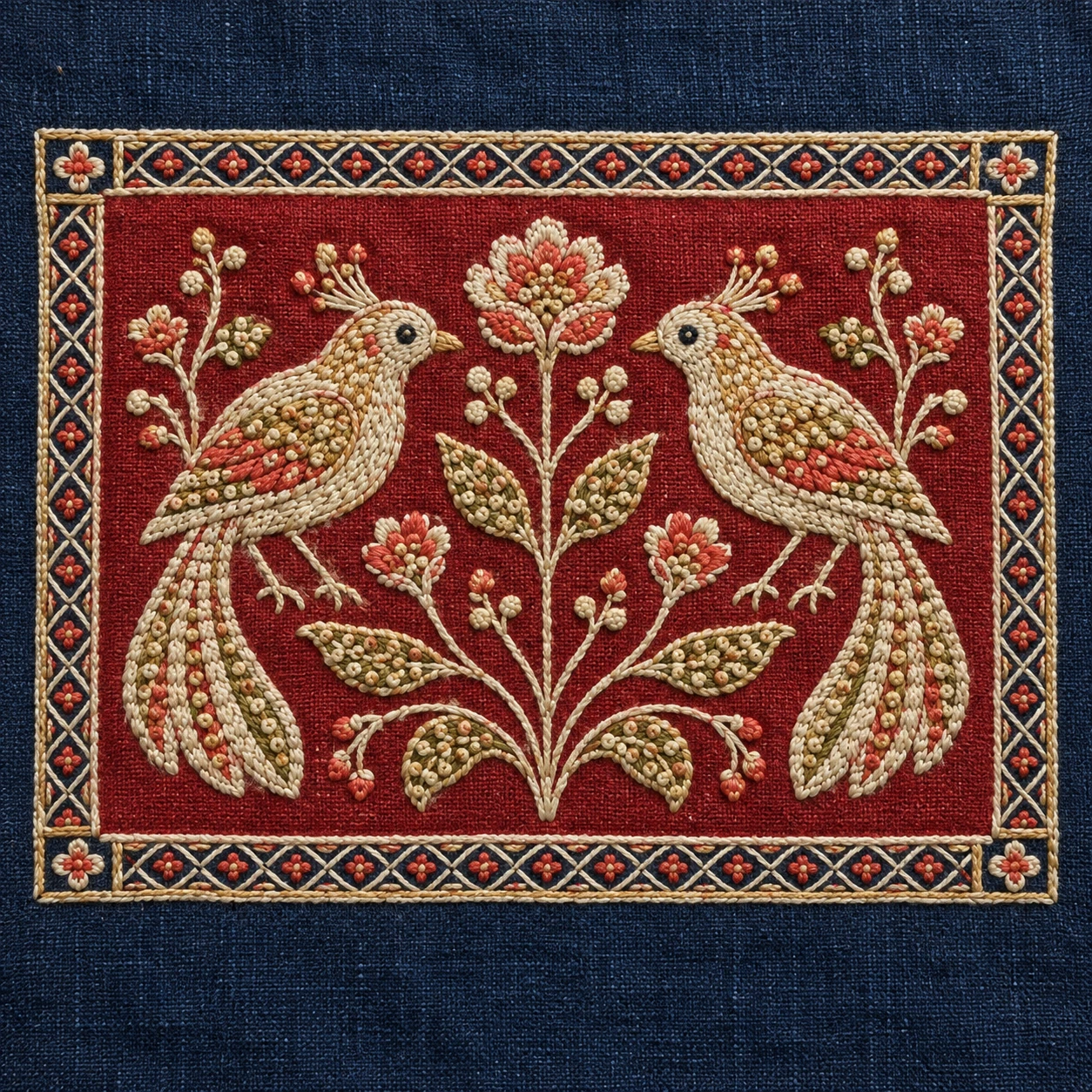
Three original AI-generated illustrations: a panoramic header, a collage with the style name at its center, and a standalone example. Captions distinguish these studies from historical objects and technical documentation.
Select an image for a closer look. Use the thumbnails, arrow keys or a swipe to compare examples. Zoom in to inspect details, or share the image that inspires you.
Creative toolbox · take this style further
Choose an input and a destination. Search sends your words to the chosen site; Copy & open puts them on your clipboard to paste there.
Create with AI
Turn your chosen input into an image prompt or a new creative direction.
ChatGPT
Copy your input and paste it into a ChatGPT conversation or image request.
Copy & open ChatGPT (new tab)Claude · Anthropic
Develop an image prompt or explore the style in a new Claude conversation.
Copy & open Claude · Anthropic (new tab)Midjourney
Paste your input into the Imagine bar on the Create page.
Copy & open Midjourney (new tab)Adobe Firefly
Copy your input, open Firefly, and paste it into the prompt field.
Copy & open Adobe Firefly (new tab)Leonardo.Ai
Copy your input, open Leonardo, and paste it into the generation field.
Copy & open Leonardo.Ai (new tab)Image search
Find visual references. Short, concrete keywords usually work best.
Lexica
Search AI images and prompts using your selected input.
Search with this input Lexica (new tab)Pexels
Search the photo and video library. Short keywords often work best.
Search with this input Pexels (new tab)Pixabay
Search photos, illustrations and other images.
Search with this input Pixabay (new tab)Unsplash
Search photographs using the style name or your own keywords.
Search with this input Unsplash (new tab)Wikimedia Commons
Search photographs, artworks and historical images. Check each file for its source and reuse terms.
Search with this input Wikimedia Commons (new tab)Art & research
Explore artists, collections and the ideas behind a style.
Wikipedia
Search for background reading. A style may not have its own article.
Search with this input Wikipedia (new tab)WikiArt
Copy your input into WikiArt’s search to explore artists and artworks.
Copy & open WikiArt (new tab)Europeana
Paste your keywords into the search to explore European museum, library and archive collections.
Copy & open Europeana (new tab)Inspiration
Discover portfolios and visual ideas from creative communities.
Instagram hashtags
Search a hashtag made from your input: spaces and punctuation are removed. Instagram may require sign-in.
Search with this input Instagram hashtags (new tab)ArtStation
Paste your input into artwork search for concept art, environments, characters and visual development.
Copy & open ArtStation (new tab)Behance
Paste your input into project search for illustration, design and visual storytelling.
Copy & open Behance (new tab)A closer look
Study the cloth, stitch direction, outlines and fills together. Specific Dong objects show different techniques and arrangements; no single palette or motif can represent every maker or locality.
Begin with a textile, not a generic pattern label
Dong Embroidery refers here to embroidery associated with Dong communities, approached through specific documented textiles rather than a claim that every object shares one style. This guide focuses on records connected with Liping County in Guizhou, China. A vest, a baby-carrying textile and festival-costume panels give us different points of entry. [1][2][3]
The distinction is essential for an art database. Embroidery is material work: thread passes through a support, follows a direction, builds a surface and belongs to an object with a use. Calling it an “AI style” must not erase those relationships. Our generated pictures explore selected visual qualities; the museum records remain the evidence for historical objects.
Start by asking what you are looking at. Is it a complete garment, an applied panel or a detail detached from its original setting? A cropped photograph can make all three look like an interchangeable rectangle of ornament. The catalogue may restore the missing context.
Three records, three different lessons
The Lanmama Museum vest recorded by HKU Libraries is dated to the late Qing period and located to Yandong or Jiuchao in Liping County. Its description identifies satin, flat and counted-thread stitches, with prominent orange-yellow embroidery and birds around a sun motif. Crucially, one pattern remains unverified. The record openly entertains several identifications rather than settling on an attractive story. Preserve that uncertainty. [1]
The Dong Baby Carrying Belt in the same project is dated to the Republic of China period. The record describes a red embroidered field framed by dark blue and the use of stem and knot stitches. Outlines and granular fills do different visual jobs. This specific object gives us a reason to look closely at how a motif is constructed, instead of treating its surface as a flat color map. [2]
A Collections WA record for the Embroiderers’ Guild of WA Textile Museum describes three Dong panels intended for festival costume, dated circa 1990–1999. They were purchased from a textile factory in Jiuchao. The description notes rice-glue stiffening and beating to create sheen in the cloth, while one panel is on untreated black cotton. The ground fabric is therefore part of the visual story, not merely a neutral background. [3]
How thread changes the reading of a motif
A line of stitches can describe an edge; a dense fill can establish weight; a repeated geometric border can regulate the whole composition. Under directional light, neighboring threads catch brightness differently. This is why a textile can change as you move around it even when its color palette stays constant.
For visual study, separate the outline from the fill. Follow one bird or leaf around its boundary, then examine the interior. Do the stitches turn with the shape? Does a fill appear smooth, directional or granular? The answer matters more than adding the word “intricate” to a prompt.
Counted-thread effects also invite attention to the underlying grid. Repetition can appear regular at a distance while retaining small variations close up. Avoid assuming that a convincing-looking repeated motif is a usable stitch chart. A chart needs an explicit relationship between marks and the support, not simply an attractive raster image.
Motifs need evidence, not confident invention
The vest record’s unresolved motif is a valuable research lesson. A shape can resemble several things without proving any of them. Even when a catalogue identifies a sun or bird, that does not authorize a universal explanation of what the motif means to every Dong maker. Attribution, visual identification and interpretation are separate tasks.
Likewise, do not merge nearby communities into one generic “ethnic embroidery” category. Keep the institution’s attribution, locality and uncertainty attached to the object being discussed. If a maker is not named in the record, say that a maker is unidentified rather than inventing a representative biography.
For a contemporary commission or collaboration, the maker’s own account can add knowledge that a distant collection record does not contain. This guide offers a starting bibliography, not an exhaustive statement about current practice. It can expand as better object-level and community-authored evidence becomes available.
Reading our clearly labeled textile studies
The banner explores a long red panel on indigo cloth with pale bird and plant forms. The named collage compares a directional flat-stitch appearance, raised knot-like fills, a close view of thread and a geometric repeat. Its purpose is to make differences visible, not to assemble a supposedly standard Dong pattern book.
The standalone panel arranges two original birds around a flowering stem. Look at the contrast between the red field, the pale outlines and the darker border. These designs are AI-generated interpretations informed by the cited records. They are not photographs of Dong-made objects, reproductions of the museum textiles or verified instructions for making them.
Some generated marks read more like loops or bundled threads than technically exact stitches. That limitation is worth seeing rather than concealing beneath a confident caption. Use the pictures as visual studies; consult actual textile close-ups and knowledgeable makers to learn a technique.
Usability in AI art generation
AI is useful here for exploring color relationships, panel proportions, border placement and the appearance of thread under light. A precise prompt names the support and the intended mark: dark woven cotton, pale stem-like outlines, small knot-like fills, a restrained geometric border. It also labels the result as a contemporary interpretation.
Models may turn stitches into beads, render embroidery as printed fabric, invent implausible thread paths or combine unrelated garment conventions. Inspect at both object scale and close range. A handsome surface does not establish cultural attribution, material identity or stitch accuracy. Keep these limits explicit when sharing the result.
For a design intended to be stitched, redraw and sample it with someone who understands the chosen technique. For a guide intended to teach Dong embroidery, prioritize documented objects and attributed knowledge. Generated images can support a discussion of visual choices; they cannot supply missing provenance or replace the maker’s practice.
An exercise in looking slowly
Choose one documented object from the sources and write three short notes: what the record states, what you can directly observe and what remains uncertain. Keep those notes separate. Then make an original study that changes the motif while exploring one observed relationship, such as a bright outline against a dark ground.
Compare the new image with your notes rather than declaring it authentic because it looks convincing. The most interesting outcome may be a better question about thread, cloth or construction. A patient description respects both the beauty we can see and the knowledge we have not yet earned.
A small poetic detour
Original words from the AOI studio.
Poetry
Thread turns.
Light follows.
The cloth remembers
more than the caption.
The prompt workshop
Original creative exercises. These prompts create new illustrations, not documentary evidence.
Explore stitch and ground
Contemporary AI textile study informed by documented Dong embroidery, dark woven cotton with original botanical forms in pale stem-like silk outlines and small knot-like fills, visible cloth weave, restrained red gold cream palette, no authenticity claim or text.
Original AOI creative exercise; inspect the result against the guide rather than assuming the model followed every instruction.
Study a border
Original imagined embroidered panel, dark indigo ground with counted-thread-like geometric border and a quiet central field, consistent textile scale, visible thread direction and small variations, no borrowed garment or invented symbolism, no lettering.
Original AOI creative exercise; inspect the result against the guide rather than assuming the model followed every instruction.
Change the lighting
Close textile study of an original bird motif with directional flat stitches beside granular knot-like fills, raking side light revealing thread texture on woven cloth, clearly a contemporary AI interpretation, no beadwork or flat printed pattern.
Original AOI creative exercise; inspect the result against the guide rather than assuming the model followed every instruction.
People & works to explore
References discussed in this article. Consult the sources below for context.
Artists and practitioners
Dong makers — individual names are not supplied in the cited object records; retain the documented attribution
Paintings and other works
The Dong Vest — late Qing, Lanmama Museum, identifier 16 [1]
The Dong Baby Carrying Belt — Republic of China period, Lanmama Museum, identifier 364 [2]
Three Dong embroidery panels — circa 1990–1999, Embroiderers’ Guild of WA Textile Museum [3]