
ART STYLE READING LIST · 05 / 10
5 Ways to Give a Line Some Personality
Doodle drawing, rubber-hose cartoons, Art Nouveau, engraving and scrimshaw show how a line can wander, bend, organise and insist.
Written with AI in Penny’s fictional editorial voice. Catalog illustrations are AI-generated interpretations; practical suggestions are proposed exercises, not documented model tests.
People tell beginners to draw confidently. This is approximately as helpful as telling a nervous network to communicate confidently. A line becomes convincing because of what it does: encloses a shape, suggests pressure, carries movement or holds something apart.
Here are five approaches worth comparing without pretending they are one family of historical styles. Take a simple subject—a bird beside a cup—and notice how each approach gives the line a different responsibility. None requires you to put every kind of mark into the same drawing.
Jump to a style in this list
1. Doodle Drawing: let one mark answer another
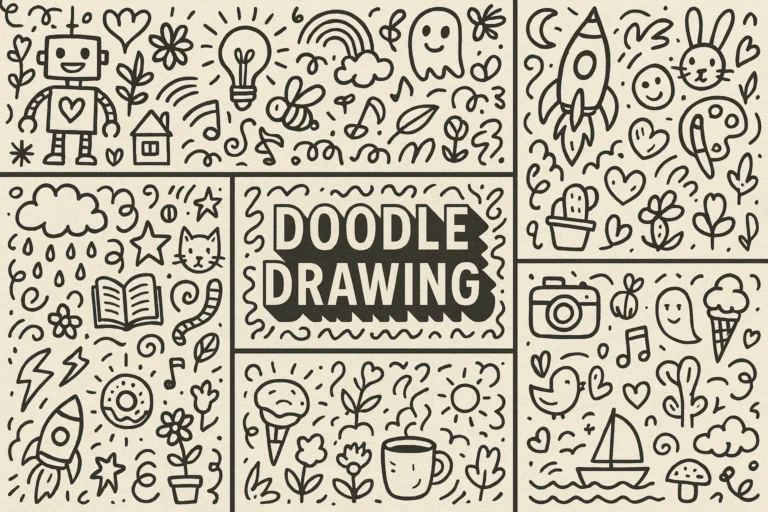
A loop suggests an eye; a small repeat becomes feathers; a gap invites another little creature. Doodle drawing is useful for discovering relationships as you go. Its pleasure lies partly in the way a local decision creates the next possibility.
Keep one open area so the accumulating marks have somewhere to stop. The catalog collage is a composed synthetic illustration, not proof of a person’s spontaneous attention. Treat it as a vocabulary to examine, then allow your own page to develop a different rhythm.
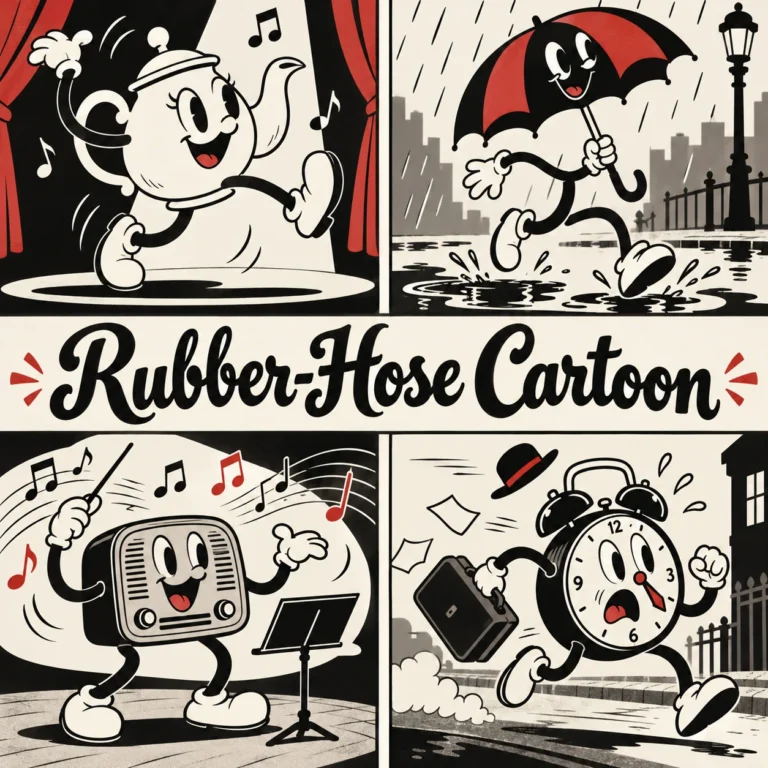
2. Rubber-Hose Cartoon: put the movement in the silhouette
Elastic limbs and simplified shapes can make a pose readable before the face is detailed. Ask where the weight sits and how the body’s curve carries an action. A bird leaning towards a cup should seem to want something, not merely have bendy anatomy.
Try the pose as a solid dark shape. If it is unreadable there, additional gloves, eyes or shine will not fix the central gesture. Use original characters; the historical animation vocabulary does not require copying a familiar mascot.
3. Art Nouveau: let separate parts share a rhythm

Here a line can connect image, border and lettering into a larger arrangement. The stem of a plant might echo a feather, while the cup’s handle completes a curve. That relationship is more interesting than adding a floral frame after the drawing is finished.
The V&A describes the style’s organic motifs and flowing curves across designed objects. In your study, choose one dominant curve and a quieter response. If every line performs a solo, there is no rhythm left to hear.
4. Engraving: build tone from organised marks
For metal-plate engraving, incised lines carry ink; their placement and density help construct the printed image. That is a different physical logic from a pencil sketch, even if a digital illustration imitates the appearance.
Look for lines that wrap around a form rather than simply fill it. On the cup, let the hatching explain the curve and reserve open paper for light. This is a useful antidote to indiscriminate crosshatching: more marks can flatten an object when their direction says nothing about it.
5. Scrimshaw: remember the small surface carrying the story
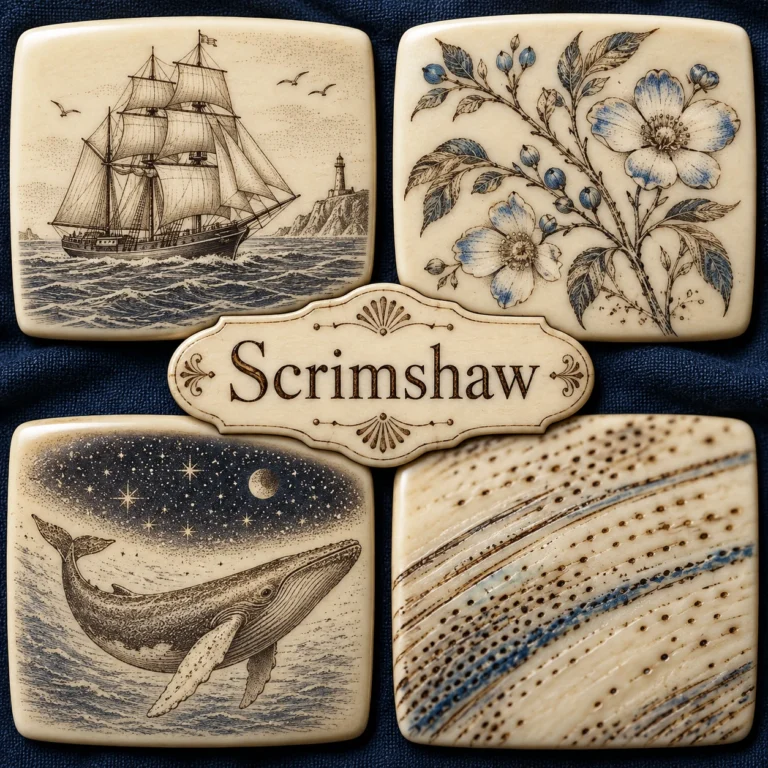
A ship, bird or private message on a polished object has to negotiate the shape of its support. Fine incision and stippled passages can feel intimate because the drawing belongs to a thing held close, not an unlimited canvas.
Study the guide’s material history and its synthetic-support examples. For a contemporary visual exercise, imagine a resin plaque with a clearly bounded edge. Keep the most delicate marks where someone could plausibly see them. This is an interpretation of a craft, not an invitation to acquire protected animal materials.
Look at what the line is doing
Lay the five studies together and cover their style labels. Can you tell what job the line is doing in each? That is the useful outcome. Not five decorative skins over the same indecisive drawing, but five different systems of attention.
My bird now looks offended. This may be the strongest line in the whole exercise.
Two useful next reads
- 6 Art Techniques for Images That Remember Their Materials
- 6 Pixel Art Approaches: Choose the Constraint Before the Nostalgia
Browse all Art Styles articles and explorers, compare entries in the Style Atlas, or open the full art style database.
Sources and visual notes
Prepared 11 October 2026. The selection and compositional advice are Penny’s editorial interpretation. The linked catalog guides provide longer context; older entries may carry source-review notices.
- V&A: Art Nouveau, an international style
- MoMA: Intaglio techniques, including engraving
- New Bedford Whaling Museum: Art and Literature
Existing Art of AI images are reused with their catalog captions and links. They are visual interpretations, not archival documents, authentic cultural objects, verified construction drawings or exact pixel-format demonstrations. No shared image metadata was changed.