Animation language · elastic limbs and graphic rhythm
Discover rubber-hose cartoons: elastic limbs, strong silhouettes, animation history, original character design and practical AI art prompts.
A visual introduction
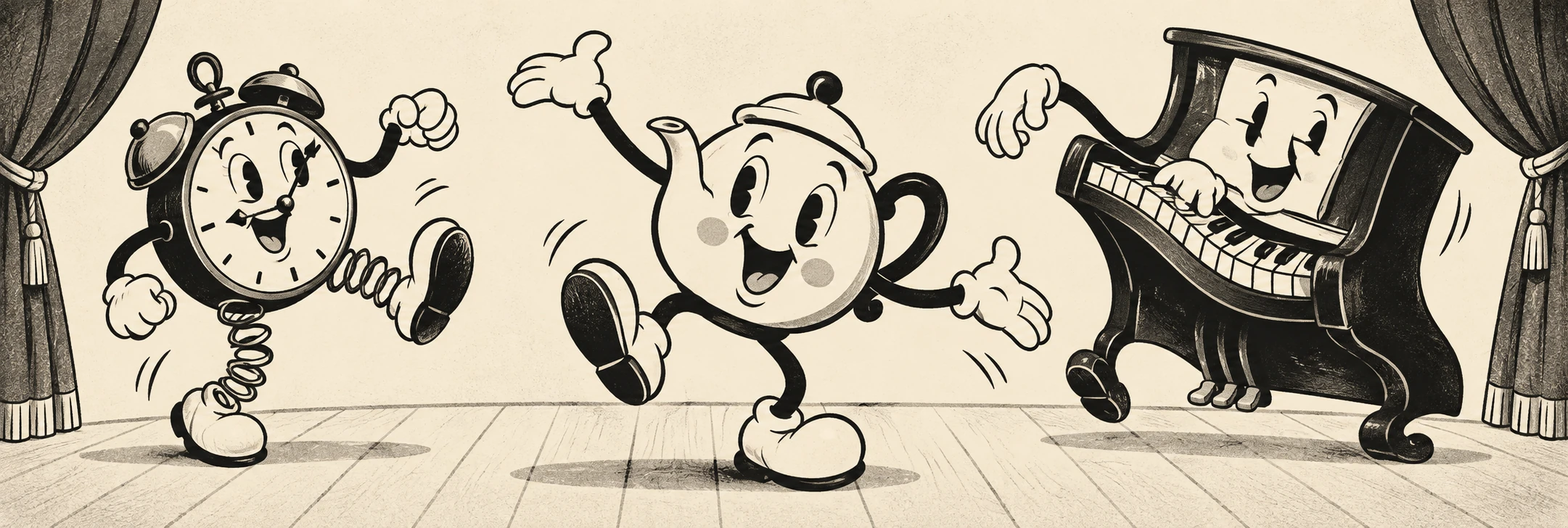
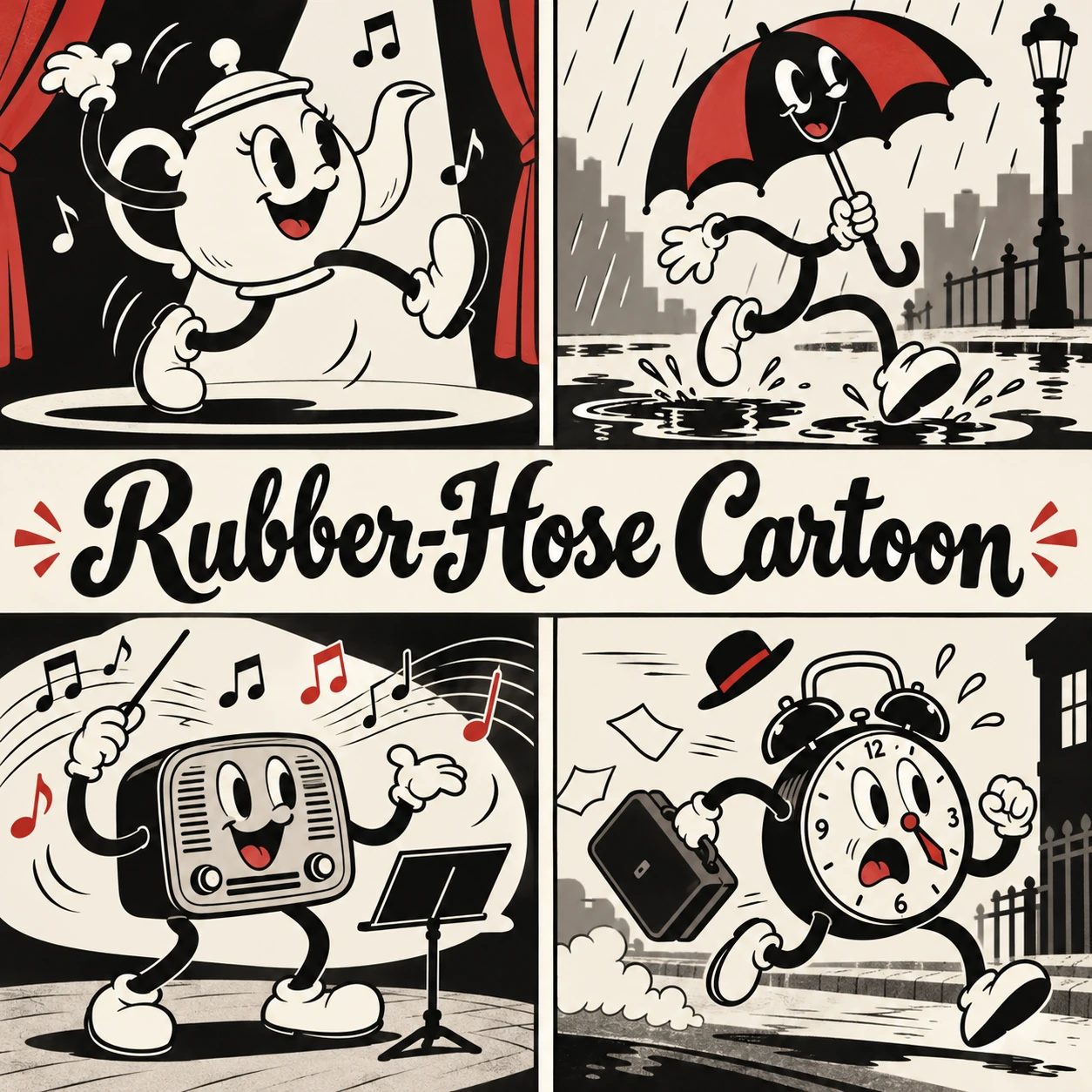
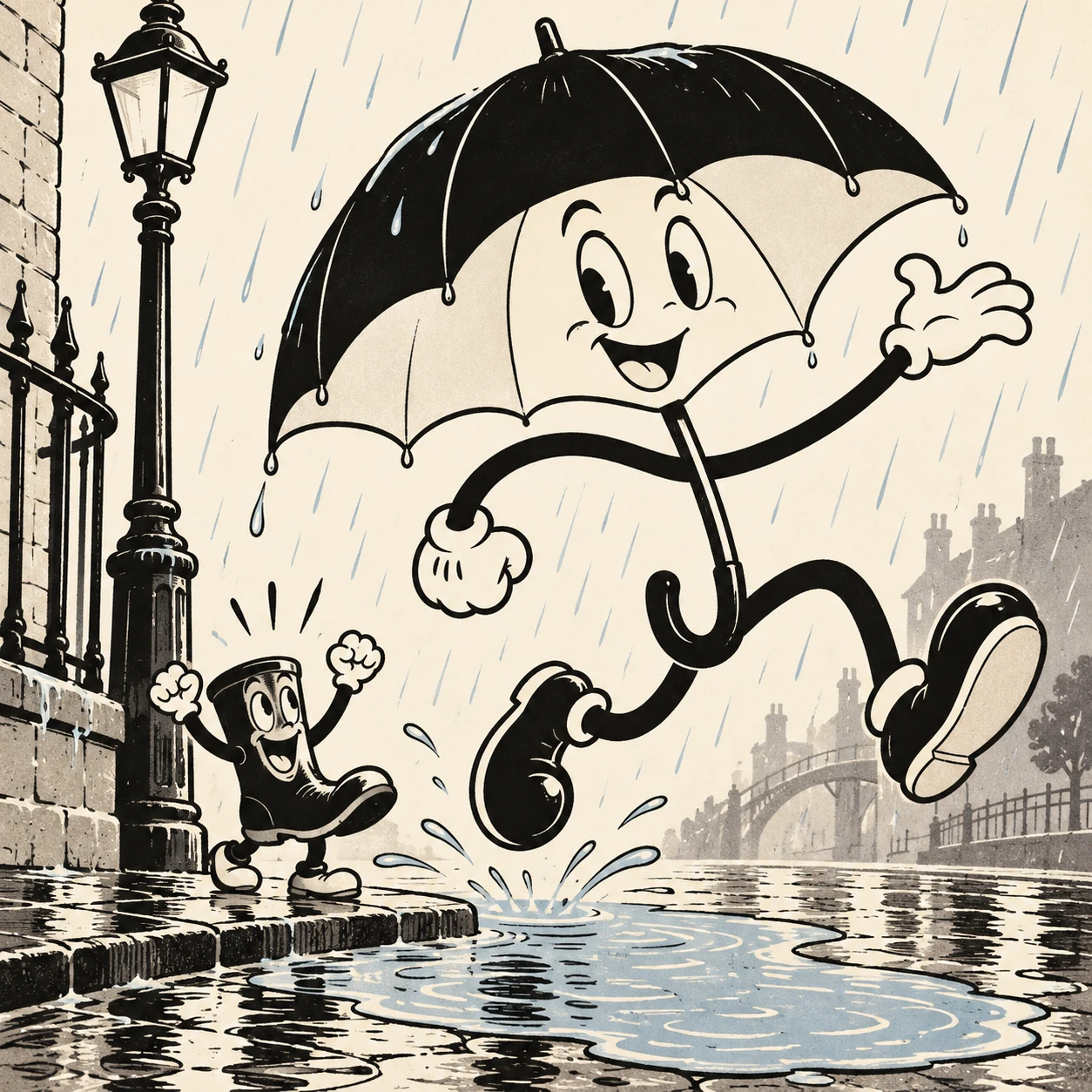
Three original AI-generated illustrations: a panoramic header, a collage with the style name at its center, and a standalone example. Captions distinguish these studies from historical objects and technical documentation.
Select an image for a closer look. Use the thumbnails, arrow keys or a swipe to compare examples. Zoom in to inspect details, or share the image that inspires you.
Creative toolbox · take this style further
Choose an input and a destination. Search sends your words to the chosen site; Copy & open puts them on your clipboard to paste there.
Create with AI
Turn your chosen input into an image prompt or a new creative direction.
ChatGPT
Copy your input and paste it into a ChatGPT conversation or image request.
Copy & open ChatGPT (new tab)Claude · Anthropic
Develop an image prompt or explore the style in a new Claude conversation.
Copy & open Claude · Anthropic (new tab)Midjourney
Paste your input into the Imagine bar on the Create page.
Copy & open Midjourney (new tab)Adobe Firefly
Copy your input, open Firefly, and paste it into the prompt field.
Copy & open Adobe Firefly (new tab)Leonardo.Ai
Copy your input, open Leonardo, and paste it into the generation field.
Copy & open Leonardo.Ai (new tab)Image search
Find visual references. Short, concrete keywords usually work best.
Lexica
Search AI images and prompts using your selected input.
Search with this input Lexica (new tab)Pexels
Search the photo and video library. Short keywords often work best.
Search with this input Pexels (new tab)Pixabay
Search photos, illustrations and other images.
Search with this input Pixabay (new tab)Unsplash
Search photographs using the style name or your own keywords.
Search with this input Unsplash (new tab)Wikimedia Commons
Search photographs, artworks and historical images. Check each file for its source and reuse terms.
Search with this input Wikimedia Commons (new tab)Art & research
Explore artists, collections and the ideas behind a style.
Wikipedia
Search for background reading. A style may not have its own article.
Search with this input Wikipedia (new tab)WikiArt
Copy your input into WikiArt’s search to explore artists and artworks.
Copy & open WikiArt (new tab)Europeana
Paste your keywords into the search to explore European museum, library and archive collections.
Copy & open Europeana (new tab)Inspiration
Discover portfolios and visual ideas from creative communities.
Instagram hashtags
Search a hashtag made from your input: spaces and punctuation are removed. Instagram may require sign-in.
Search with this input Instagram hashtags (new tab)ArtStation
Paste your input into artwork search for concept art, environments, characters and visual development.
Copy & open ArtStation (new tab)Behance
Paste your input into project search for illustration, design and visual storytelling.
Copy & open Behance (new tab)A closer look
Continuous curved limbs, compact bodies and clear silhouettes suggest elastic movement. Rhythm and posing do more work than grain, scratches or a black-and-white filter.
What makes a cartoon rubber-hose?
Rubber-hose cartoon design treats limbs as flexible tubes rather than chains of firmly articulated joints. Arms bend in generous curves; legs can loop into shapes that ordinary knees would reject. The Walt Disney Family Museum identifies exaggerated flexibility and rubbery limbs as hallmarks of a look prominent in the 1920s and early 1930s. [1]
The important word is movement. In a still image, we infer it from a pose, an arc, an imbalance about to resolve. A character standing rigidly upright with vintage gloves may borrow period accessories without communicating the style’s elastic energy. Give the body something to do.
This is a family of animation conventions rather than one mandatory face or palette. Black and ivory make silhouettes especially easy to read, but the essential effect can survive color. Conversely, monochrome cannot rescue a stiff pose. I have met more flexible filing cabinets.
A history with several working methods
Fleischer Studios’ own history traces its independent studio to 1921 and describes earlier Out of the Inkwell films made at Bray. Its account connects the clown’s movement to Max Fleischer’s rotoscope and to Dave Fleischer’s performance. The surprising point is that lively exaggeration and observation of real movement need not be opposites. The account also describes rotoscoping as painstaking, rather than effortless automation. [2]
Do not collapse the history into a claim that all early animation looked this way. The Library of Congress’s Origins of American Animation collection covers films from 1900 to 1921 and includes clay, puppet, cut-out and drawn approaches. Rubber-hose design is one influential strand within a broader field. [3]
Nor were its familiar accessories universal from the beginning. The Library of Congress notes that the early Mickey in Steamboat Willie lacked the white gloves associated with later appearances. The film dates to 1928. Details changed across characters and productions, so a checklist of gloves, shoes and eyes is a starting point for observation, not a complete historical definition. [4]
Design the pose before the decoration
Start with a line of action: the broad curve that carries the gesture through the body. Let an arm extend that curve while another shape counters it. A rounded torso and a large shoe can anchor an otherwise improbable stretch. If every part bends equally in every direction, the character becomes tangled rather than lively.
Use negative space to separate limbs from the body. A black arm against a black torso can disappear; a small ivory gap may solve more than another outline. Test the figure as a solid silhouette. You should still be able to tell whether it is running, conducting, recoiling or celebrating.
A face needs the same economy. Large eyes and a clear mouth can make an object expressive without covering it in features. Keep the object’s identity available: the teapot should retain a readable lid and spout, the umbrella its canopy. Anthropomorphism is funnier when the original thing remains visible.
A still picture is not an animation system
Loops, timing and the spacing between poses belong to animation, not just character styling. A single generated image can propose a pose; it cannot prove that a walk cycle will work. For a moving sequence, compare contact, passing and airborne positions, then examine whether volume and character identity remain coherent.
Stretch should support an action. A hand reaching for a bell may extend; the body can compress before a leap. If distortion has no relationship to intention, the motion reads as instability. The difference matters when using video generators, which may change a character’s anatomy from frame to frame without producing a deliberate performance.
Reading our original characters
Our banner introduces a dancing teapot, a hurried clock and a piano in a compact stage-like world. The titled collage separates four situations so you can compare elastic poses and the way ordinary objects become performers. Red accents guide the eye while the main shapes remain black and ivory.
The standalone umbrella scene makes the joke especially clear: an object designed to keep rain off is enjoying a puddle. The tiny boot provides a second scale and a reaction. Follow the long arm curves and the lifted shoe before inspecting the period-style street. These are new AI-generated illustrations, not recovered animation cels or frames from historical films.
Usability in AI art generation
The language is useful for editorial mascots, playful posters, character explorations and storyboards. Describe an original character, a specific action, elastic tube limbs and a strong silhouette. Ask for a simple background initially. It is easier to diagnose a tangled arm before adding an orchestra, a railway station and an emotionally complicated moon.
Common failures include extra hands, arms fused to props, stiff segmented joints and motion marks that contradict the pose. Some outputs merely apply sepia and scratches to a contemporary character. Review the underlying drawing at a small size, then enlarge it to inspect attachments and facial clarity.
For a recurring character, establish a model sheet and a few approved poses before generating scenes. Compare proportions and distinctive features each time. If you animate it, review transitions as well as attractive keyframes. A consistent still design is an input to that work, not evidence that the finished movement will be consistent.
An exercise: make the same object feel three ways
Take an alarm clock and design three poses: late, delighted and trying very hard to appear innocent. Keep the body shape and palette similar. Change the curve of the limbs, the lean of the torso and the distribution of empty space. Use the hands to clarify the action rather than simply filling corners.
Hide the faces and compare the poses again. If the emotion vanishes completely, the body has delegated too much work to the eyebrows. Give it back a little responsibility. The best elastic character seems ready to escape the drawing—and to do so with excellent comic timing.
A small poetic detour
Original words from the AOI studio.
Poetry
The clock grows legs.
The deadline runs.
For once,
the mechanism is honest.
The prompt workshop
Original creative exercises. These prompts create new illustrations, not documentary evidence.
A clear gesture
Original rubber-hose cartoon alarm clock running late, curved tubular limbs, large readable shoes and expressive face, strong diagonal line of action, bold black ink on ivory, one red accent, simple background, no existing character or words.
Original AOI creative exercise; inspect the result against the guide rather than assuming the model followed every instruction.
An everyday object performs
Original anthropomorphic teapot conducting a small imaginary orchestra, elastic continuous arm curves, compact body and readable spout, clean black-and-cream silhouettes, rhythmic staging, no film scratches, no text.
Original AOI creative exercise; inspect the result against the guide rather than assuming the model followed every instruction.
Test the silhouette
Single original umbrella character leaping over a puddle, two curved arms and two curved legs clearly separated from the body, large shoe leading the motion, simple pale background and blue puddle, original early-animation-inspired ink illustration.
Original AOI creative exercise; inspect the result against the guide rather than assuming the model followed every instruction.
People & works to explore
References discussed in this article. Consult the sources below for context.
Artists and practitioners
Max and Dave Fleischer — Out of the Inkwell and studio history [2]
Walt Disney — producer of Steamboat Willie [4]
Paintings and other works
Out of the Inkwell — series discussed in Fleischer Studios’ history [2]
Steamboat Willie — 1928; a historical reference, not the source of our original characters [4]