
Stationary abstract sculpture · Grounded form and changing viewpoints
A stabile is a stationary abstract sculptural construction, a term closely associated with Alexander Calder’s work. Its parts remain fixed while the viewer moves around it. Openings, intersecting planes and contact with the ground can create an energetic composition without mechanical motion.
A visual introduction
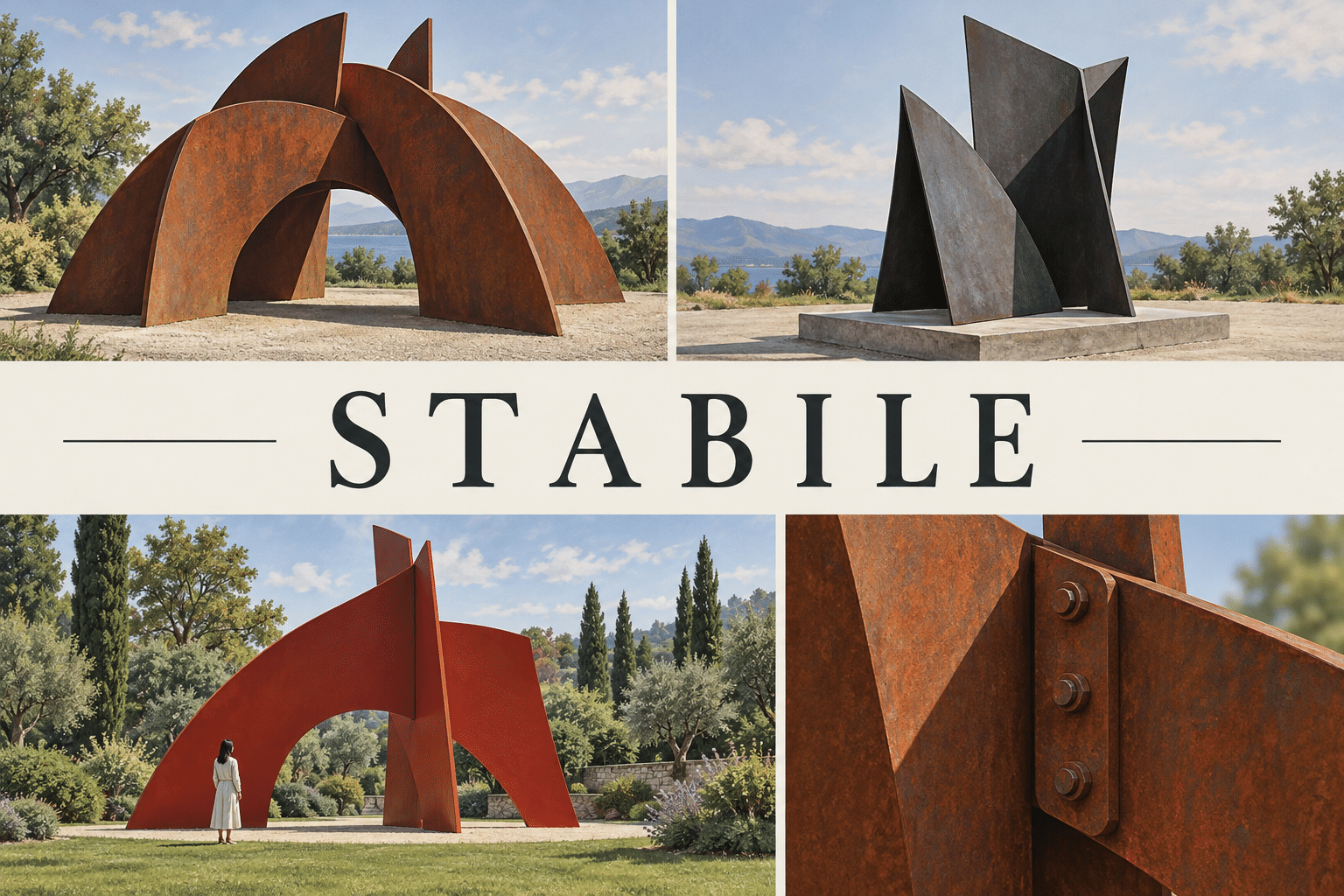
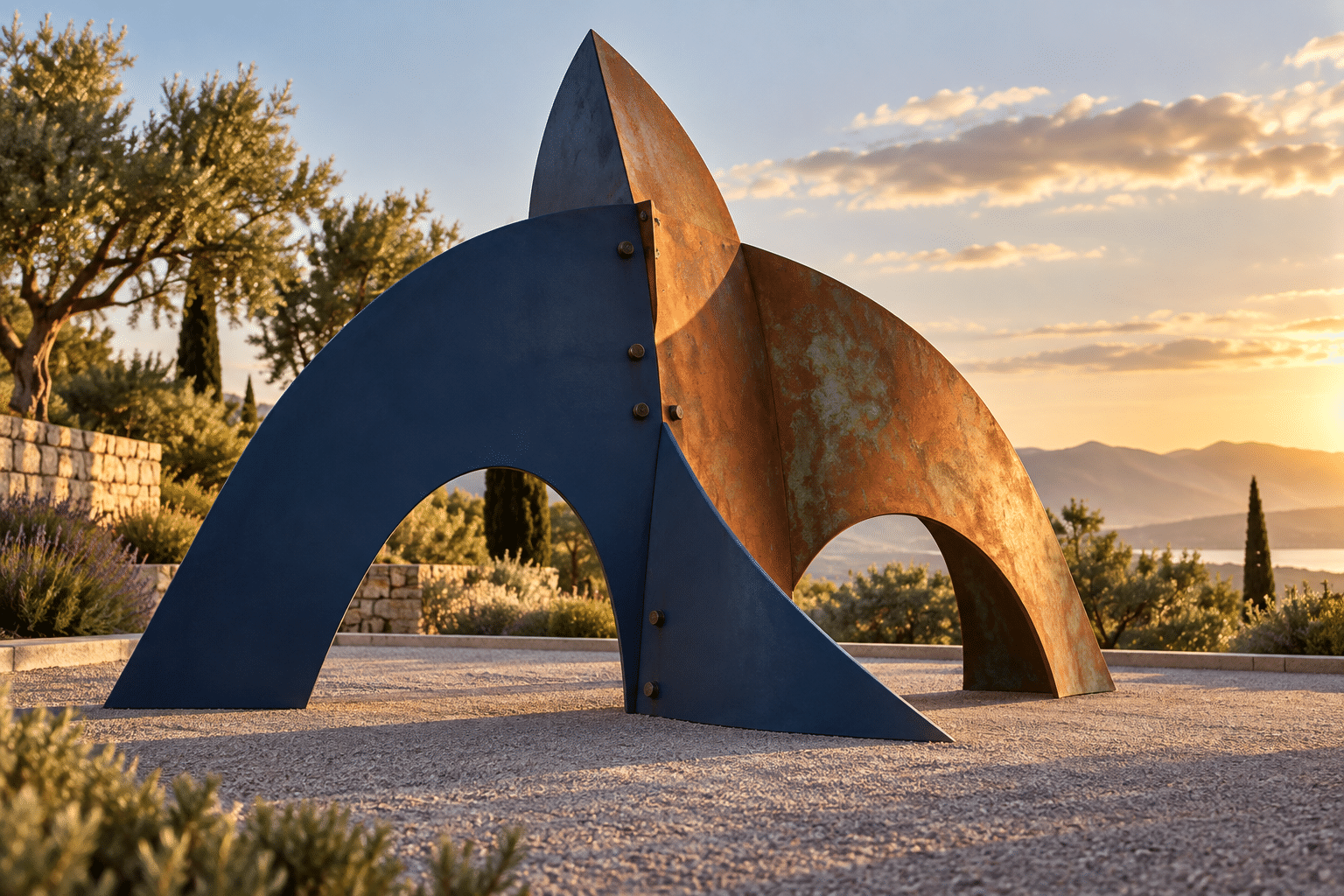
An original illustrative example and a centrally titled four-study collage. These AI-generated images explain visual possibilities; they do not document historical works or certify a physical construction.
Select an image for a closer look. Use the thumbnails, arrow keys or a swipe to compare examples. Zoom in to inspect details, or share the image that inspires you.
Creative toolbox · take this style further
Choose an input and a destination. Search sends your words to the chosen site; Copy & open puts them on your clipboard to paste there.
Create with AI
Turn your chosen input into an image prompt or a new creative direction.
ChatGPT
Copy your input and paste it into a ChatGPT conversation or image request.
Copy & open ChatGPT (new tab)Claude · Anthropic
Develop an image prompt or explore the style in a new Claude conversation.
Copy & open Claude · Anthropic (new tab)Midjourney
Paste your input into the Imagine bar on the Create page.
Copy & open Midjourney (new tab)Adobe Firefly
Copy your input, open Firefly, and paste it into the prompt field.
Copy & open Adobe Firefly (new tab)Leonardo.Ai
Copy your input, open Leonardo, and paste it into the generation field.
Copy & open Leonardo.Ai (new tab)Image search
Find visual references. Short, concrete keywords usually work best.
Lexica
Search AI images and prompts using your selected input.
Search with this input Lexica (new tab)Pexels
Search the photo and video library. Short keywords often work best.
Search with this input Pexels (new tab)Pixabay
Search photos, illustrations and other images.
Search with this input Pixabay (new tab)Unsplash
Search photographs using the style name or your own keywords.
Search with this input Unsplash (new tab)Wikimedia Commons
Search photographs, artworks and historical images. Check each file for its source and reuse terms.
Search with this input Wikimedia Commons (new tab)Art & research
Explore artists, collections and the ideas behind a style.
Wikipedia
Search for background reading. A style may not have its own article.
Search with this input Wikipedia (new tab)WikiArt
Copy your input into WikiArt’s search to explore artists and artworks.
Copy & open WikiArt (new tab)Europeana
Paste your keywords into the search to explore European museum, library and archive collections.
Copy & open Europeana (new tab)Inspiration
Discover portfolios and visual ideas from creative communities.
Instagram hashtags
Search a hashtag made from your input: spaces and punctuation are removed. Instagram may require sign-in.
Search with this input Instagram hashtags (new tab)ArtStation
Paste your input into artwork search for concept art, environments, characters and visual development.
Copy & open ArtStation (new tab)Behance
Paste your input into project search for illustration, design and visual storytelling.
Copy & open Behance (new tab)A closer look
Grounded supports, rigid connections, readable masses and openings, changing silhouettes and deliberate relations to the surrounding site. Apparent movement comes from shape, viewpoint and light rather than freely swinging parts.
The counterpart to the mobile
The Calder Foundation’s 1930–1936 timeline distinguishes Calder’s stationary abstract works, named stabiles by Jean Arp, from his kinetic experiments. That historical usage grounds the term; it should not be applied to every sculpture simply because it does not move.
This entry covers the sculptural form, not a new AOI movement. The illustrations are original proposals and are not attributed to Calder. A mobile may include fixed supports, but its moving components remain central to its identity.
Make the openings as deliberate as the plates
Consider the space beneath an arch and between intersecting planes as part of the sculpture. A strong opening can change character as the viewer walks around it. Broad dark surfaces may read as one mass from the front and separate into thin edges from the side.
Show coherent ground contact and joints. A dramatic silhouette should not depend on unexplained floating parts. An image can suggest a stable construction, but structural adequacy requires material and engineering work beyond the picture.
Compare three viewpoints
Develop a small rigid model concept with two or three intersecting planes. Draw front, side and oblique views, checking that the same connections make sense in each. Give the sculpture a site with enough space for its openings and shadows to be seen.
For generated images, request a stationary construction, clear supports and original geometry. Avoid asking for a copy of a named sculpture. The gallery is a set of illustrative concepts, not fabrication drawings or a claim that the objects have been built.
A small poetic detour
Original words from the AOI studio.
Poetry
The metal rests, the shadows slide;
I walk around its quiet side.
No hinge must turn, no wire sway,
For shape to find another way.
The prompt workshop
Original creative exercises. These prompts create new illustrations, not documentary evidence.
Start here · Two planes and an opening
Original stabile sculpture concept: two rigid intersecting curved sheet-like planes in matte navy and oxidized copper, an asymmetrical arch opening, broad grounded supports and visible bolted joints in a quiet garden. No moving suspended parts or copied sculpture.
Compact · Folded interval
Original small stationary abstract sculpture of three folded pale-metal planes with a clear stable base and an open central interval, side-lit on a plain plinth. Coherent rigid connections, no lettering or historical attribution.
Site · Shadow through an arch
Original outdoor stabile concept with broad fixed curved planes and two unequal openings, a path passing nearby and a person for scale. Warm raking light creates long shadows; clear ground contact and original geometry, no signature.
Your next inspiration
Discover another art style
Follow a visual thread to the next subject.
A smile from the studio
Jokes
The stabile declined dance lessons; its shadows had already enrolled.
The arch said it was open to interpretation.