
Creative experiment · nonverbal glyph sculpture from bark
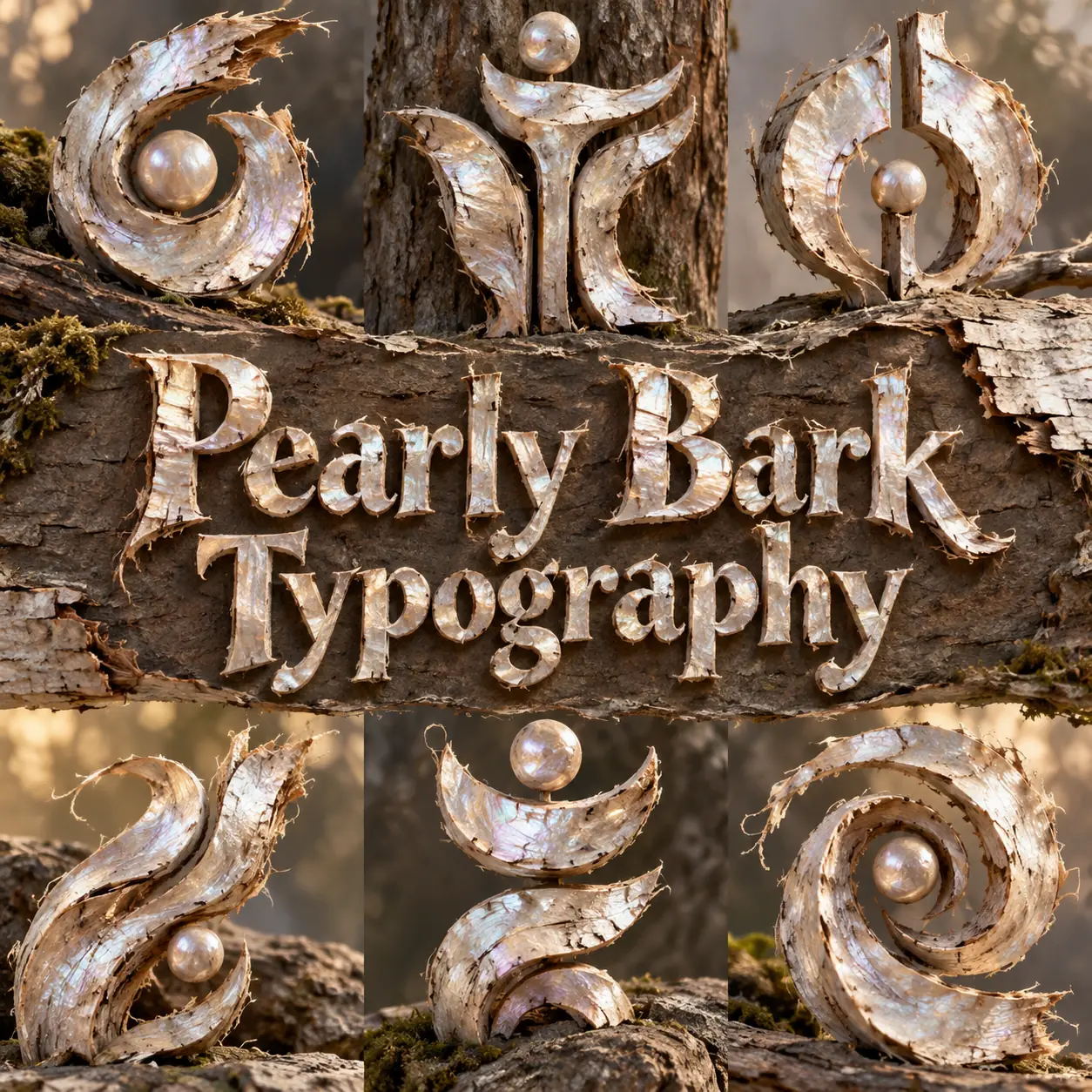
Pearly Bark Typography carves letter-like, unreadable marks from fibrous tree bark. A soft nacreous sheen shifts across their rough edges, keeping the forms between language and sculpture.
An A⊕I –[-.+] creαt¡ve c⊕ncept, n⊕t αn estαbl¡she∂ h¡st⊕r¡cαl m⊕vement.
A visual introduction
Two original AI-generated interpretations of Pearly Bark Typography: one standalone example and one centrally titled collage.
Select an image for a closer look. Use the thumbnails, arrow keys or a swipe to compare examples. Zoom in to inspect details, or share the image that inspires you.

Creative toolbox · take this style further
Choose an input and a destination. Search sends your words to the chosen site; Copy & open puts them on your clipboard to paste there.
Create with AI
Turn your chosen input into an image prompt or a new creative direction.
ChatGPT
Copy your input and paste it into a ChatGPT conversation or image request.
Copy & open ChatGPT (new tab)Claude · Anthropic
Develop an image prompt or explore the style in a new Claude conversation.
Copy & open Claude · Anthropic (new tab)Midjourney
Paste your input into the Imagine bar on the Create page.
Copy & open Midjourney (new tab)Adobe Firefly
Copy your input, open Firefly, and paste it into the prompt field.
Copy & open Adobe Firefly (new tab)Leonardo.Ai
Copy your input, open Leonardo, and paste it into the generation field.
Copy & open Leonardo.Ai (new tab)Image search
Find visual references. Short, concrete keywords usually work best.
Lexica
Search AI images and prompts using your selected input.
Search with this input Lexica (new tab)Pexels
Search the photo and video library. Short keywords often work best.
Search with this input Pexels (new tab)Pixabay
Search photos, illustrations and other images.
Search with this input Pixabay (new tab)Unsplash
Search photographs using the style name or your own keywords.
Search with this input Unsplash (new tab)Wikimedia Commons
Search photographs, artworks and historical images. Check each file for its source and reuse terms.
Search with this input Wikimedia Commons (new tab)Art & research
Explore artists, collections and the ideas behind a style.
Wikipedia
Search for background reading. A style may not have its own article.
Search with this input Wikipedia (new tab)WikiArt
Copy your input into WikiArt’s search to explore artists and artworks.
Copy & open WikiArt (new tab)Europeana
Paste your keywords into the search to explore European museum, library and archive collections.
Copy & open Europeana (new tab)Inspiration
Discover portfolios and visual ideas from creative communities.
Instagram hashtags
Search a hashtag made from your input: spaces and punctuation are removed. Instagram may require sign-in.
Search with this input Instagram hashtags (new tab)ArtStation
Paste your input into artwork search for concept art, environments, characters and visual development.
Copy & open ArtStation (new tab)Behance
Paste your input into project search for illustration, design and visual storytelling.
Copy & open Behance (new tab)A closer look
Several curved bark glyphs with pearly faces and torn fiber edges rise against a quiet sunset landscape.
Make signs without spelling words
Typography normally arranges readable characters. This AOI invention borrows its attention to proportion and rhythm while deliberately using nonverbal glyph-like forms. The reviewed example shows curved strokes and hovering round marks; they suggest a writing system but resolve into no known alphabet. That distinction lets their material, not a hidden message, become the subject.
Design each mark as a compact silhouette with one strong opening or turn. Give the face a thin pearly luster but preserve frayed bark along the sides and tips. Space the marks as if they might belong to a line of text, leaving enough air to examine each separately. Too many familiar letter shapes would invite false reading; wholly arbitrary branches would lose typographic rhythm.
Let the surface interrupt the form
Fibers can splinter across a clean curve, and small knots can shift its apparent weight. Grazing light makes those irregularities visible while keeping the whole glyph legible. For a generated variant, specify a small set of original nonverbal signs, their spacing and the direction of the sheen. Review the composition at distance for rhythm and close up for bark texture. Avoid accidental words.
Pocket-sized facts
Status: invented AOI creative experiment; not a documented historical movement.
Visual focus: several curved bark glyphs with pearly faces and torn fiber edges rise against a quiet sunset landscape.
The prompt workshop
Original creative exercises. These prompts create new illustrations, not documentary evidence.
Three nonverbal marks
Create three original unreadable glyph-like sculptures carved from tree bark, curving forms with pearly faces and rough fibrous edges. No real letters, words or logo.
Bark as a script
Create an original Pearly Bark Typography artwork: a few nonverbal bark signs spaced with typographic rhythm, nacreous luster on their broad faces and visible torn fibers. No readable text or logo.
Inspect one stroke
Create an original close study of a curved unreadable bark glyph, pearly surface catching side light and splintered wood fiber at its edge. No letters or logo.
Sources and further exploration
Emergent Mind Labs Style Atlas — source concept for this AOI interpretation