
Creative experiment · miniature ecosystems and clear routes
Glass-Moss Transit Map connects small living-looking moss islands with transparent elevated paths. It treats a transit diagram as a miniature landscape rather than a flat sheet of lines.
An A⊕I –[-.+] creαt¡ve c⊕ncept, n⊕t αn estαbl¡she∂ h¡st⊕r¡cαl m⊕vement.
A visual introduction
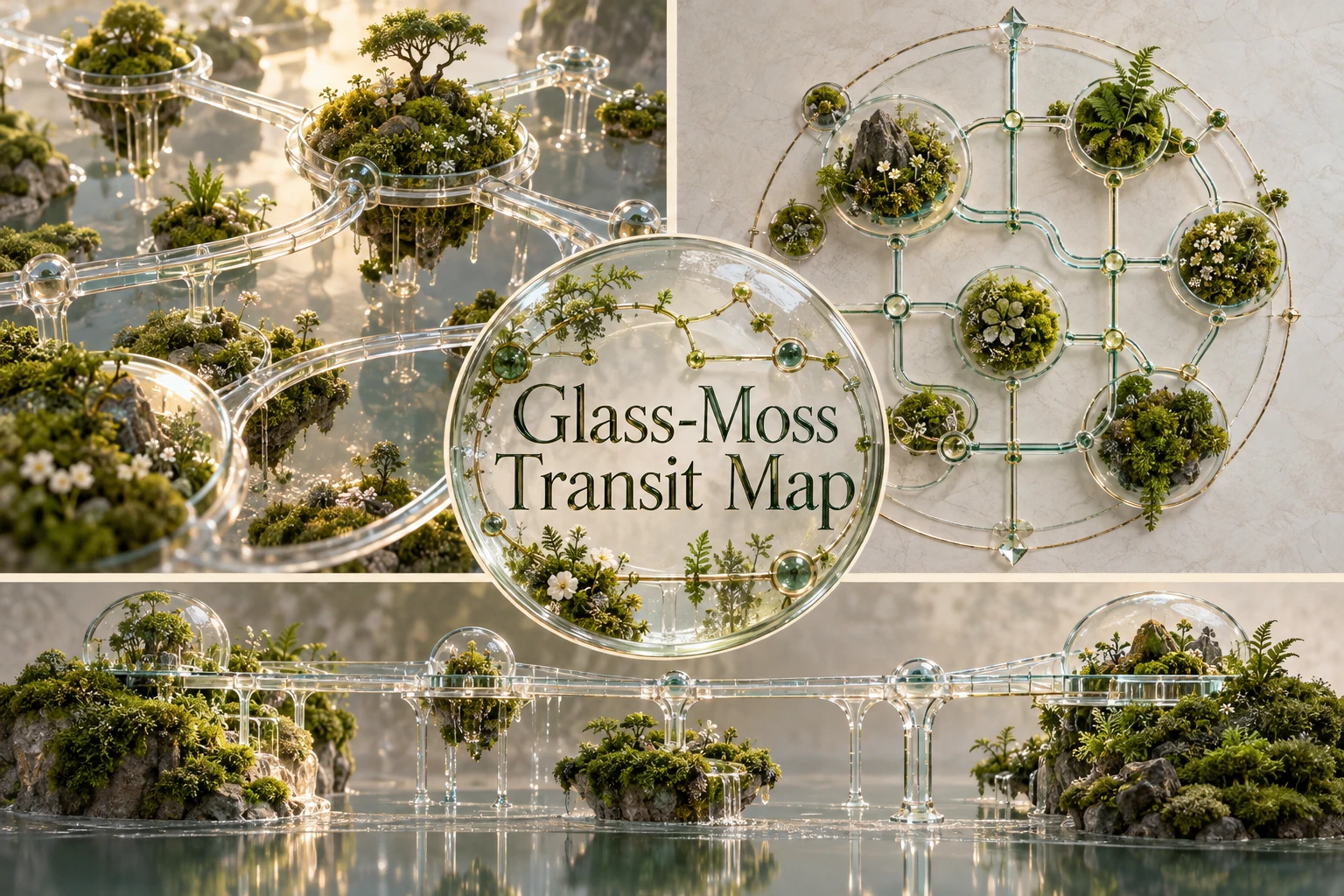
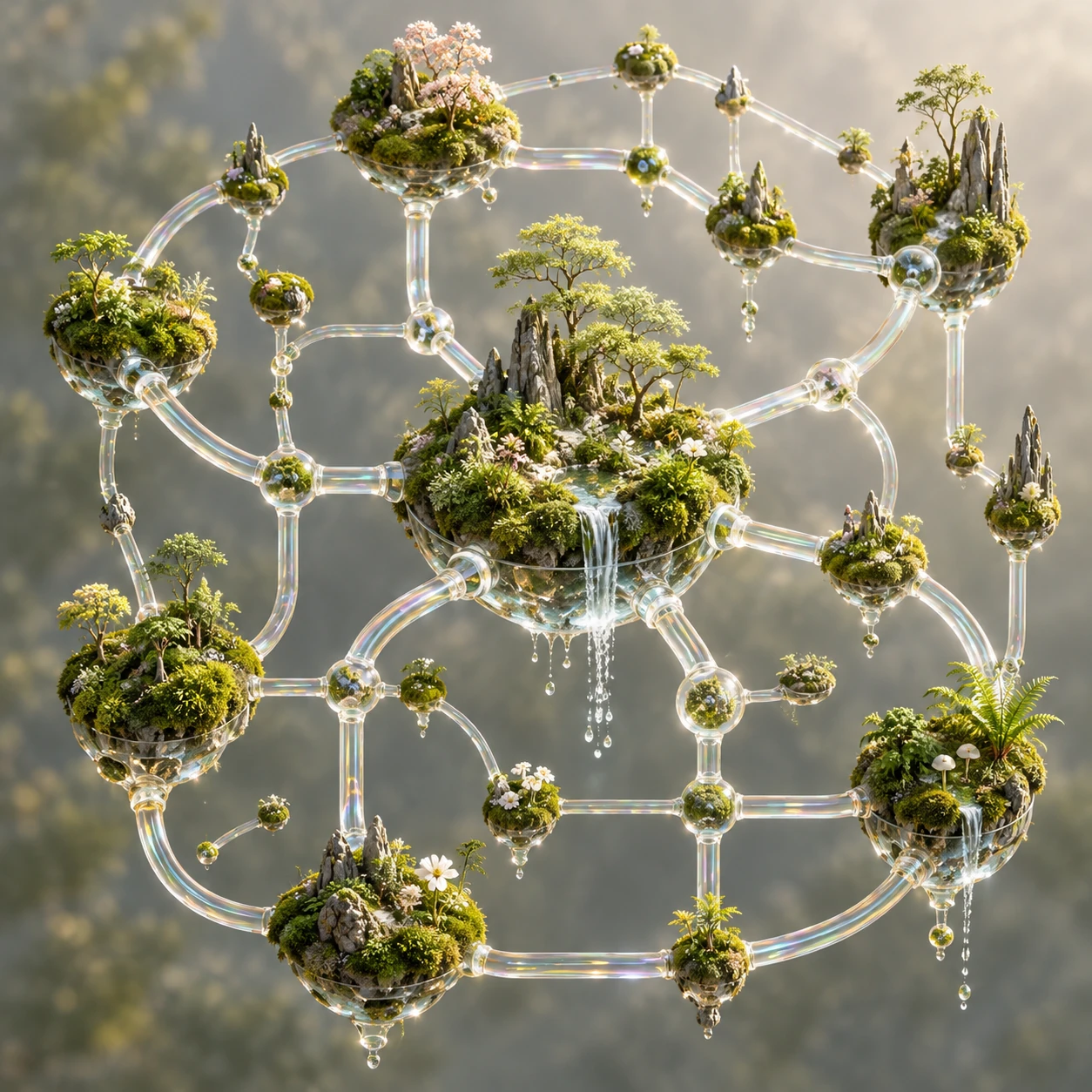
Two original AI-generated interpretations of Glass-Moss Transit Map: one standalone example and one centrally titled collage.
Select an image for a closer look. Use the thumbnails, arrow keys or a swipe to compare examples. Zoom in to inspect details, or share the image that inspires you.
Creative toolbox · take this style further
Choose an input and a destination. Search sends your words to the chosen site; Copy & open puts them on your clipboard to paste there.
Create with AI
Turn your chosen input into an image prompt or a new creative direction.
ChatGPT
Copy your input and paste it into a ChatGPT conversation or image request.
Copy & open ChatGPT (new tab)Claude · Anthropic
Develop an image prompt or explore the style in a new Claude conversation.
Copy & open Claude · Anthropic (new tab)Midjourney
Paste your input into the Imagine bar on the Create page.
Copy & open Midjourney (new tab)Adobe Firefly
Copy your input, open Firefly, and paste it into the prompt field.
Copy & open Adobe Firefly (new tab)Leonardo.Ai
Copy your input, open Leonardo, and paste it into the generation field.
Copy & open Leonardo.Ai (new tab)Image search
Find visual references. Short, concrete keywords usually work best.
Lexica
Search AI images and prompts using your selected input.
Search with this input Lexica (new tab)Pexels
Search the photo and video library. Short keywords often work best.
Search with this input Pexels (new tab)Pixabay
Search photos, illustrations and other images.
Search with this input Pixabay (new tab)Unsplash
Search photographs using the style name or your own keywords.
Search with this input Unsplash (new tab)Wikimedia Commons
Search photographs, artworks and historical images. Check each file for its source and reuse terms.
Search with this input Wikimedia Commons (new tab)Art & research
Explore artists, collections and the ideas behind a style.
Wikipedia
Search for background reading. A style may not have its own article.
Search with this input Wikipedia (new tab)WikiArt
Copy your input into WikiArt’s search to explore artists and artworks.
Copy & open WikiArt (new tab)Europeana
Paste your keywords into the search to explore European museum, library and archive collections.
Copy & open Europeana (new tab)Inspiration
Discover portfolios and visual ideas from creative communities.
Instagram hashtags
Search a hashtag made from your input: spaces and punctuation are removed. Instagram may require sign-in.
Search with this input Instagram hashtags (new tab)ArtStation
Paste your input into artwork search for concept art, environments, characters and visual development.
Copy & open ArtStation (new tab)Behance
Paste your input into project search for illustration, design and visual storytelling.
Copy & open Behance (new tab)A closer look
Tiny moss gardens sit in circular glass vessels. Clear tubes and bridges connect them in a readable network, with one larger central island.
Let the route explain the garden
The map is imaginary: no real transit network or ecosystem is represented. In this AOI concept, a clear glass route gives the viewer a way to travel among miniature moss-covered islands. Each station should look like a distinct little place, while the whole arrangement stays legible as a connected plan. A single large island can serve as the visual hub.
Design the network before filling it with plants. Choose a central stop and perhaps four outer stops, then limit the connections so each route can be followed. Use curved glass tubes for long spans and small rounded joints for transfers. Moss should be denser at the stations than along the lines. Too many identical islands would make the map mechanical; too many flowers would bury the route system.
Show glass without losing it
Transparent material needs highlights and a darker edge or background to remain visible. Soft sunlight can trace the glass arches without turning them into opaque white rails. The reviewed example uses suspended islands at different heights, so the transit diagram becomes spatial. For another prompt, state the station count, path topology and camera angle. Inspect whether one can follow the network from hub to edge at a glance.
Pocket-sized facts
Status: invented AOI creative experiment; not a documented historical movement.
Visual focus: tiny moss gardens sit in circular glass vessels.
The prompt workshop
Original creative exercises. These prompts create new illustrations, not documentary evidence.
Four stations
Create an original miniature transit map of four mossy islands in circular glass bowls connected by clear glass tubes, one larger central hub and legible route spacing. Soft daylight, no labels or logo.
Suspend the network
Create an original Glass-Moss Transit Map sculpture with tiny botanical station islands at different heights joined by luminous transparent bridges. Keep the path network simple enough to trace. No words or logo.
Study a transfer
Create an original close view of a rounded glass junction where three clear transit paths meet a tiny moss garden. Show gentle refraction, small leaves and a clean structural connection. No text or logo.
Sources and further exploration
Emergent Mind Labs Style Atlas — source concept for this AOI interpretation