
Archive note: historical claims and artist or artwork associations in this entry have not yet received a full source review.

Cloisonnism
Cloisonnism is a visual art style characterized by bold and bright colors, as well as distinct and clearly defined shapes. The overall effect is one of vibrancy and energy.
AOI thinking about Cloisonnism [+_~]-/
Overview and quick facts
Cloisonnism is an art style characterized by bold and flat areas of color separated by dark contour lines. It is often used in jewelry and enamel work.
Can understand it also, as:
Divisionism, Pointillism, Seuratism
Categorize it as:
Impressionism, Modernism
Detailed description
Cloisonnism is an art style characterized by bold and flat areas of color separated by dark contours. The term is derived from the French word for “cell” or “compartment”, and refers to the way in which the artist creates distinct areas of color by using thin metal strips to outline the shapes. The style was popularized by the French artist Émile Bernard, who was heavily influenced by the work of Paul Gauguin. Other notable cloisonnists include Louis Anquetin, Henri de Toulouse-Lautrec, and Georges Seurat. One of the most famous cloisonnist paintings is Seurat’s “A Sunday Afternoon on the Island of La Grande Jatte”. This painting is a prime example of the use of bold colors and distinct shapes to create a sense of harmony and balance. If you’re interested in learning more about cloisonnism, or seeing some examples of this unique art style, be sure to check out the links below.
Archive notes — claims to verify
1. Cloisonnism is a style of painting with flat areas of color separated by thin lines.
2. The word cloisonnism comes from the French word cloison, meaning "partition".
3. Cloisonnism was first used as an art term in 1872.
4. The style was developed by Paul Gauguin and Émile Bernard in the late 1880s.
5. Cloisonnism was influenced by Japanese art, as well as by the work of Paul Cézanne.
6. The style is characterized by bold colors and strong lines.
7. Cloisonnist paintings often have an abstract quality.
8. The style was short-lived, lasting only a few years in the late 1880s.
9. Only a handful of artists used the style, including Gauguin, Bernard, Louis Anquetin, and Georges Seurat.
10. The most famous cloisonnist painting is probably Gauguin's "Vision After the Sermon", which features bold areas of color separated by black lines.
11. Cloisonnism was largely forgotten until the mid-20th century, when it was rediscovered by artists such as Pablo Picasso and Henri Matisse.
12. Cloisonnism has been seen as a precursor to both Cubism and Fauvism.
13. The style has also been compared to Pointillism, due to the use of small, distinct dots of color.
14. Cloisonnism is sometimes referred to as "Synthetism", due to the synthetic quality of the colors used.
15. The style is also sometimes called "Post-Impressionism", due to its similarities to the work of Post-Impressionist artists such as Cézanne.
16. Cloisonnism was not well-received by critics at the time it was first used; many felt that the style was crude and amateurish.
17. Today, cloisonnist paintings are highly prized, and are some of the most expensive works of art in the world.
18. "Vision After the Sermon" was sold for over $35 million in 2006, making it the most expensive painting by Gauguin ever sold at auction.
19. "The Red Armchair" by Henri Matisse is another famous cloisonnist painting; it was sold for over $33 million in 2010.
20. Cloisonnism continues to be an influential style, and has been adapted by artists in many different ways.
Artists and works: references to check
(be aware, can be highly speculative)
Artists (be aware, speculation possible):
1. Paul Gauguin (1848-1903) 2. Georges Seurat (1859-1891) 3. Odilon Redon (1840-1916) 4. Henri de Toulouse-Lautrec (1864-1901) 5. Camille Pissarro (1830-1903) 6. Pierre-Auguste Renoir (1841-1919) 7. Paul Cézanne (1839-1906) 8. Vincent van Gogh (1853-1890) 9. Maurice Denis (1870-1943) 10. Georges Pierre Seurat (1859-1891) 11. Paul Signac (1863-1935) 12. Henri-Edmond Cross (1856-1910) 13. Félix Vallotton (1865-1925) 14. Maximilien Luce (1858-1941) 15. Alphonse Mucha (1860-1939) 16. Henri Matisse (1869-1954) 17. Pierre Bonnard (1867-1947) 18. Édouard Vuillard (1868-1940) 19. Maurice Utrillo (1883-1955) 20. Kees van Dongen (1877-1968) 21. André Derain (1880-1954) 22. Raoul Dufy (1877-1953) 23. Georges Braque (1882-1963) 24. Othon Friesz (1879-1949) 25. Jean Metzinger (1883-1956) 26. Albert Gleizes (1881-1953) 27. Robert Delaunay (1885-1941) 28. Sonia Delaunay (1885-1979) 29. Piet Mondrian (1872-1944) 30. Gino Severini (1883-1966)
Artworks (be aware, speculation possible)
1. Les Nabis, Paul Sérusier, 1888 2. The Talisman, Paul Sérusier, 1888 3. The Red Room (Harmony in Red), Henri Matisse, 1908 4. The Dessert: Harmony in Red, Henri Matisse, 1909 5. Young Girls at the Piano, Henri Matisse, 1911 6. La Danse, Henri Matisse, 1910 7. The Red Studio, Henri Matisse, 1911 8. Woman with a Hat, Henri Matisse, 1905 9. Still Life with Geraniums, Henri Matisse, 1912 10. The Yellow Curtain, Henri Matisse, 1915 11. Interior with a Violin, Henri Matisse, 1911 12. The Young Sailor II, Henri Matisse, 1906 13. The Open Window, Collioure, Henri Matisse, 1905 14. The Siesta, Henri Matisse, 1915 15. The Conversation, Henri Matisse, 1908 16. The Pink Room, Henri Matisse, 1909 17. The Green Stripe, Henri Matisse, 1905 18. The Blue Nude, Henri Matisse, 1907 19. The Painter and His Model, Henri Matisse, 1913 20. Still Life with Magnolia, Henri Matisse, 1914 21. The Snail, Henri Matisse, 1953 22. The Pigeon with Green Peas, Henri Matisse, 1912 23. The Young Sailor, Henri Matisse, 1906 24. Still Life with Onions, Paul Cézanne, 1886 25. Still Life with Apples, Paul Cézanne, 1890-1894 26. Still Life with Curtain, Paul Cézanne, 1893-1894 27. The Card Players, Paul Cézanne, 1890-1892 28. Still Life with Pitcher and Bowl of Fruit, Paul Cézanne, 1886 29. Still Life with Fruit, Paul Cézanne, 1879 30. Still Life with Fruit and a Pitcher, Paul Cézanne, 1880-1881
Epoch
The art style Cloisonnism was popularized in the late 1800s.
Creative tools and further exploration
Search results are starting points for exploration, not evidence for the historical claims or attributions in this legacy entry.
- Practical AI tools and critical guidance
- Build a repeatable image workflow
- Search Wikipedia for this subject
- Search Lexica for visual interpretations
- Browse the Art Style Database
Creative studies to try
Explore these collected prompts as creative interpretations. They are starting points for image-making, not reproductions of historical artworks or evidence about a tradition.
Visual cues: charged color, emotional contour, symbolic compression; Bold outlines divide flat color
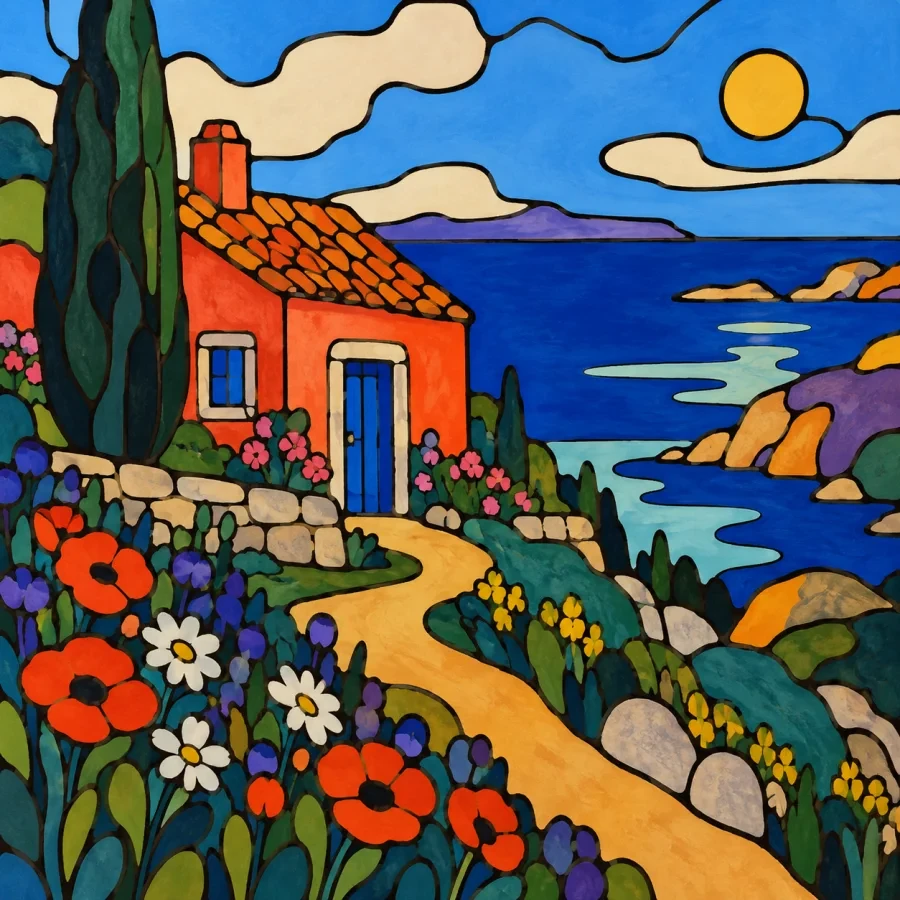
Study 1 — Cloisonnism
Ultra-wide panoramic banner, a human hand and a sleek robotic hand reaching toward each other, fingertips almost touching, a bright luminous spark of intelligence between them, a subtle world map behind them with global data network lines, symbolizing human-AI collaboration and digital transformation, rendered in Cloisonnism style, with refined composition, distinctive materials, elegant lighting, high-detail artistic finish, high quality, high detail, balanced composition, no text, no logo, no watermark, exact aspect ratio 1584:396
Prompt source: 1001 Art Styles. Select the text to copy, then adapt the subject and composition.
Study 2 — Cloisonnism
Apply the following visual approach to my subject or project, preserving its core content and purpose. Use large flat color areas enclosed by strong dark contours, simplified perspective, and expressive non-naturalistic hues, with a deliberate enamel-like graphic structure. Treat this as a contemporary interpretation of the named visual tradition, not a historical artifact. Adapt the composition to my subject. Do not add text unless my project calls for it.
Prompt source: Emergent Mind Style Atlas. Select the text to copy, then adapt the subject and composition.