
Creative experiment · lunar shadow and ceramic time
Ceramic Moon Dial imagines time measured by changing crescent-shaped shadows on matte clay. It is an abstract sculptural idea, not a working clock or a claim about historical lunar instruments.
An A⊕I –[-.+] creαt¡ve c⊕ncept, n⊕t αn estαbl¡she∂ h¡st⊕r¡cαl m⊕vement.
A visual introduction
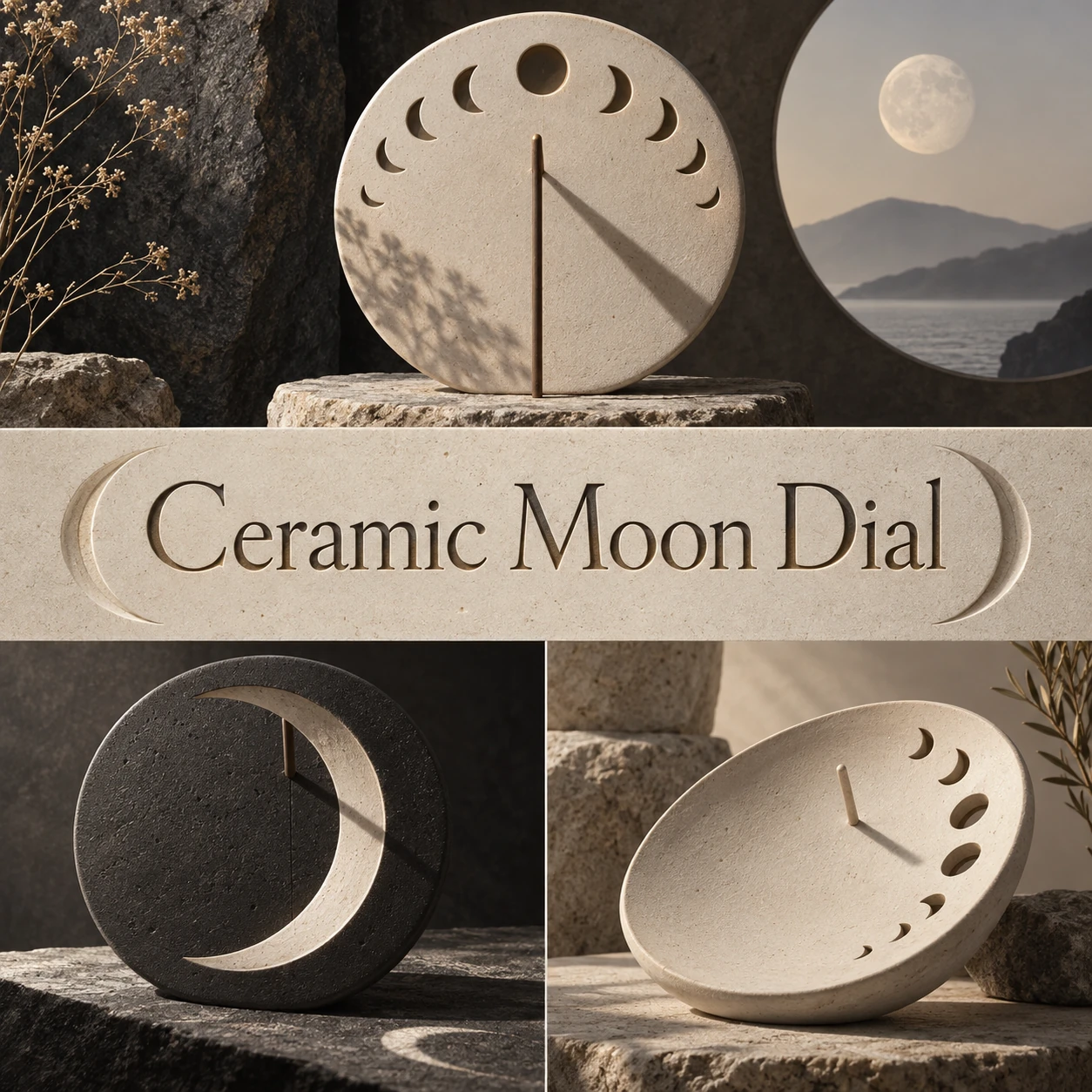
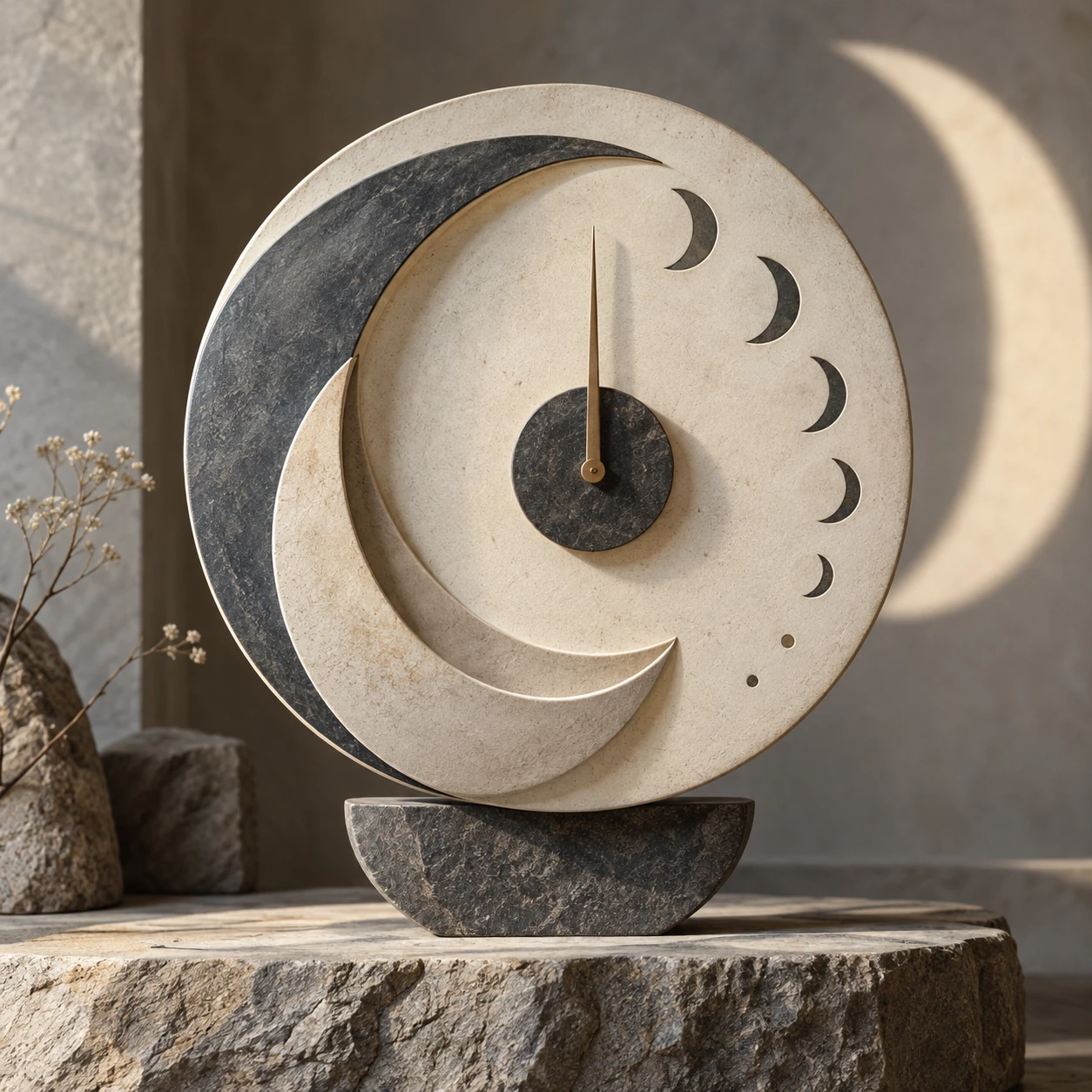
Two original AI-generated interpretations of Ceramic Moon Dial: one standalone example and one centrally titled collage.
Select an image for a closer look. Use the thumbnails, arrow keys or a swipe to compare examples. Zoom in to inspect details, or share the image that inspires you.
Creative toolbox · take this style further
Choose an input and a destination. Search sends your words to the chosen site; Copy & open puts them on your clipboard to paste there.
Create with AI
Turn your chosen input into an image prompt or a new creative direction.
ChatGPT
Copy your input and paste it into a ChatGPT conversation or image request.
Copy & open ChatGPT (new tab)Claude · Anthropic
Develop an image prompt or explore the style in a new Claude conversation.
Copy & open Claude · Anthropic (new tab)Midjourney
Paste your input into the Imagine bar on the Create page.
Copy & open Midjourney (new tab)Adobe Firefly
Copy your input, open Firefly, and paste it into the prompt field.
Copy & open Adobe Firefly (new tab)Leonardo.Ai
Copy your input, open Leonardo, and paste it into the generation field.
Copy & open Leonardo.Ai (new tab)Image search
Find visual references. Short, concrete keywords usually work best.
Lexica
Search AI images and prompts using your selected input.
Search with this input Lexica (new tab)Pexels
Search the photo and video library. Short keywords often work best.
Search with this input Pexels (new tab)Pixabay
Search photos, illustrations and other images.
Search with this input Pixabay (new tab)Unsplash
Search photographs using the style name or your own keywords.
Search with this input Unsplash (new tab)Wikimedia Commons
Search photographs, artworks and historical images. Check each file for its source and reuse terms.
Search with this input Wikimedia Commons (new tab)Art & research
Explore artists, collections and the ideas behind a style.
Wikipedia
Search for background reading. A style may not have its own article.
Search with this input Wikipedia (new tab)WikiArt
Copy your input into WikiArt’s search to explore artists and artworks.
Copy & open WikiArt (new tab)Europeana
Paste your keywords into the search to explore European museum, library and archive collections.
Copy & open Europeana (new tab)Inspiration
Discover portfolios and visual ideas from creative communities.
Instagram hashtags
Search a hashtag made from your input: spaces and punctuation are removed. Instagram may require sign-in.
Search with this input Instagram hashtags (new tab)ArtStation
Paste your input into artwork search for concept art, environments, characters and visual development.
Copy & open ArtStation (new tab)Behance
Paste your input into project search for illustration, design and visual storytelling.
Copy & open Behance (new tab)A closer look
An ivory disc carries a dark central pointer and a measured sequence of crescent cuts. Side light casts another curved shadow onto the wall. Quiet mineral colors and a simple base let the relationship between solid disc and changing light stay clear.
Let a shadow become the hand
A dial normally gives time through numbers or an advancing hand. Ceramic Moon Dial replaces much of that notation with shaped absence: carved crescents and the shadow cast by a slender pointer suggest a sequence without claiming precise measurement. The idea is an AOI creative experiment. Its strength lies in making a familiar circle feel contemplative through material, light and gaps rather than ornament.
Build the composition around one large disc. Place only a few crescent marks at unequal intervals, leaving enough blank clay for the eye to read their sequence. A dark center anchors the pointer; a wider crescent cut gives the piece its emotional weight. Let the clay stay visibly matte, with small irregularities along the edge. If the surface becomes polished like metal, the contrast between object and soft shadow loses its character.
Choose the light deliberately
Low side light can project a second moon shape onto a wall; overhead light makes the dial more graphic and quiet. In a generated image, state where the light enters, how many crescents appear, and whether the object sits on a plinth or hangs vertically. Review the result for a readable central pointer and a single dominant shadow. The sculptural study should invite attention to passing light, even though it is not presented as a functional timepiece.
Pocket-sized facts
Status: invented AOI creative experiment; not a documented historical movement.
Visual focus: an ivory disc carries a dark central pointer and a measured sequence of crescent cuts.
The prompt workshop
Original creative exercises. These prompts create new illustrations, not documentary evidence.
A quiet first dial
Create an original matte ivory ceramic disc on a simple stone base, with one dark center, a slender pointer and five small crescent cutouts. Warm side light casts a clear crescent shadow on a plain wall. Mineral palette, no numbers, text or logo.
Let the wall participate
Create an original Ceramic Moon Dial sculpture in a small gallery. Carve one broad crescent and several narrow lunar marks into a clay disc; position low light so its shadow draws another large crescent behind it. Keep the surface tactile and the composition quiet. No words or logo.
Study a different phase
Create an original close-up ceramic moon dial with a near-full circular opening and a single fine pointer. Use charcoal and chalk-colored clay, soft evening light and generous negative space. Treat it as an abstract sculpture, not a functional clock. No text or logo.
Sources and further exploration
Emergent Mind Labs Style Atlas — source concept for this AOI interpretation