
Creative experiment · living growth and visible linkage
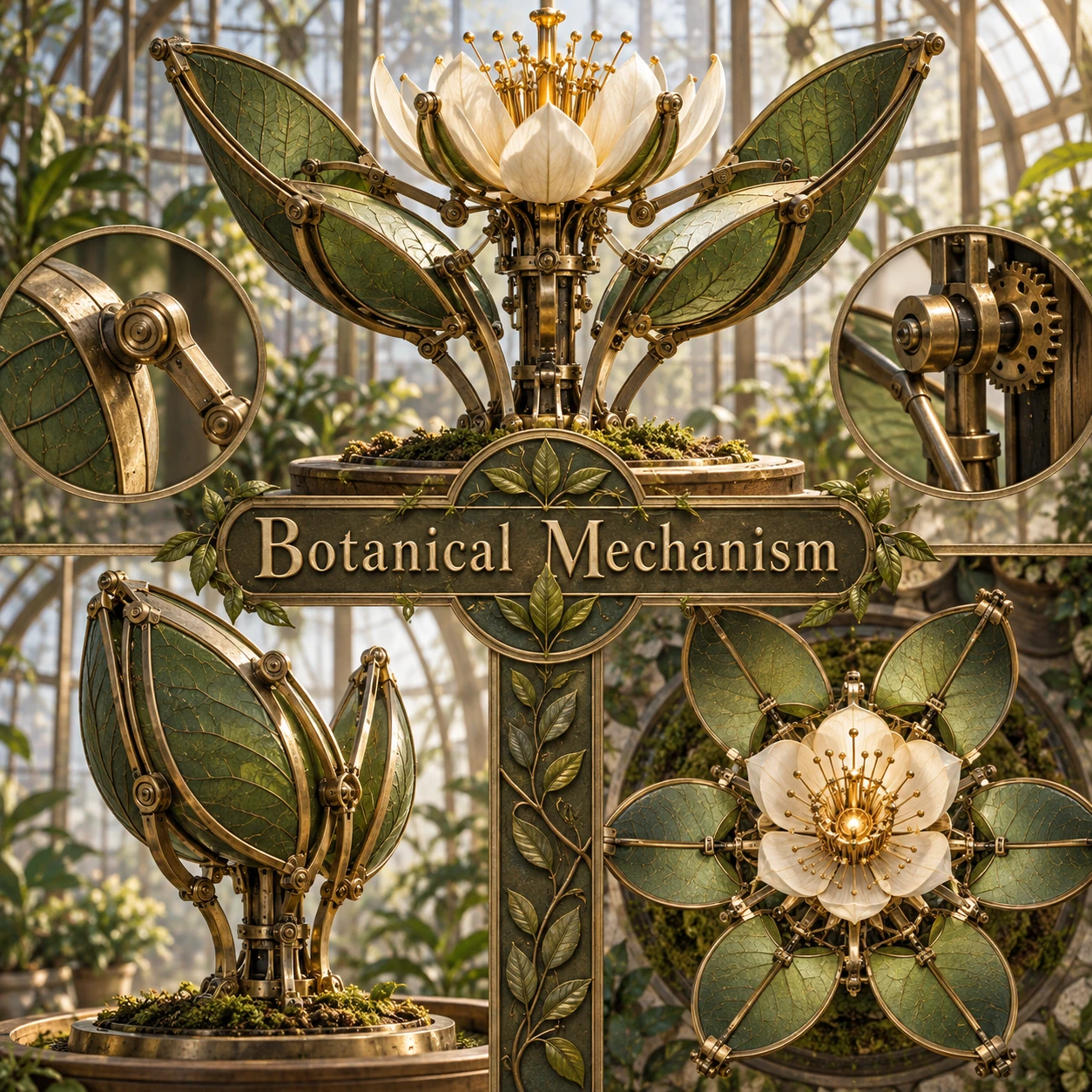
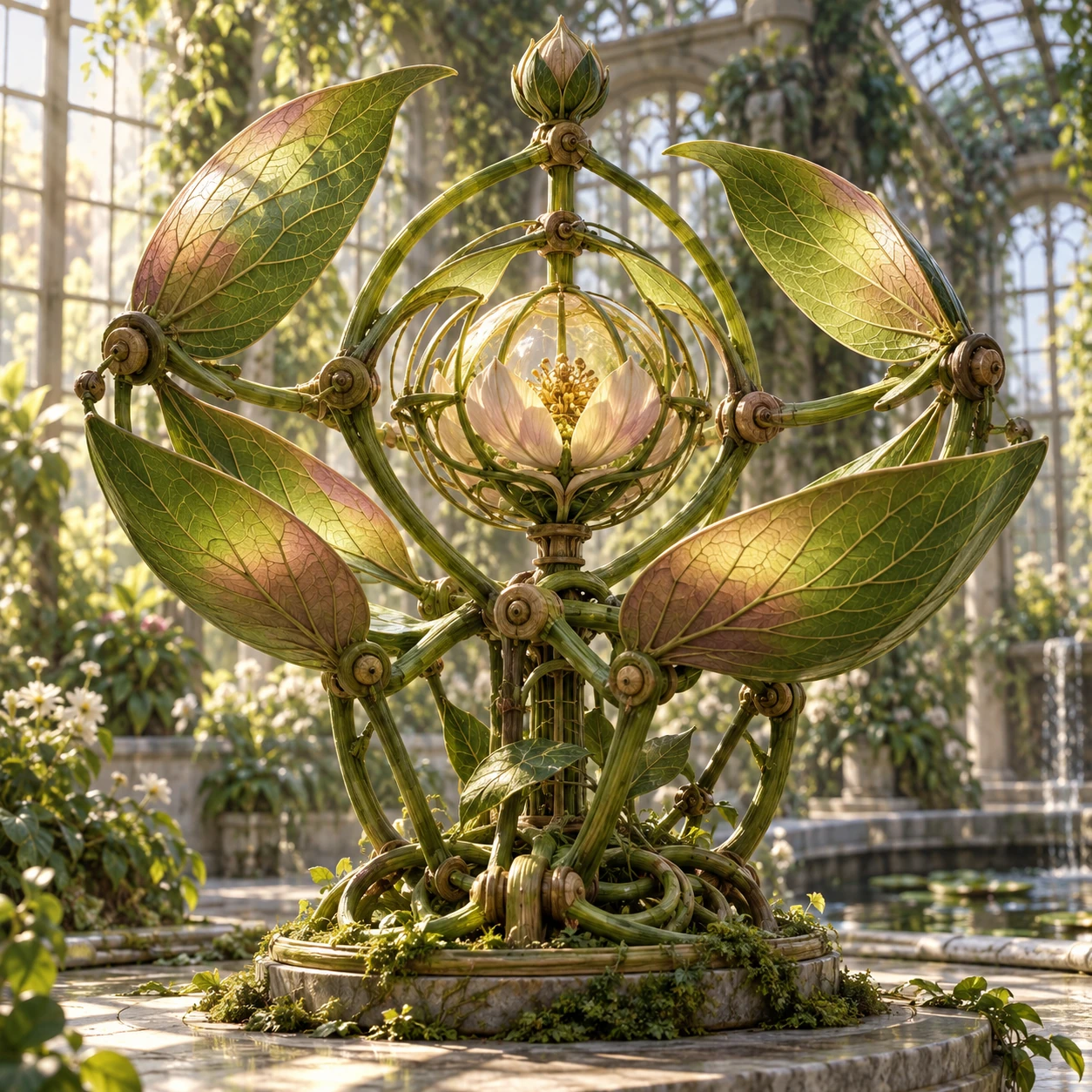
Botanical Mechanism imagines a machine whose leaves, stems and flower-like parts participate in its motion. The image is a speculative design, with visible joints that make the living and mechanical ideas meet.
An A⊕I –[-.+] creαt¡ve c⊕ncept, n⊕t αn estαbl¡she∂ h¡st⊕r¡cαl m⊕vement.
A visual introduction
Two original AI-generated interpretations of Botanical Mechanism: one standalone example and one centrally titled collage.
Select an image for a closer look. Use the thumbnails, arrow keys or a swipe to compare examples. Zoom in to inspect details, or share the image that inspires you.
Creative toolbox · take this style further
Choose an input and a destination. Search sends your words to the chosen site; Copy & open puts them on your clipboard to paste there.
Create with AI
Turn your chosen input into an image prompt or a new creative direction.
ChatGPT
Copy your input and paste it into a ChatGPT conversation or image request.
Copy & open ChatGPT (new tab)Claude · Anthropic
Develop an image prompt or explore the style in a new Claude conversation.
Copy & open Claude · Anthropic (new tab)Midjourney
Paste your input into the Imagine bar on the Create page.
Copy & open Midjourney (new tab)Adobe Firefly
Copy your input, open Firefly, and paste it into the prompt field.
Copy & open Adobe Firefly (new tab)Leonardo.Ai
Copy your input, open Leonardo, and paste it into the generation field.
Copy & open Leonardo.Ai (new tab)Image search
Find visual references. Short, concrete keywords usually work best.
Lexica
Search AI images and prompts using your selected input.
Search with this input Lexica (new tab)Pexels
Search the photo and video library. Short keywords often work best.
Search with this input Pexels (new tab)Pixabay
Search photos, illustrations and other images.
Search with this input Pixabay (new tab)Unsplash
Search photographs using the style name or your own keywords.
Search with this input Unsplash (new tab)Wikimedia Commons
Search photographs, artworks and historical images. Check each file for its source and reuse terms.
Search with this input Wikimedia Commons (new tab)Art & research
Explore artists, collections and the ideas behind a style.
Wikipedia
Search for background reading. A style may not have its own article.
Search with this input Wikipedia (new tab)WikiArt
Copy your input into WikiArt’s search to explore artists and artworks.
Copy & open WikiArt (new tab)Europeana
Paste your keywords into the search to explore European museum, library and archive collections.
Copy & open Europeana (new tab)Inspiration
Discover portfolios and visual ideas from creative communities.
Instagram hashtags
Search a hashtag made from your input: spaces and punctuation are removed. Instagram may require sign-in.
Search with this input Instagram hashtags (new tab)ArtStation
Paste your input into artwork search for concept art, environments, characters and visual development.
Copy & open ArtStation (new tab)Behance
Paste your input into project search for illustration, design and visual storytelling.
Copy & open Behance (new tab)A closer look
Leaf-like panels hinge around a flowering center. Stems work as curved linkages, small pivots make the imagined motion readable, and greenhouse light reveals leaf veins against restrained metal fittings.
Give each plant part a job
This invented AOI style asks what a machine might look like if its visible parts were shaped by growth. A leaf can act as a light-catching panel, a stem as a linkage, and a flower as the visual center of a changing sequence. Botanical Mechanism is a creative interpretation, not a working device or a claim about actual plant engineering. Its force comes from making the relationships between parts understandable.
Start with one simple action, such as opening around a central bloom. Place the pivots where a viewer can follow that action. Repeat a leaf shape only when its position changes the mechanism's rhythm. Show veins and imperfect edges so the panels still feel botanical, but avoid hiding every connection under foliage. The image should have a readable path from base to central joint to outer leaves.
Keep growth and assembly in tension
A greenhouse gives the structure a believable setting and lets transmitted light pass through the leaves. Small metal or wooden fittings can clarify the joints without taking over. In a generated image, ask for a limited number of moving-looking parts, the exact position of the flower, and the direction of light. Reject results that are merely a robot decorated with plants or a tangle of vines with no causal structure. The style succeeds when the machine looks as though it could unfold like a plant, even while remaining fanciful.
Pocket-sized facts
Status: invented AOI creative experiment; not a documented historical movement.
Visual focus: leaf-like panels hinge around a flowering center.
The prompt workshop
Original creative exercises. These prompts create new illustrations, not documentary evidence.
One opening flower
Create an original speculative botanical machine centered on a pale flower. Four veined leaves act as hinged panels, connected by curved living-looking stems and a few small visible pivots. Use quiet greenhouse light. Keep the mechanism readable. No text or logo.
Build an elegant assembly
Create an original Botanical Mechanism sculpture in a greenhouse: a flowering central chamber, six leaf-like arms and a clear path of joints from the base outward. Balance living texture with restrained fittings; let sunlight pass through the leaves. No words or logo.
Change the motion
Create an original imagined plant mechanism that folds inward at dusk. Show two leaf panels partly closed, the central flower still lit, and visible linkages that suggest the motion. Preserve botanical veins and a clean silhouette. No text or logo.
Sources and further exploration
Emergent Mind Labs Style Atlas — source concept for this AOI interpretation