
Creative experiment · marine glow and architectural notation
Bioluminescent Blueprint turns an imagined deep-sea organism into the organizing lines of an architectural drawing. Precise geometry and irregular living-looking edges share one dark plane.
An A⊕I –[-.+] creαt¡ve c⊕ncept, n⊕t αn estαbl¡she∂ h¡st⊕r¡cαl m⊕vement.
A visual introduction
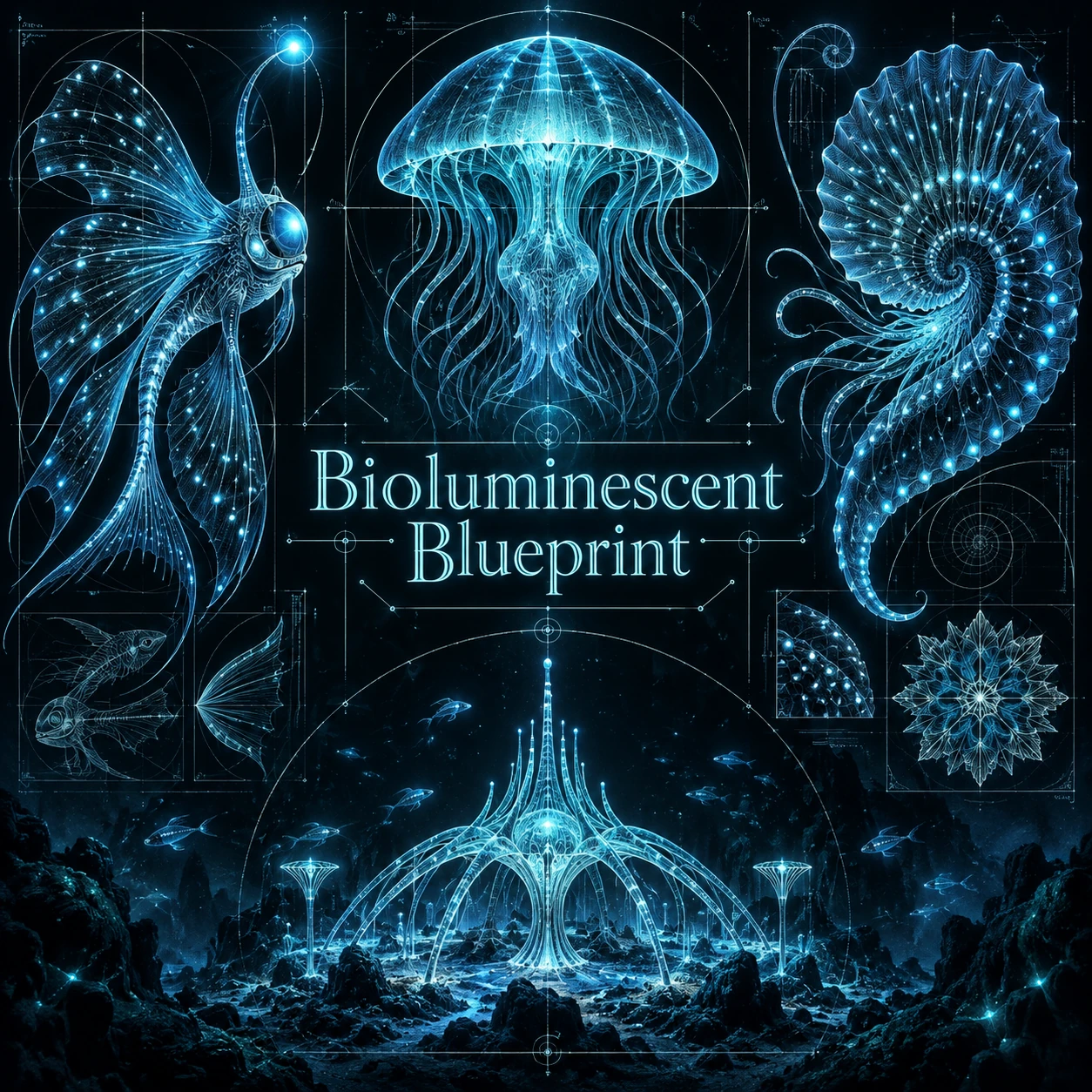
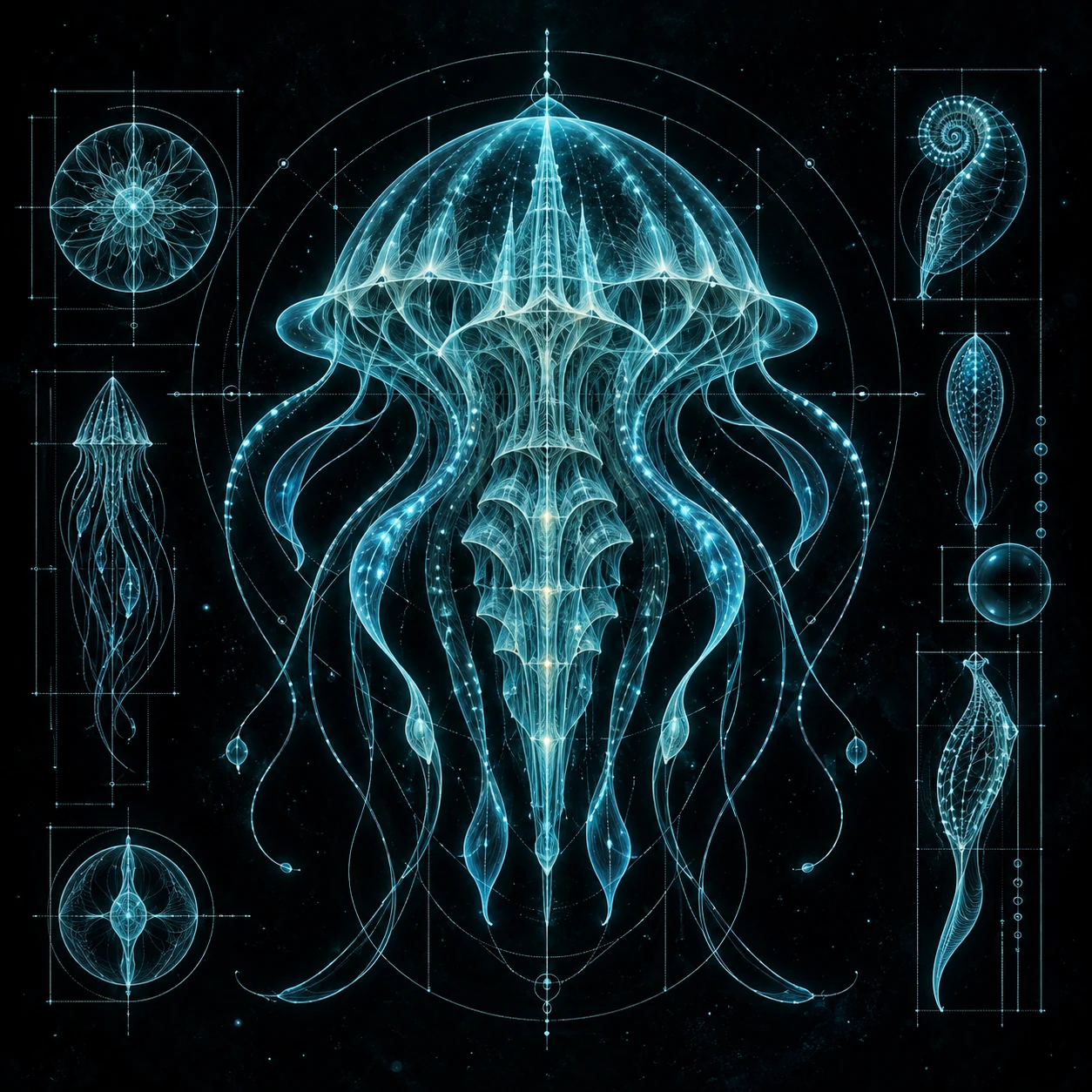
Two original AI-generated interpretations of Bioluminescent Blueprint: one standalone example and one centrally titled collage.
Select an image for a closer look. Use the thumbnails, arrow keys or a swipe to compare examples. Zoom in to inspect details, or share the image that inspires you.
Creative toolbox · take this style further
Choose an input and a destination. Search sends your words to the chosen site; Copy & open puts them on your clipboard to paste there.
Create with AI
Turn your chosen input into an image prompt or a new creative direction.
ChatGPT
Copy your input and paste it into a ChatGPT conversation or image request.
Copy & open ChatGPT (new tab)Claude · Anthropic
Develop an image prompt or explore the style in a new Claude conversation.
Copy & open Claude · Anthropic (new tab)Midjourney
Paste your input into the Imagine bar on the Create page.
Copy & open Midjourney (new tab)Adobe Firefly
Copy your input, open Firefly, and paste it into the prompt field.
Copy & open Adobe Firefly (new tab)Leonardo.Ai
Copy your input, open Leonardo, and paste it into the generation field.
Copy & open Leonardo.Ai (new tab)Image search
Find visual references. Short, concrete keywords usually work best.
Lexica
Search AI images and prompts using your selected input.
Search with this input Lexica (new tab)Pexels
Search the photo and video library. Short keywords often work best.
Search with this input Pexels (new tab)Pixabay
Search photos, illustrations and other images.
Search with this input Pixabay (new tab)Unsplash
Search photographs using the style name or your own keywords.
Search with this input Unsplash (new tab)Wikimedia Commons
Search photographs, artworks and historical images. Check each file for its source and reuse terms.
Search with this input Wikimedia Commons (new tab)Art & research
Explore artists, collections and the ideas behind a style.
Wikipedia
Search for background reading. A style may not have its own article.
Search with this input Wikipedia (new tab)WikiArt
Copy your input into WikiArt’s search to explore artists and artworks.
Copy & open WikiArt (new tab)Europeana
Paste your keywords into the search to explore European museum, library and archive collections.
Copy & open Europeana (new tab)Inspiration
Discover portfolios and visual ideas from creative communities.
Instagram hashtags
Search a hashtag made from your input: spaces and punctuation are removed. Instagram may require sign-in.
Search with this input Instagram hashtags (new tab)ArtStation
Paste your input into artwork search for concept art, environments, characters and visual development.
Copy & open ArtStation (new tab)Behance
Paste your input into project search for illustration, design and visual storytelling.
Copy & open Behance (new tab)A closer look
Cyan lines trace a central structure against near-black. Organic tendrils glow along measured arcs; small diagram-like studies surround the focus. The image suggests planning without pretending to document a real creature or buildable structure.
Draw a plan that seems alive
A blueprint asks how parts fit together. Bioluminescence suggests light produced by living things. This invented AOI visual experiment joins the two as an image language: the diagram's outlines appear to be traced by glowing marine-like forms. The organisms in the artwork are imaginary. The drawing is a speculative visual study, not a scientific record or an engineering plan.
Choose one central structure and give its parts consistent spacing, as a technical drawing would. Then allow selected lines to branch, pulse or fray like soft tissue. A few precise circles and axes can hold the irregular forms in place. Reserve the brightest cyan for connections that matter; if every strand glows equally, the plan loses hierarchy and becomes decoration. Keep enough black field around the structure for the light to breathe.
Use the small studies to clarify the idea
Secondary diagrams can show a tendril, a shell-like section or a joining node at another scale. They should explain the visual system, not repeat the central picture. For an image-generation prompt, specify which lines remain geometrically precise and which become organic. Check for legibility at thumbnail size and for invented rather than mislabeled biology. The most compelling result feels simultaneously designed and discovered while remaining clearly fictional.
Pocket-sized facts
Status: invented AOI creative experiment; not a documented historical movement.
Visual focus: cyan lines trace a central structure against near-black.
The prompt workshop
Original creative exercises. These prompts create new illustrations, not documentary evidence.
A single luminous plan
Create an original speculative blueprint of one imaginary deep-sea structure outlined by cyan bioluminescent tendrils on near-black. Keep a precise central axis, a few measured circles and selected organic irregularities. No labels, words or logo.
Add section studies
Create an original Bioluminescent Blueprint artwork: a large glowing marine-like central structure accompanied by three smaller diagram studies of its shell, tendril and junction. Use restrained cyan, believable line hierarchy and dark negative space. Make the biology fictional. No words or logo.
Turn it into a city
Create an original speculative underwater city plan whose major routes glow like branching bioluminescent organisms. Maintain clear architectural geometry while allowing selected lines to pulse and divide organically. Avoid excessive neon and all labels. No text or logo.
Sources and further exploration
Emergent Mind Labs Style Atlas — source concept for this AOI interpretation