
Creative experiment · imaginary microbiology and transmitted light
Bacterial Stained Glass imagines a window assembled from cell-like shapes rather than conventional panes. It uses microbial visual cues as a source of pattern, while making no claim to depict a particular species or scientific sample.
An A⊕I –[-.+] creαt¡ve c⊕ncept, n⊕t αn estαbl¡she∂ h¡st⊕r¡cαl m⊕vement.
A visual introduction
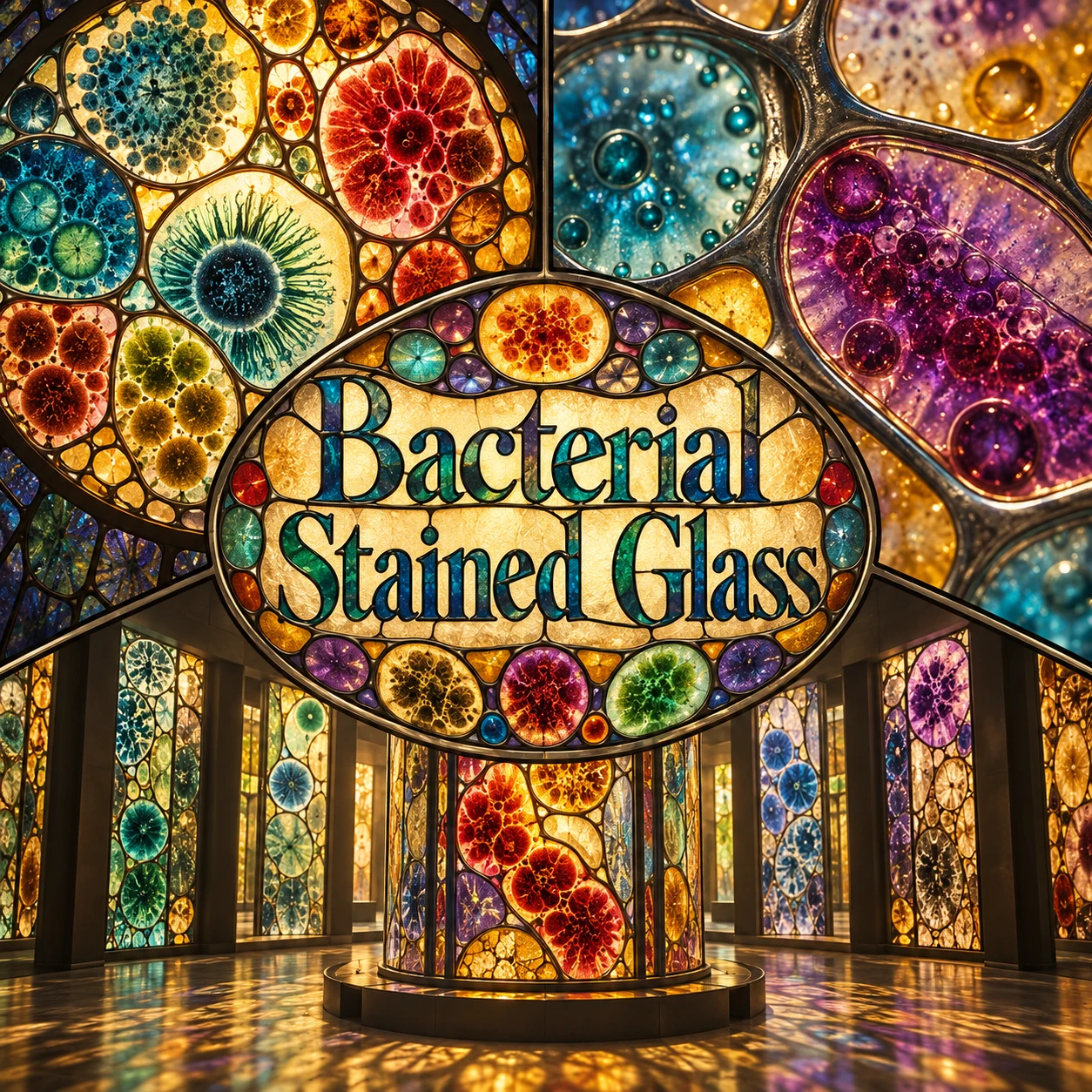
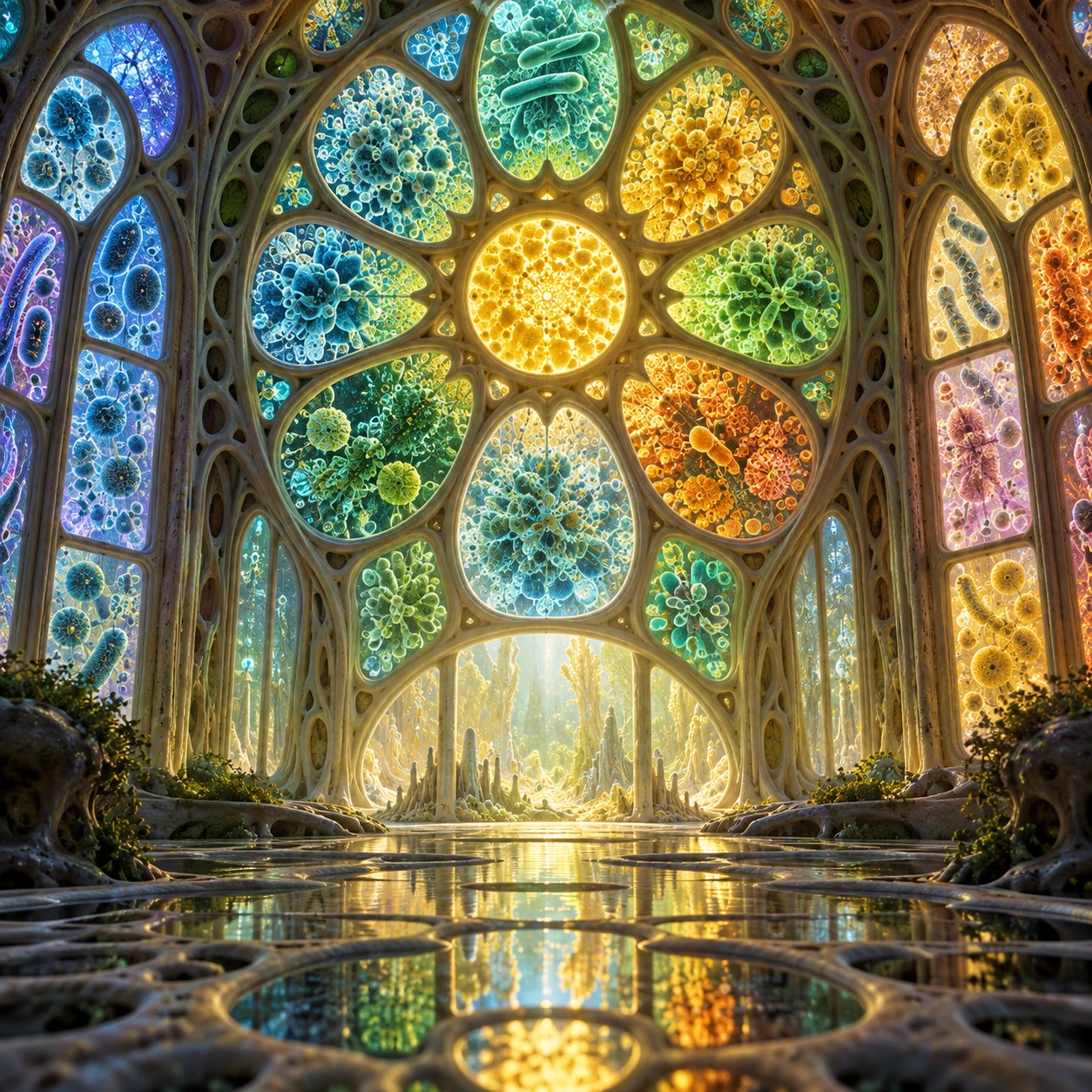
Two original AI-generated interpretations of Bacterial Stained Glass: one standalone example and one centrally titled collage.
Select an image for a closer look. Use the thumbnails, arrow keys or a swipe to compare examples. Zoom in to inspect details, or share the image that inspires you.
Creative toolbox · take this style further
Choose an input and a destination. Search sends your words to the chosen site; Copy & open puts them on your clipboard to paste there.
Create with AI
Turn your chosen input into an image prompt or a new creative direction.
ChatGPT
Copy your input and paste it into a ChatGPT conversation or image request.
Copy & open ChatGPT (new tab)Claude · Anthropic
Develop an image prompt or explore the style in a new Claude conversation.
Copy & open Claude · Anthropic (new tab)Midjourney
Paste your input into the Imagine bar on the Create page.
Copy & open Midjourney (new tab)Adobe Firefly
Copy your input, open Firefly, and paste it into the prompt field.
Copy & open Adobe Firefly (new tab)Leonardo.Ai
Copy your input, open Leonardo, and paste it into the generation field.
Copy & open Leonardo.Ai (new tab)Image search
Find visual references. Short, concrete keywords usually work best.
Lexica
Search AI images and prompts using your selected input.
Search with this input Lexica (new tab)Pexels
Search the photo and video library. Short keywords often work best.
Search with this input Pexels (new tab)Pixabay
Search photos, illustrations and other images.
Search with this input Pixabay (new tab)Unsplash
Search photographs using the style name or your own keywords.
Search with this input Unsplash (new tab)Wikimedia Commons
Search photographs, artworks and historical images. Check each file for its source and reuse terms.
Search with this input Wikimedia Commons (new tab)Art & research
Explore artists, collections and the ideas behind a style.
Wikipedia
Search for background reading. A style may not have its own article.
Search with this input Wikipedia (new tab)WikiArt
Copy your input into WikiArt’s search to explore artists and artworks.
Copy & open WikiArt (new tab)Europeana
Paste your keywords into the search to explore European museum, library and archive collections.
Copy & open Europeana (new tab)Inspiration
Discover portfolios and visual ideas from creative communities.
Instagram hashtags
Search a hashtag made from your input: spaces and punctuation are removed. Instagram may require sign-in.
Search with this input Instagram hashtags (new tab)ArtStation
Paste your input into artwork search for concept art, environments, characters and visual development.
Copy & open ArtStation (new tab)Behance
Paste your input into project search for illustration, design and visual storytelling.
Copy & open Behance (new tab)A closer look
Porous branching boundaries divide luminous circles, rods, and irregular clusters. Warm light passes through jewel-colored panels; a few large organisms establish the rhythm, while smaller forms fill selected gaps. The overall window reads as one architectural object before the tiny cell motifs appear.
Scale up an imagined micro-world
A microscopic image invites close looking; a stained-glass window invites light into a room. Bacterial Stained Glass joins those experiences by enlarging invented cell-like structures until they become an architectural field. The forms may suggest colonies, membranes, or branching growth, but they are imaginative motifs, not identified organisms or educational diagrams. This is an AOI creative experiment rather than a historical glassmaking school.
Set the main window structure first. Choose a large central cluster and let secondary clusters grow around it without making every pane equally busy. Thick, dark dividers give the image a readable skeleton; small porous edges keep it from looking like ordinary geometric glass. Limit the palette to a few families so transmitted light can make the biological pattern glow. Leave one bright opening or calmer region where the eye can rest.
Let the room prove the light
The colored window becomes more convincing when its light falls on a floor or wall. Show one warm patch and one cool patch of transmitted color rather than an even rainbow wash. For a generated image, specify both the cell-like pane shapes and the architectural scale. Check that the organisms remain stylized and that the overall object reads as a real window at a glance. The close view can then reveal tiny bubbles, membranes and lead-like joints without turning the entire image into a microscope illustration.
Pocket-sized facts
Status: invented AOI creative experiment; not a documented historical movement.
Visual focus: porous branching boundaries divide luminous circles, rods, and irregular clusters.
The prompt workshop
Original creative exercises. These prompts create new illustrations, not documentary evidence.
Begin with one window
Create an original stained-glass window built from imagined cell-like circles, rods and branching membranes. Use a strong central cluster, a few smaller supporting shapes, thick dark dividers and warm transmitted light touching a stone floor. Treat the biology as fictional visual inspiration, not an identified species. No words or logo.
Build a luminous hall
Create an original Bacterial Stained Glass interior: a quiet vaulted hall lined with jewel-toned windows whose irregular panes resemble imaginary microbial colonies. Keep one bright focal window, readable organic boundaries and colored light patches on the floor. Avoid a chaotic rainbow. No text or logo.
Zoom into the joints
Create an original close study of a fictional biological stained-glass panel. Contrast one large turquoise cell-like form with amber and violet satellite forms, porous lead-like joints and tiny trapped bubbles. Show warm light passing through the glass and preserve a clear overall pattern. No words or logo.
Sources and further exploration
Emergent Mind Labs Style Atlas — source concept for this AOI interpretation