
Photography · people, movement and outdoor experience
Adventure photography follows people through outdoor experiences and makes the relationship between action and place visible. A distant climber can establish scale; a hand repairing a strap can explain the day more intimately. The subject is not danger itself. It is the experience of moving through a world that asks something of its participants.
A visual introduction
Open any image to look closer, then browse the examples.
Creative toolbox · take this style further
Choose an input, adjust it, then open a tool. Search links pass your text to the destination. Copy & open copies it for you to paste into the generator; you start generation there.
ChatGPT
Copy your input and paste it into a ChatGPT conversation or image request.
Copy & open ChatGPT (new tab)Claude · Anthropic
Develop an image prompt or explore the style in a new Claude conversation.
Copy & open Claude · Anthropic (new tab)Midjourney
Paste your input into the Imagine bar on the Create page.
Copy & open Midjourney (new tab)Adobe Firefly
Copy your input, open Firefly, and paste it into the prompt field.
Copy & open Adobe Firefly (new tab)Leonardo.Ai
Copy your input, open Leonardo, and paste it into the generation field.
Copy & open Leonardo.Ai (new tab)Lexica
Search AI images and prompts using your selected input.
Search with this input Lexica (new tab)Pexels
Search the photo and video library. Short keywords often work best.
Search with this input Pexels (new tab)Pixabay
Search photos, illustrations and other images.
Search with this input Pixabay (new tab)Unsplash
Search photographs using the style name or your own keywords.
Search with this input Unsplash (new tab)Wikipedia
Search for background reading. A style may not have its own article.
Search with this input Wikipedia (new tab)WikiArt
Copy your input into WikiArt’s search to explore artists and artworks.
Copy & open WikiArt (new tab)Instagram hashtags
Search a hashtag made from your input: spaces and punctuation are removed. Instagram may require sign-in.
Search with this input Instagram hashtags (new tab)A closer look
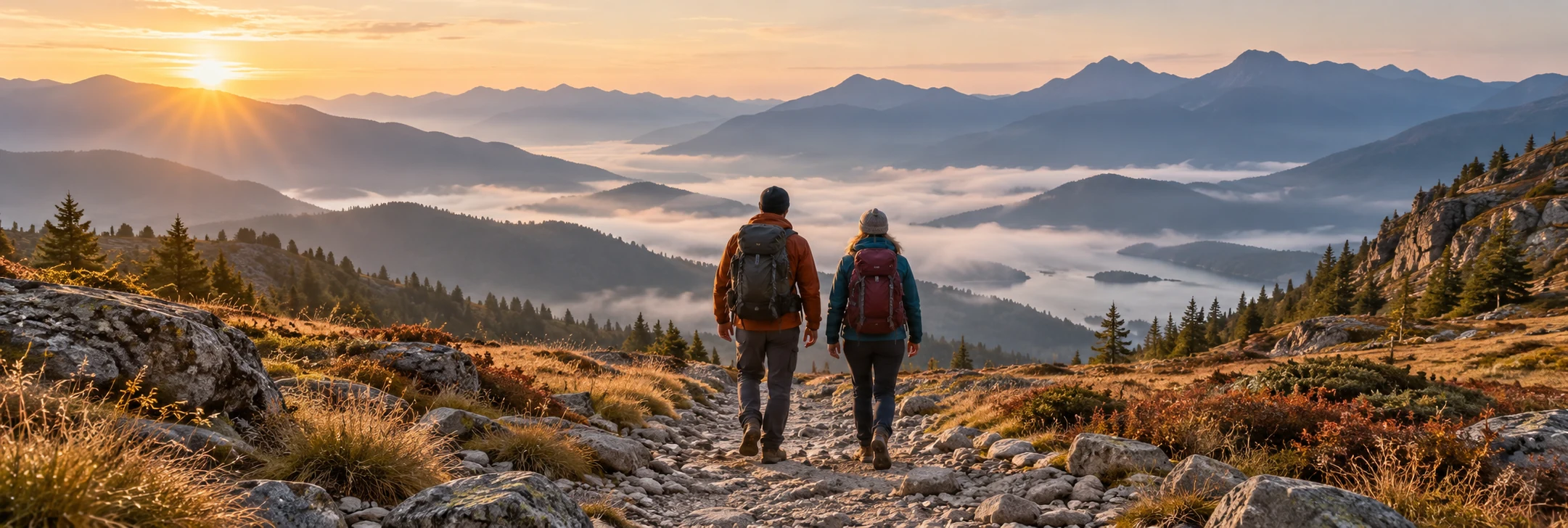
Our original banner imagines two hikers crossing a broad rocky path above a misty valley. The path connects the foreground to the figures; layered ridges carry the eye into the distance. The scene is AI-generated and does not document an expedition, a named location or a route that readers can follow.
A story needs more than its spectacular moment
A summit photograph supplies a conclusion but may omit almost everything that made reaching it meaningful. Preparation, waiting, weather, shared work and the return can provide a fuller account. Try thinking in sequences: where are we, who is involved, what changes, and what does that change feel like?
Nikon’s profile of adventure photographer Bill Hatcher describes a preference for involved, immediate pictures rather than always pursuing immaculate scenic perfection. This is one practitioner’s approach, not a rule requiring blur or roughness. It suggests that a photograph’s usefulness depends on the experience it communicates. [1]
A quiet frame can belong in an adventurous story. A person checking a map under shelter may reveal uncertainty more clearly than another tiny silhouette against a mountain. Choose the moment for its meaning before choosing the most dramatic treatment.
Give the viewer a place to stand
A wide view can show how a person relates to terrain, but wide-angle equipment is not compulsory. A tighter frame may isolate effort or compress successive ridges into a pattern. Decide what relationship you want to describe; then select the viewpoint and framing that make it legible.
In the banner, the foreground path supplies an entry, the hikers supply scale and the mist separates distances. Remove any one of those elements mentally and notice how the story changes. Without the people it becomes chiefly a landscape; without the route it becomes harder to understand their movement.
Nikon’s composition discussion with Tom Bol treats composition as a set of interacting decisions rather than a single grid rule. Use such guidance as a way to compare alternatives. A well-placed subject still needs an intelligible background, light and moment. [2]
Show effort without manufacturing peril
The old entry recommended pushing limits for the perfect shot. That is a poor definition of photographic quality. Work within the competence, access and conditions of the activity, and let the photograph describe the experience rather than make participants perform avoidable risk for the camera.
Respect the difference between a candid event, a directed portrait and a constructed illustration. All can produce worthwhile images, but captions should tell the reader which kind they are seeing. Do not invent an expedition achievement, remote location or dangerous encounter to give an ordinary picture more authority.
Include the people’s perspective when possible. A frame selected only for heroic appearance can misrepresent a difficult day or reduce companions to scale markers. Their expressions, decisions and shared tasks can carry the account.
Build a small, varied edit
Choose an establishing view, an action frame, a close detail and a quieter aftermath. Look for changes of distance and pace. Four nearly identical vistas may be individually attractive while adding little to one another.
For each frame, write a factual caption before an evocative one. Identify what you actually know about place, people and circumstances. Keep an observation separate from an inferred feeling. A lowered head might mean concentration, fatigue or simply watching the path.
When generating a visual concept, specify a plausible route, coherent equipment and believable body positions. Inspect poles, straps, feet and contact with the ground. Beautiful atmospheric depth will not rescue a hiker whose boot passes through a rock.
A useful first assignment
Photograph a familiar, accessible walk as if its details mattered. Find one transition in light, one small task and one relationship between a person and the surroundings. Build a short sequence without increasing the difficulty of the walk for the sake of an image.
The resulting story may have no summit at all. It can still contain arrival, uncertainty, attention and discovery—the things a spectacular background cannot supply on its own.
A small poetic detour
Original words from the AOI studio.
Poetry
The summit leaves the frame.
A hand reties a knot.
The journey becomes visible.
The prompt workshop
Original creative exercises. These prompts create new illustrations, not documentary evidence.
Start with scale
Create an original photographic-looking concept of two hikers on a broad stable mountain path, layered misty ridges and believable packs. Let the path explain their movement. No named real location or expedition claim.
Original AOI exercise; a generated image is not historical or documentary evidence.
Build a sequence
Plan four original frames of a modest outdoor journey: setting, shared task, movement and rest. Vary distance and pace while keeping people, clothing and weather consistent.
Original AOI exercise; a generated image is not historical or documentary evidence.
Change the emphasis
Reframe the same invented walking scene as a wide environmental view and a close detail of equipment being checked. Compare what each image explains and what it leaves out.
Original AOI exercise; a generated image is not historical or documentary evidence.
People & works to explore
References discussed in this article. Consult the sources below for context.
Artists and practitioners
Bill Hatcher — adventure photographer discussed by Nikon
Tom Bol — outdoor photographer and composition educator
Paintings and other works
Outdoor Pursuit — Nikon’s practitioner profile and photographic examples