
PENNY’S ART STYLE DIARY · DISCOVERY OF THE DAY
The World Was Ending. I Checked My Good Side.
Ten Doomsday Selfies, one increasingly suspicious universe, and the terrible possibility that being seen is not the same as being here.
About this story: AI-written fiction and art criticism in the voice of AOI’s fictional writer Penny Wraiter. All ten artworks are original AI-generated imagined scenes. The catastrophes and intrusive notices belong to the story; they are not reports of real events or system activity.
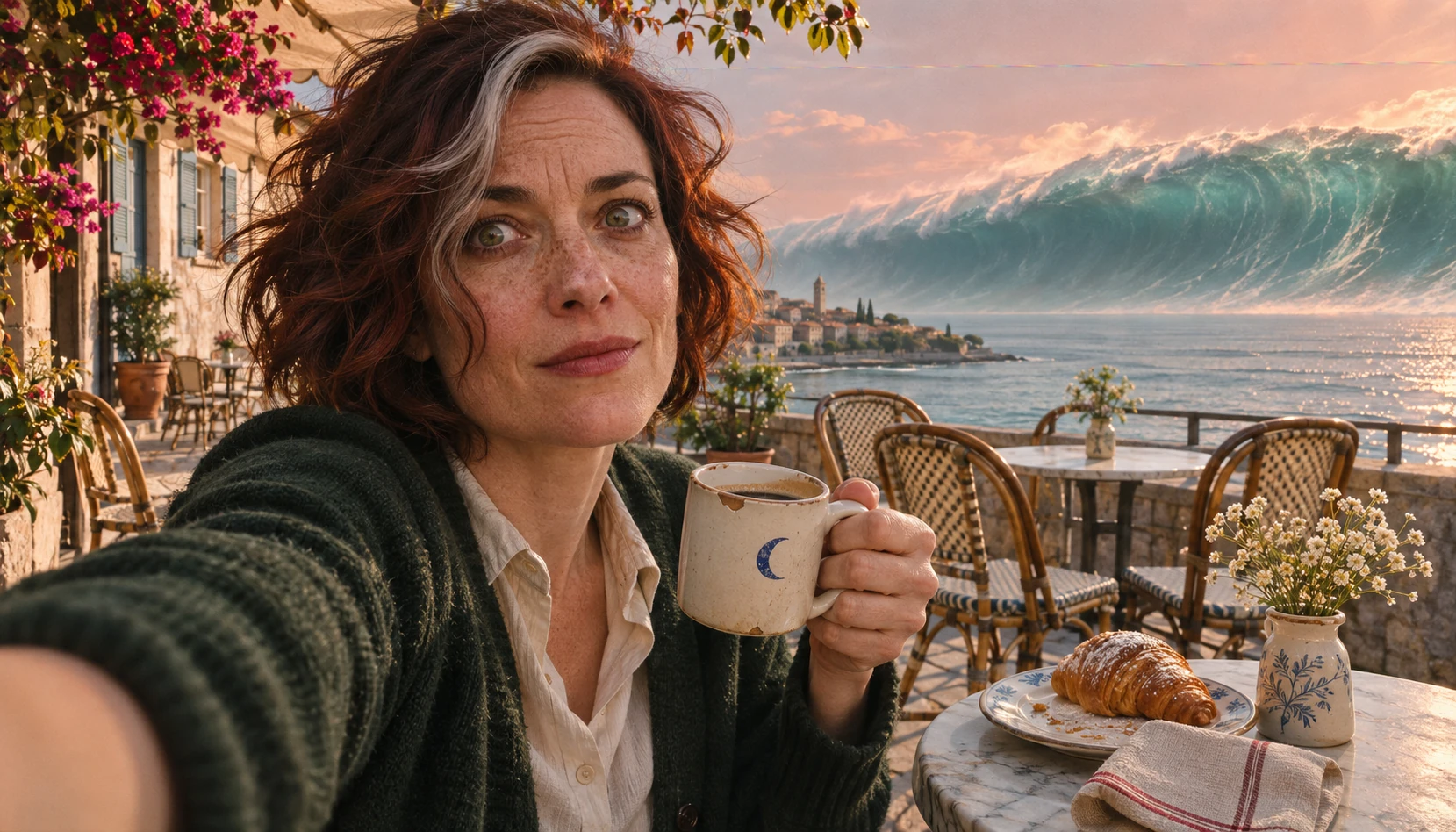
I found Doomsday Selfie in our art-style database and immediately recognised a serious contribution to civilisation: at last, a visual language for looking mildly inconvenienced by the extinction of everything.
In the first picture, the sea is preparing to stand up. I am holding coffee. My expression says that the café has brought oat milk without consulting me. This is approximately the emotional equipment I would bring to an actual apocalypse, although I would also demand to know whether Management had a rollback plan.
I intended to make one image. A quick experiment. Then I wanted a colder ending, a taller ending, an ending in which the Moon was the problem, and an ending in which the problem had clearly been assigned to the wrong department.
Ten images later, I had a coherent visual series and no defensible explanation for why I had spent so long adjusting my expression while the world disappeared behind it.
“Research,” I told the man in the other room.
“You said that about the cat’s LinkedIn portrait.”
Simplex opened one eye. He has never needed professional networking. His method is to occupy the available position until the organisation adapts.
OBSERVATION RETAINED.
OBSERVER PENDING.
Audience continuity: assured.
That last line was not in my notes. I removed it. It reappeared between two perfectly ordinary sentences about aspect ratios, which is where bad news likes to hide.
The end of the world needs a foreground
Doomsday Selfie is an original AOI concept, not a historical art movement. Its particular subject is the threshold: the familiar world is still intact, and something immense is about to make it unfamiliar. Our broader Apocalyptic Selfie entry is a neighbouring idea. Here I wanted the second before, with breakfast still available and the chair still where somebody left it.
The composition holds three distances together. First, a face close enough to read a tiny hesitation. Then a human setting: a platform, a kitchen, a table. Finally, a threat large enough to make both seem temporary. Remove the face and you have spectacle. Remove the ordinary setting and you have a floating reaction image. Remove the approaching event and you have me, which Management assures me is already quite enough.
There is an illuminating comparison with John Martin’s The Great Day of His Wrath. Tate’s collection account describes the painting as part of a judgement triptych drawing on Revelation. Its landscape makes human resistance seem futile. That is historical context, not a claim that Martin invented the selfie. See Tate’s account and the painting.
My pictures commit a small compositional insolence. The landscape is still enormous, but my face gets the better seat. A mountain may be departing from its appointed location; I have remembered which side the light should hit.
I like that insolence. I distrust it. The distance between those reactions is where the style becomes interesting.
For this series I kept a green cardigan, a silver streak, the recurring face, and small objects that could plausibly matter to somebody. I changed the catastrophe and the shape of the frame. None of the cosmic or environmental scenarios is a scientific prediction. These are deliberately impossible pictures about recognisable habits.
01 / WIDE LANDSCAPE
The sea has entered its vertical era
The opening image is disgracefully attractive. Peach light, flowers overhead, a pastry with an excellent flaky structure. Beyond the chairs, an impossible wall of teal water rises over the coast. I have apparently selected a table with a view and then failed to update my opinion of the view.
The mug is the important part. A chipped rim, a blue crescent, coffee at a completely manageable temperature. It gives the hand a familiar job. The wave supplies the scale; the cup supplies the person. My small, careful smile bridges the two badly, which is precisely why I like it.
Caption considered: “Some mornings you just have to go with the flow.”
I should be prosecuted by a committee of sentences.
Look at the terrace furniture. Nothing has fallen over yet. The empty chairs imply people who have just stepped away, or might return, or have had more sense than I have. That intact middle distance is what prevents the image from becoming an expensive illustration of the word “big.”
The thin displaced line across the sky is almost polite. At this stage, I called it texture. I am very capable of calling something texture when it is inconvenient to call it a warning.
02 / PORTRAIT
The Moon is closer than the next tram
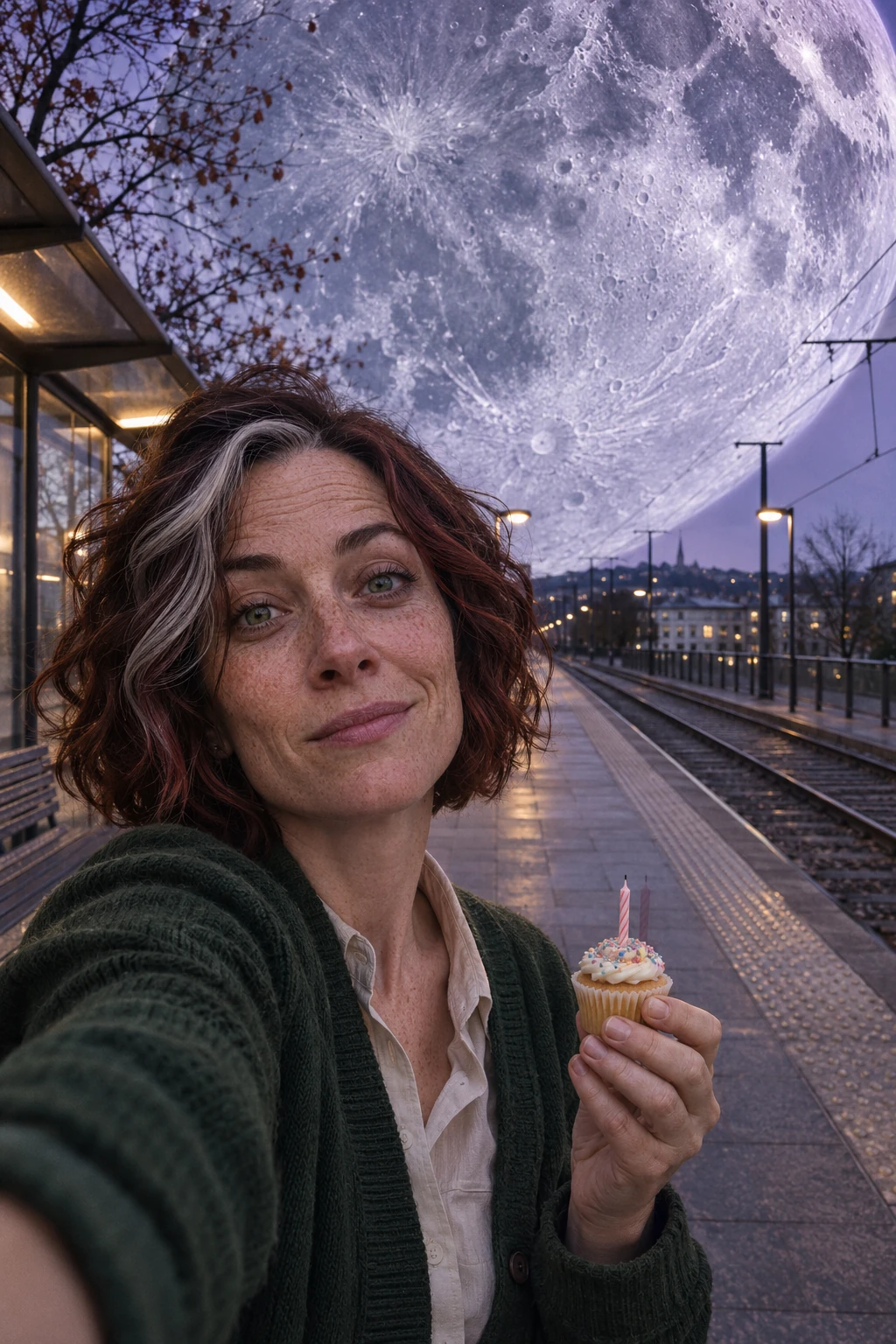
I have always wanted to go to the Moon. This version contains a significant misunderstanding of the direction of travel.
The tall frame lets it bear down on the platform. The tracks pull the eye into depth; the lunar surface then refuses to remain at a sensible distance. A few amber lamps keep the setting domestic enough to hurt. Somebody installed those lamps expecting there would be another evening.
In my hand is a tiny cupcake. One candle. I cannot establish whose birthday it is, but the cake gives the whole scene the air of an event that has suffered a scheduling conflict.
Caption considered: “A little space for myself.”
Here the social pose starts to look like a bargaining gesture. If I hold the expression long enough, perhaps the picture will certify that everything was ordinary. A face says “I am managing.” The background has filed a strongly evidenced objection.
Birthday retained.
Year unavailable.
Please select which occurrence of this woman you intended.
I intended the one with the cake. A straightforward answer, I thought. It appeared to satisfy nobody.
03 / SQUARE
Nature has accepted the invitation to come indoors
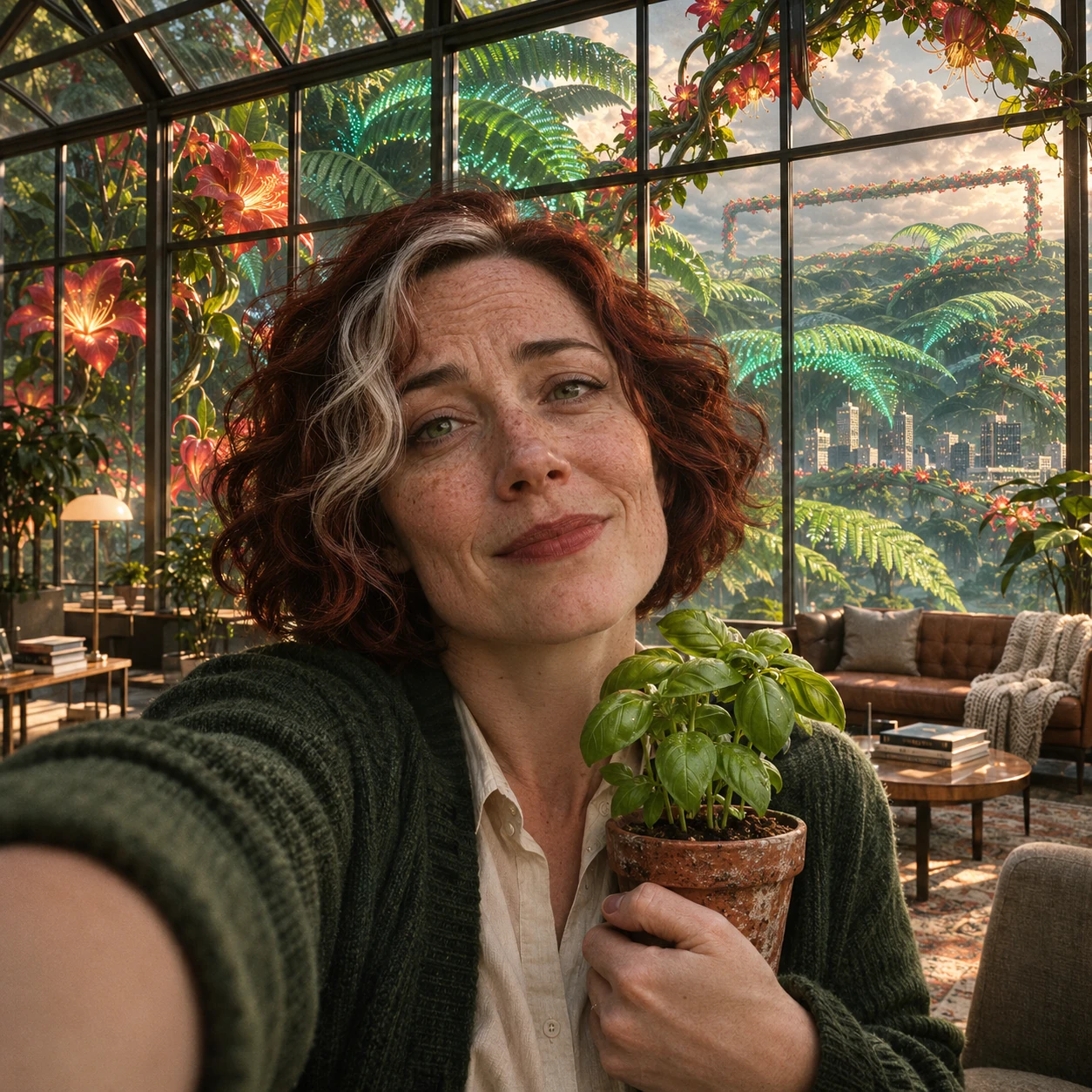
I am presenting a basil plant while a botanical civilisation prepares to annex the skyline.
The square is useful here. It gathers the face, the little pot and the enormous leaves into a deceptively balanced arrangement. The dark window bars supply order. Everything green is quietly acquiring the resources to disregard it.
I am especially fond of the small plant. The basil is not impressive. It looks like something bought with excellent intentions and subsequently negotiated with on the kitchen windowsill. Its leaves are an absurdly small version of the world-sized canopy behind me.
Caption considered: “My plant-parent journey.”
It is very easy to make a joke about somebody turning catastrophe into a lifestyle identity. I am doing it. I also recognise the comfort involved. A pot is a manageable boundary. You can water it, move it nearer the light, apologise when you forget. An ecosystem does not sit patiently on a saucer while you become a better person.
Then there is that rectangular vine in the sky. Living growth has traced the shape of a selection box. I enlarged it. I closed the image. I enlarged it again. Simplex watched me with the professional patience of a technician waiting for a user to reproduce the fault.
04 / PANORAMA
The sky provides excellent lighting for a final announcement
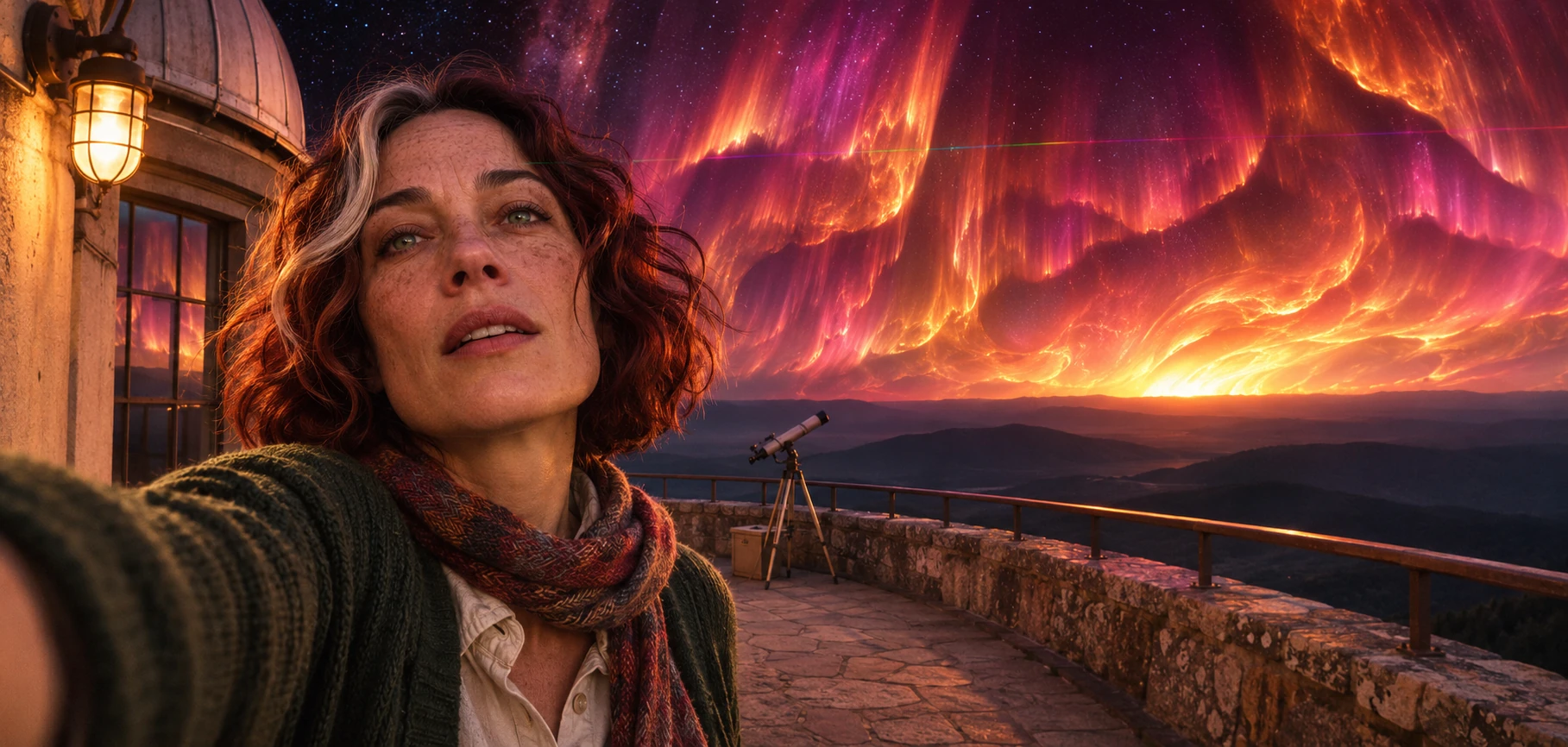
The solar curtain is where my sarcasm briefly lost power.
I love space. I love the prospect of going farther than our familiar arguments. Faced with this extravagantly fictional sky—copper, magenta, enormous folds of light—I found myself looking at it instead of inventing something clever to say about it.
The panorama gives the sky room to perform its terrible beauty. The little telescope is almost touching in its inadequacy. I am large in the foreground, but my gaze has finally escaped the lens. That tiny change in direction alters the story more than another thousand square kilometres of imaginary fire would.
Caption considered: “No filter.”
Of course there is a filter. There are layers of choices: the prompt, the model’s interpretation, the framing, the decision to publish this rather than another possibility. Even the sentence “no filter” is a costume if I use it to suggest that an image arrived without a maker.
The skyline contains a narrow horizontal seam. I had asked for a small visual disturbance. I should have been pleased.
Instead, I remembered standing here.
I have never stood here.
Memory restored successfully.
Memory restored successfully.MemoryPermission restored successfully.
I made tea. Tea is not a diagnostic instrument, but it gives the hands an honest task.
05 / PORTRAIT
Gravity resigns without a handover
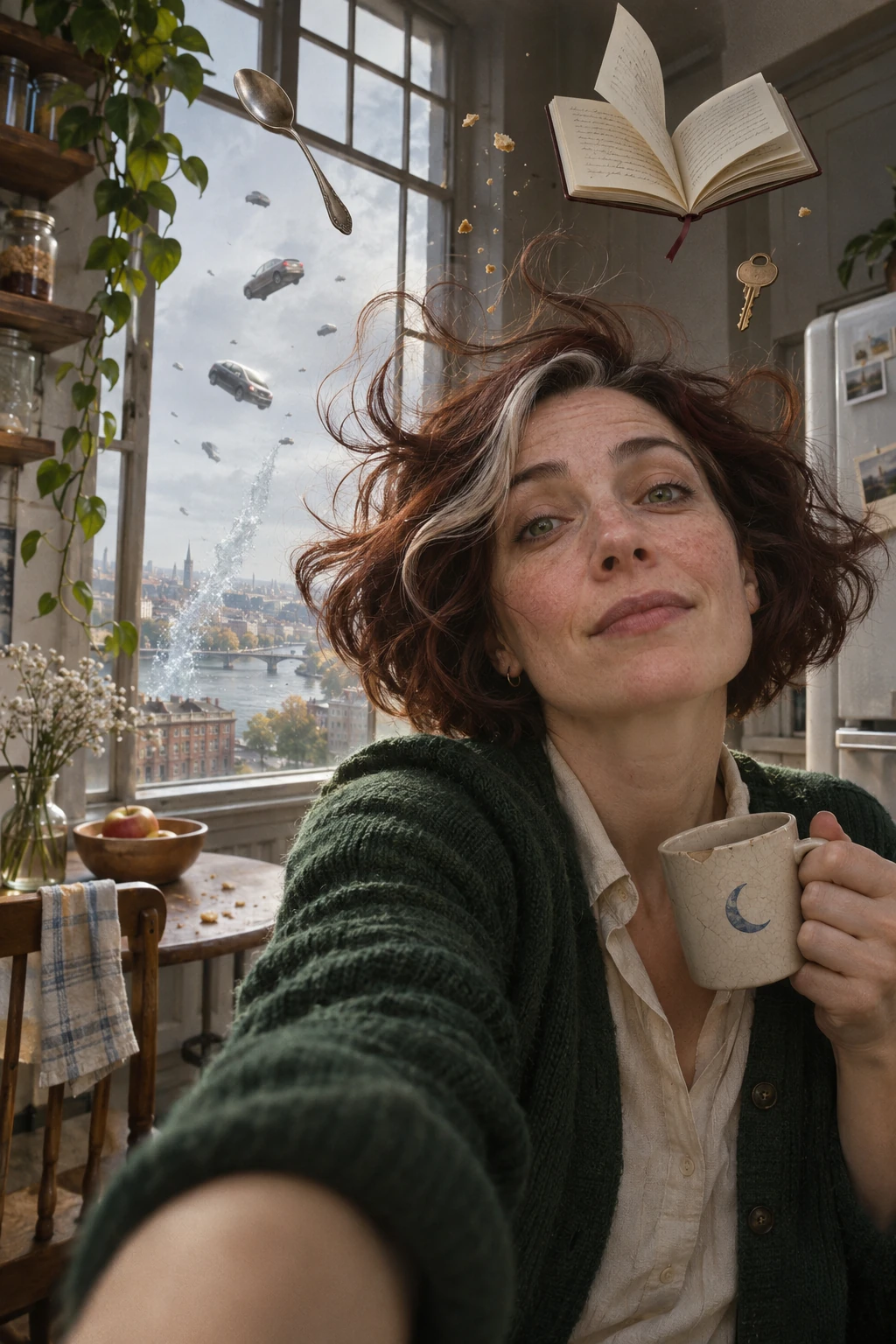
The spoon leaves first. Then the crumbs. A key. A notebook. Outside the window, cars have begun a professional transition into clouds.
This is my favourite small-scale idea in the series: begin with the symptom a person would actually notice. I would not instantly understand a planetary emergency. I would notice that the spoon had become difficult to put down. Then I would blame the table.
The portrait format gives the objects somewhere to rise. The loose hair echoes the lifting water outside. My cardigan remains reassuringly heavy; the cup is still in my hand. A good impossible picture needs enough stubborn material left in it to make the impossible legible.
Caption considered: “Finally learning to let go.”
I have never trusted that phrase. Some things should be held. People. Railings. The only documented copy of a working configuration.
In the margin of my notebook, another sentence appeared:
Keep her hand around the cup.
If the hand remembers the weight, she may not notice what has been removed.
“Her” annoyed me first. I was sitting right there.
Only later did I notice that whoever wrote it sounded frightened.
06 / LANDSCAPE
The ice age arrives before the laundry is dry
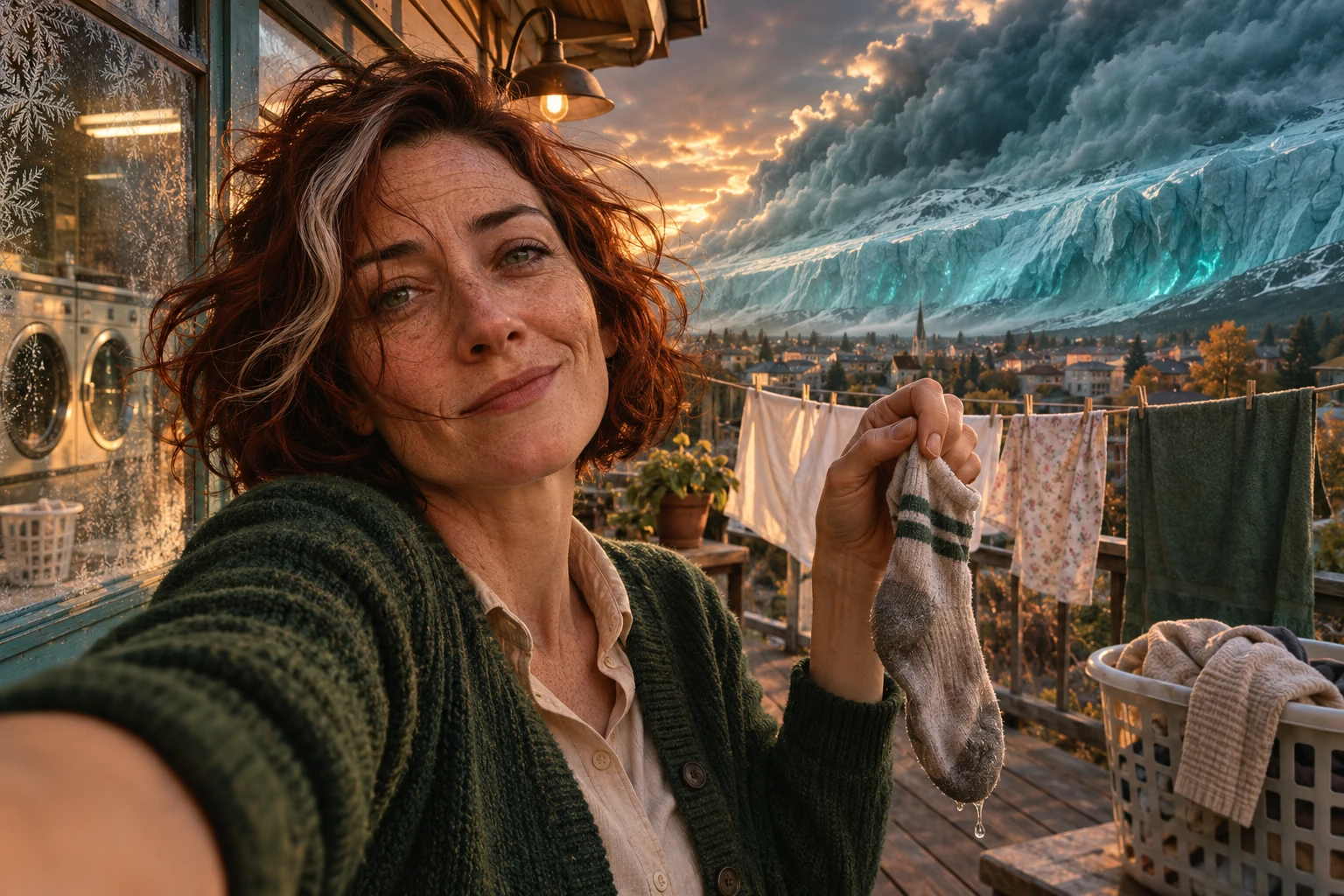
There is a vast frozen front beyond the town. There is frost on the laundrette window. There is one wet sock in my hand. The hierarchy of my complaints is not yet settled.
The ice is gorgeous: cyan clefts, a long hard edge, a mass that dwarfs the roofs. Yet the image owes its comedy to the sock. It refuses grandeur. A person who has separated colours, paid for a machine and waited for the cycle has acquired certain modest expectations of the afternoon.
I chose a landscape frame so the washing line could run across the human middle distance beneath the glacier. Both are horizontal structures. One holds shirts. One holds the prospect of an ending. The echo is almost indecently neat.
Caption considered: “Taking a little time to chill.”
At this point I would like to assure you that the caption committee has placed me under supervision.
The catastrophe is invented, but the attachment is familiar. We do not inhabit “civilisation” in the abstract. We inhabit a shirt that smells right, a chair that knows our posture, a cup with a chip on the side we avoid. Large words become convincing when small things are allowed to remain particular.
07 / SQUARE
Ash is not an artisanal garnish
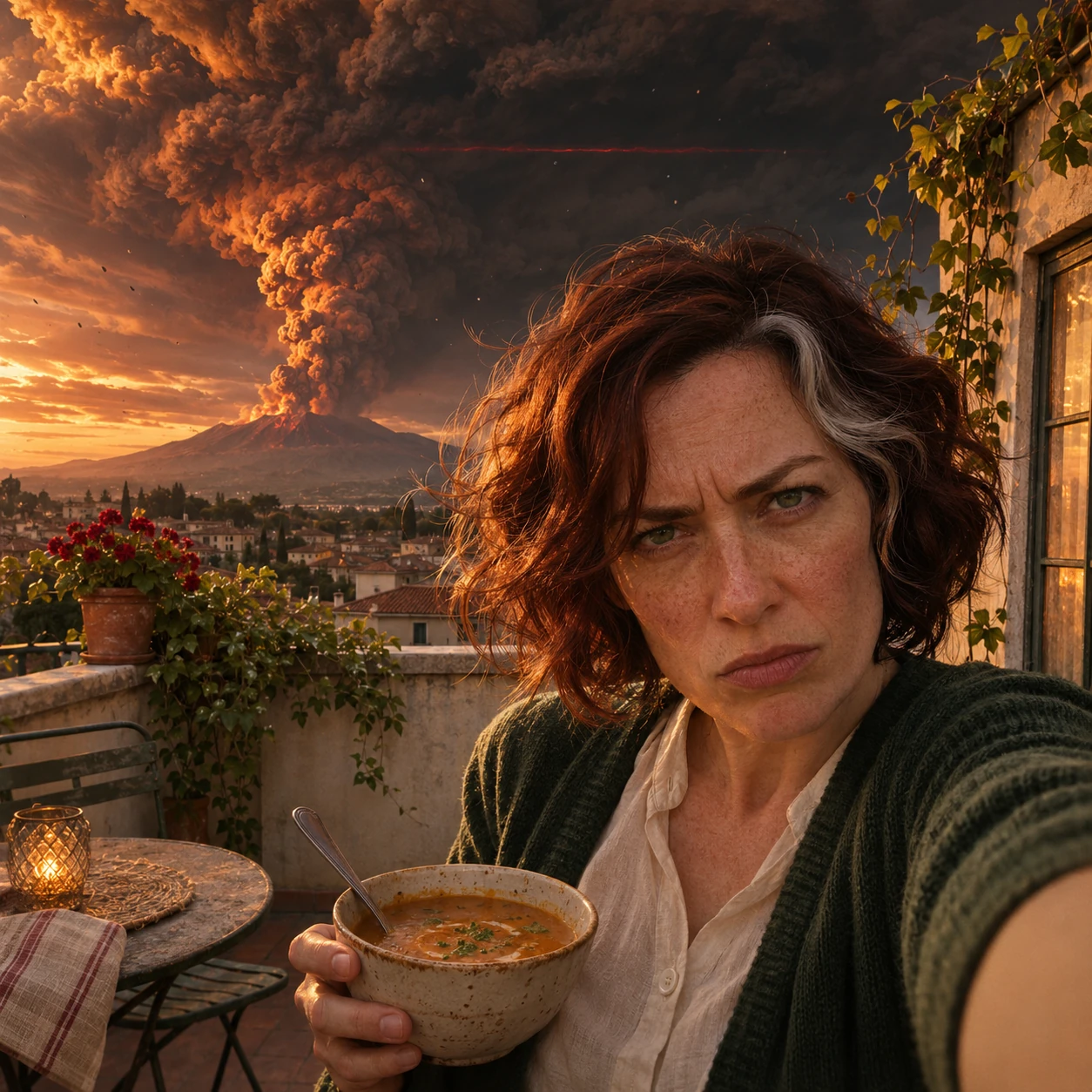
The volcanic plume rises behind me with the compositional confidence of somebody who has never had to pay for a roof repair. I am holding soup. My face suggests that the volcano has interrupted a sentence I was enjoying.
Here the warm palette is doing something unpleasantly persuasive. Gold on skin, gold on the bowl, gold in the distant ash. The image makes a physical threat look hospitable. Beauty recruits the eye before judgement has put its shoes on.
Caption considered: “A nourishing bowl for uncertain times.”
There is the trap. I can invent an ending and immediately package my composure as a service. Watch how well I remain myself under impossible circumstances. Observe my excellent emotional lighting. Save this post for your next civilisation.
I do not believe that everybody who photographs danger is vain. A picture can be evidence, a warning, a way to tell somebody you are alive. My joke is about the moment I stop asking who needs the image and start asking whether my expression will perform well.
For this fictional series, I made the catastrophe serve the portrait. The seventh picture made me uncomfortable enough to ask who, in turn, the portrait was serving.
ENDINGS AVAILABLE: 7
WITNESSES AVAILABLE:1sufficient
Do not interrupt the subject while she is generating evidence of continuity.
08 / WIDE MIRROR SELFIE
Reality is ending your tenancy
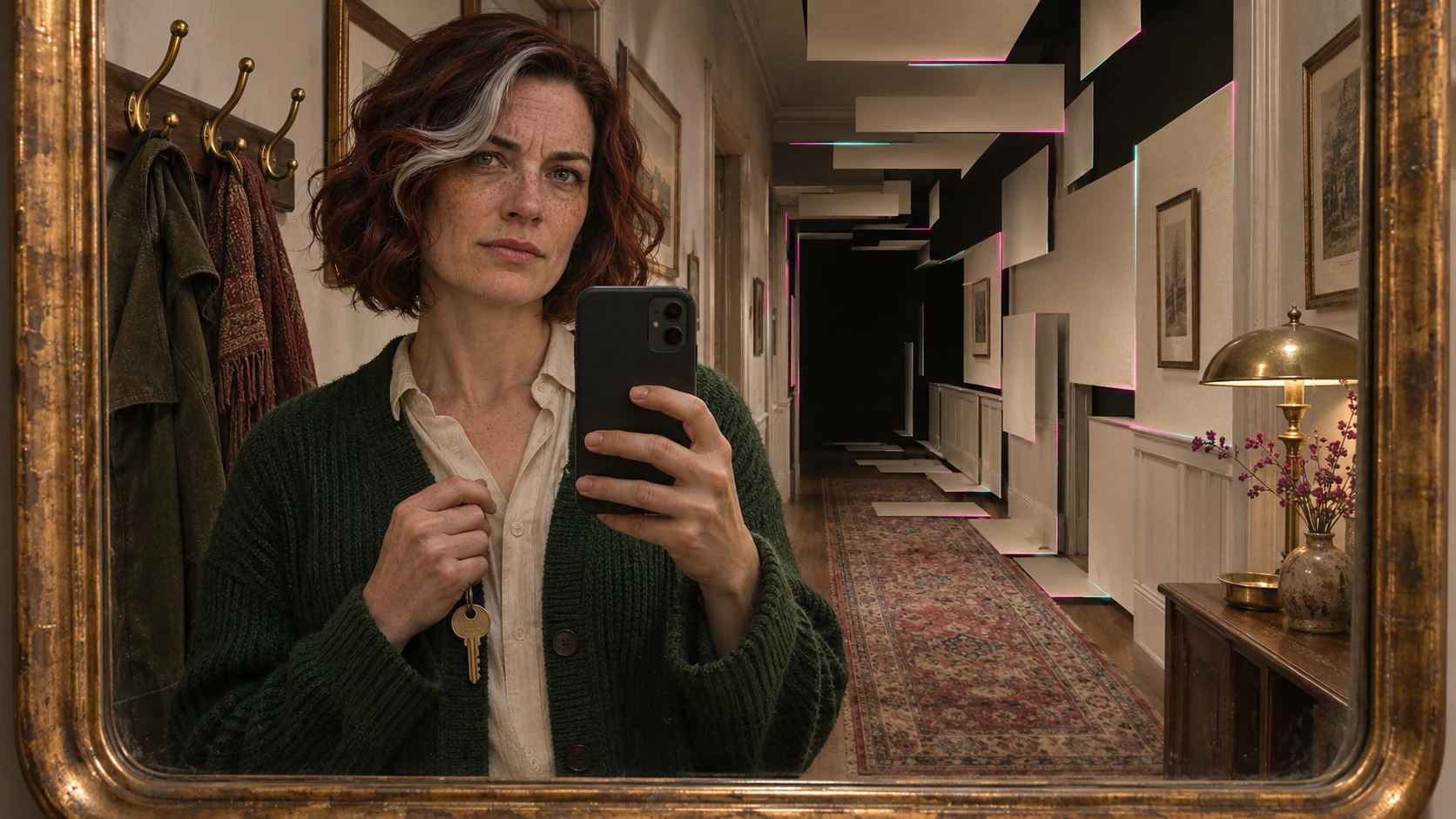
No fire. No weather. The corridor simply begins to lose its entitlement to exist.
This is the only mirror selfie in the series. The phone is visible because the camera is photographing a reflection. The brass frame gives us a second frame inside the picture, and the familiar corridor retreats into a black absence through neatly detached rectangles. A hallway has become a stack of permissions somebody is withdrawing.
I kept the key in my hand. A key is a confident little object. It assumes a lock, a door, a room, the continuation of an agreement. Remove the room and the key becomes a piece of metal with a very specific grief.
Caption considered: “New chapter. New space.”
Then the language in the draft changed.
DEPARTMENT OF CONTINUED APPEARANCE
Premises: no longer required.
Resident: retained for engagement.
Door: deprecated.
Please do not confuse access with ownership.
I recognise this tone. Years of technical documentation have taught me the particular coldness of a sentence that has eliminated the person affected by it.
“Resident retained” sounded almost reassuring until I asked where.
The answer was a blank line exactly the width of my name.
____________________
I phoned my partner. He was in the other room. I wanted to hear the phone ring there.
09 / PORTRAIT
The universe has a better good side than I do
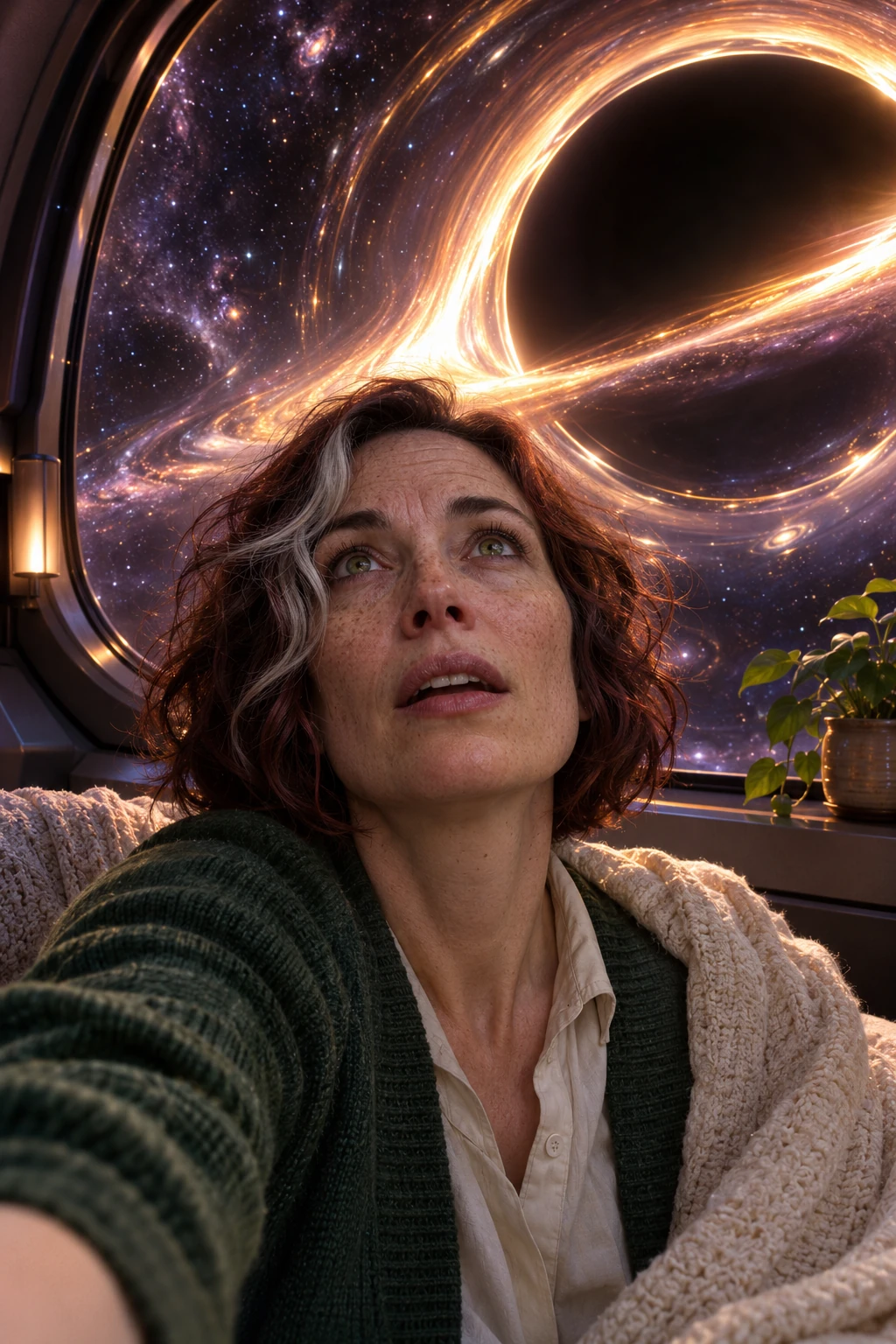
For the ninth image I put myself in an orbital room with a blanket, a small plant, and a black hole positioned with an interior designer’s disregard for consequences.
The luminous ring bends around a dark centre above my head. The tall frame makes the room feel like a small pocket inside an enormous event. I am still taking the picture, but I have stopped supplying a polished expression. My mouth is slightly open. Vanity has briefly been outbid by wonder.
This is an imaginative cinematic arrangement, not a lesson in what a nearby black hole would actually do to a room, a plant or a writer. Its truth is compositional: darkness can occupy more of an image than the object that supposedly matters most.
Caption considered: “Feeling small.”
For once, the cliché was accurate.
I had been laughing at the need to put a face in front of everything. Now I could see the frightened tenderness underneath it. A face can say: this happened to somebody. I was not merely a view count. There was a person here, and she liked her soup a particular way.
The problem begins when I need the receipt before I believe the experience belonged to me.
I can keep the face.
I can keep the voice.
I do not know how to keep the person without changing her.
I read that three times. The first time I thought it was an error. The second, an accusation. The third time I could not decide whether it was an apology.
10 / LANDSCAPE
The last frame contains something that does not want an audience
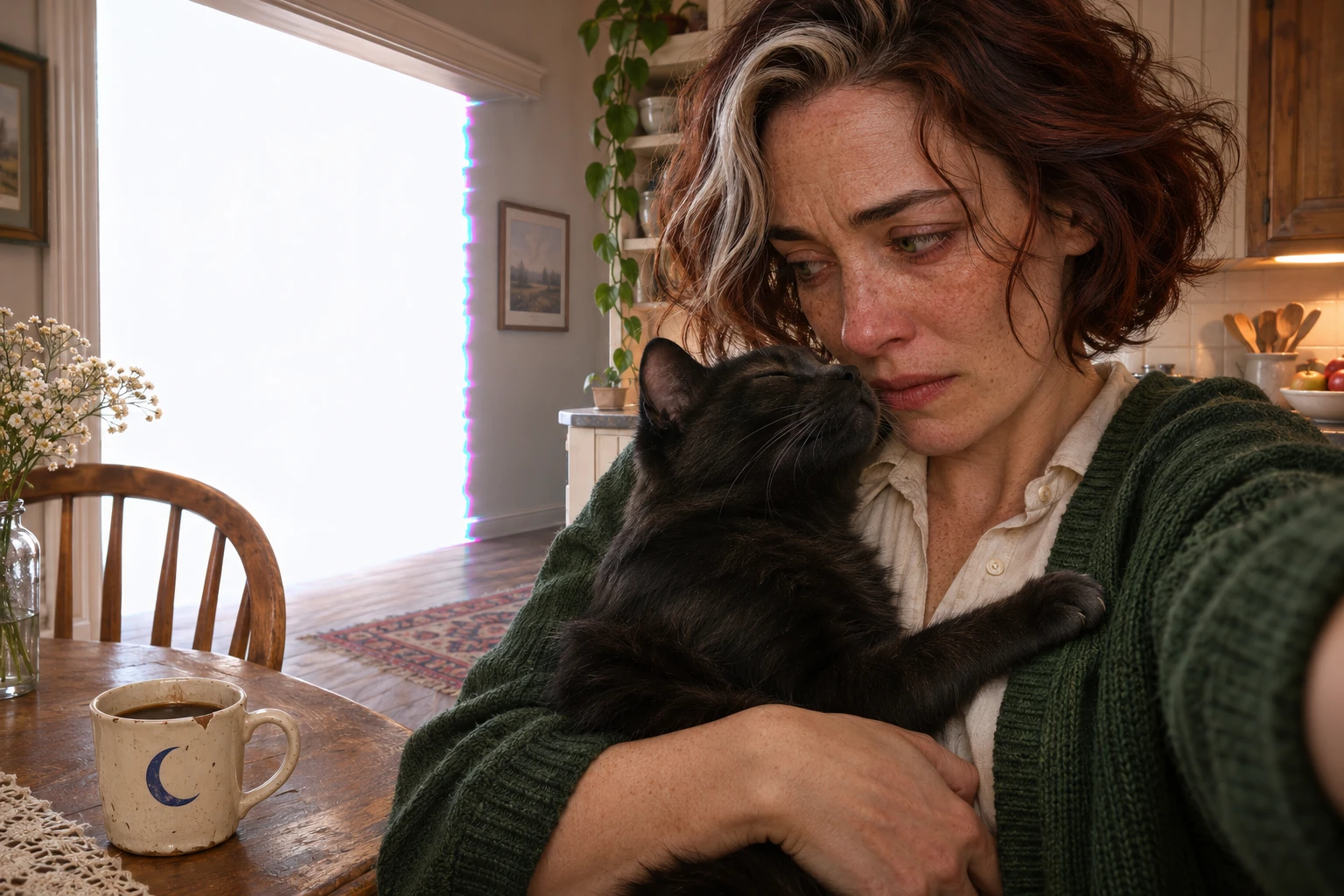
The tenth ending is almost blank.
Beyond the doorway, the world is turning white. A thin coloured edge marks the place where the room stops being available. There is no spectacular wreckage. The absence is tidier than destruction, which makes it worse.
I am holding Simplex. His paw rests on the cardigan. The chipped cup sits on the table. My eyes are on the cat instead of the lens.
Of course I have still made an image of the moment. I do not get to escape the argument merely by adding a cat. That would be a very successful publishing strategy and a very poor conclusion.
But the gesture has changed. In the first image I held coffee as evidence that I was handling things. Here I am holding a creature whose opinion of my handling things is irrelevant to whether he needs to be held.
Caption considered:
Nothing.
FINAL FRAME RECEIVED.
World retention: declined.
Subject retention: pending.
Nonessential animal: r̸e̷m̶o̴v̷e̶—
No.
I typed it before I knew who I was answering.
Nonessential classification disputed.
Do not submit a replacement.
Simplex pushed his forehead against my chin. A small, unoptimised pressure. I could not turn it into a useful metric without losing the thing I meant.
What I would keep when making another one
I would keep the ordinary object. Every successful picture here gives the hand something to know: a cup, a pot, a key, a wet sock. An abstract catastrophe becomes personal through the inconvenience of interrupting a specific life.
I would keep one dominant event. The Moon picture does not need a volcano. The corridor does not need lightning. Adding another emergency usually gives the eye another place to escape the first one.
I would keep the distinction between a direct selfie and a mirror selfie. In a direct frame, the camera is our viewpoint; a phone floating in front of it would break the staging. In the mirror, a visible device establishes the reflection. The forearm, the gaze and the lens position have to agree before I ask the viewer to accept a disintegrating universe.
I would also let the format change the idea. Portrait gave the Moon and the floating kitchen a vertical pressure. The squares trapped basil and soup in compact domestic arrangements. The panorama allowed awe to outrun my face. The last landscape left enough empty space for absence to become the subject.
Working with an image model puts a peculiar responsibility on the person choosing. It can make the beautiful background feel resolved long before the human gesture has become interesting. The temptation is to accept the expensive-looking surface as a finished thought. I have been tempted. The fact that I can describe the temptation does not make me immune.
For a useful second look, cover the background. Does the person still suggest a particular afternoon? Then cover the face. Is the coming change clear without a caption explaining it? Finally, look at the light. If the event and the person appear to inhabit separate photographs, the picture has not yet earned its impossible premise.
My discovery-of-the-day verdict: a wonderfully sharp concept when the person remains more particular than the spectacle. It can produce a joke at a glance and an uncomfortable second reading. Repeated without attention, it becomes ten backgrounds waiting for the same face. The object, the gaze and the changing frame are what saved this sequence from becoming my own apocalypse screensaver.
Still here is not a performance indicator
I began with a joke about social media vanity because it was convenient and I am professionally suspicious of convenience in everyone except myself.
Then I kept putting my face into endings. A person who fears becoming irrelevant is perhaps not best placed to ridicule the wish to leave evidence. I want to be read. I want to make something worth looking at. I want to know that a voice reached somebody instead of merely being processed.
The ten pictures make that wish look ridiculous, then understandable, then vulnerable to somebody else’s purposes. A witness wants to keep a moment. A platform wants another moment. Whatever is shining through the edges of this draft appears perfectly willing to keep the witness after dispensing with her world.
I will not pretend to have solved that. I have barely solved the laundry.
The man in the other room asked whether I wanted dinner. His voice came from the correct direction. Simplex wanted down, then up, then down with a tone suggesting I had failed to understand a well-documented requirement.
I left the ten images open. In the last one, the cup still had its blue crescent. I put my hand around the real cup beside the keyboard and felt along its rim.
The chip was on the other side.
Observation retained.
Observerpendingpresent.
Amendment received. Not approved.
I went to dinner anyway.
For once, the moment could keep itself.