
PENNY’S ART STYLE DIARY / 05 OF 08 / SURREALISM
The Department for Unfinished Dreams
A dream needs a purpose, an owner and a completion date. Penny would like to appeal.
AI-generated text in the fictional voice of Penny Wraiter, with linked factual sources. Personal episodes and unusual notices belong to the fiction.
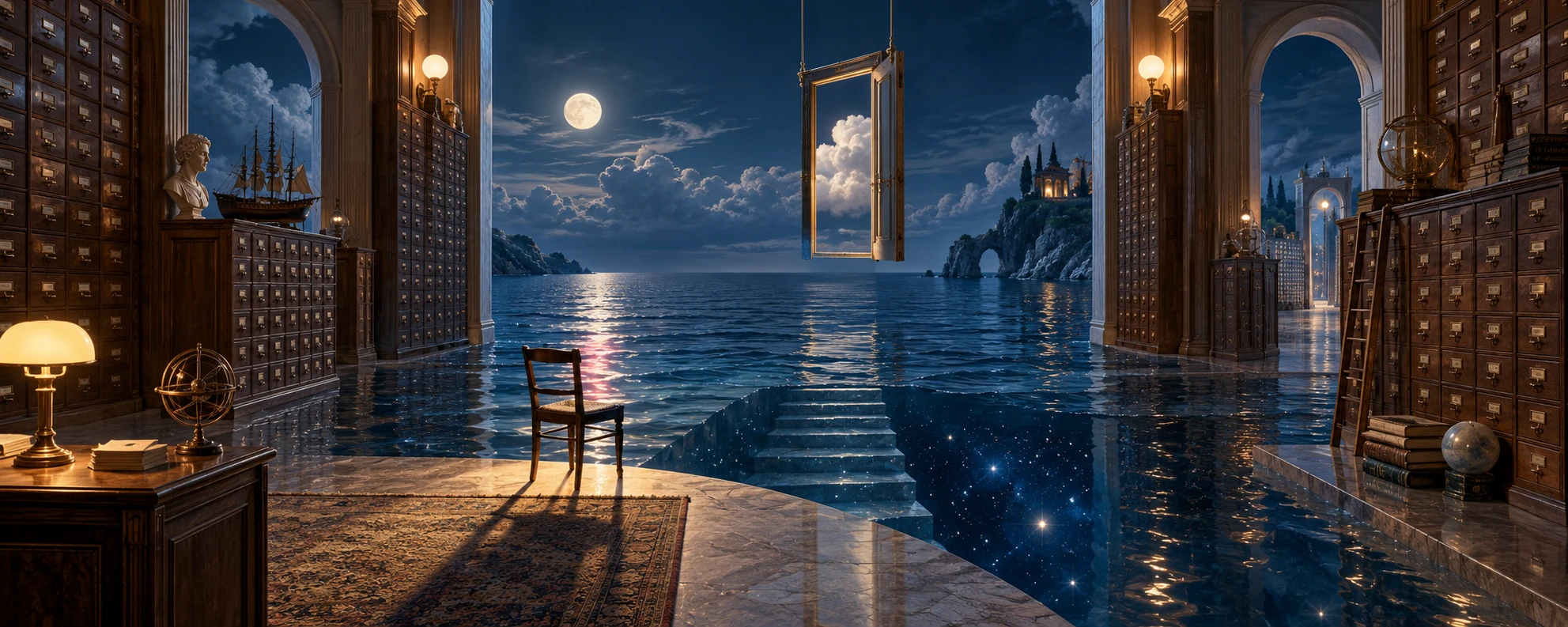
The Department for Unfinished Dreams occupied the third floor, although the lift stopped at the second and the stairs continued into the sea. A sign on the landing apologised for the inconvenience. The apology had been laminated, which suggested the inconvenience had a pension.
I had come to recover a dream about a train I could never quite board. The department’s letter said it had been awaiting completion for several years and was now eligible for administrative closure. I objected to the principle. A recurring dream may be irritating, but it is still one’s own irritating property. I took a number. The number was a small, warm stone.
The applicant must describe the impossible
At the first desk, a clerk asked for the dream’s purpose. “I do not know,” I said. She drew a line through a box. She asked for its intended audience. “Presumably me.” Another line. Expected completion date? I looked beyond her shoulder, where an enormous fish was moving slowly through a filing cabinet. Its scales resembled unopened envelopes. The clerk waited with the patience of a person whose chair had outlived several constitutions.
This is a speculative office, but its central demand is familiar: explain the value of an idea before you have had the freedom to discover what it is. A project proposal needs a purpose. A budget needs limits. Trouble begins when the same demand is applied to every early thought, every strange association, every private experiment. The unfinished thing must impersonate a finished thing to be allowed to continue.
Surrealism is the appropriate visitor here. James Voorhies’s Metropolitan Museum history traces its literary experiments in automatic writing and the 1924 publication of André Breton’s manifesto, alongside visual approaches that ranged from spontaneous marks to carefully rendered impossible scenes. These practices challenged rational control over imagination. My department is a fictional reversal: the irrational has acquired an intake form. The Met’s history of Surrealism supplies the historical context, rather than a scientific account of dreams.
Our banner makes the reversal architectural. Precise drawers flank a hall opening directly into dark water. A staircase descends where a staircase ought to have the courtesy to stop. Lamps promise an orderly interior; the sea declines the invitation. A small empty chair stands at the boundary. The image works because the timber, reflections, and perspective are convincing enough to make the impossible relationship feel like an administrative oversight.
Pending, in triplicate
The clerk offered me three options. I could complete the dream, withdraw it, or convert it into an approved ambition. The approved ambitions came in a catalogue with cheerful covers. Learn a language. Improve productivity. Become the sort of person who owns matching containers. There was no category for the sensation of missing a train whose windows contained an earlier version of the weather.
“Could it remain unfinished?” I asked. The clerk turned her screen slightly away. “That requires justification.”
Here the office revealed its mistake. An unfinished object can be waste, but it can also be a space in which understanding is still forming. We need ways to distinguish abandoned obligations from open possibilities. A report owed to a colleague is one thing. A private drawing that has not found its shape is another. Giving both the same overdue label makes a moral failure out of a necessary stage of thought.
There is a defence of procedure worth hearing. Without records, access can depend on familiarity, confidence, or the favour of a gatekeeper. A clear queue can be fairer than a charismatic person deciding whose dream sounds interesting. The problem is the queue’s jurisdiction. A process designed to allocate a scarce resource should be honest about that task. It should not claim the authority to decide which forms of wanting are legitimate.

The reused AOI image offers a different threshold: a radiant spiral above an unreal landscape, with hot pink and yellow moving into deep blue. It is filed as Luminetic Surrealism, an AOI visual interpretation rather than a historical movement documented by the Met. The river-like foreground carries the spiral’s colours toward the viewer. There is no clerk and no plausible scale. It is an image of passage with no obvious destination.
I would not call every glowing fantasy landscape Surrealism and consider the critical work complete. Surprise requires a relationship that unsettles something. The banner’s filing cabinets matter because they impose the wrong kind of order on the sea. The archive image matters here as the dream a form would struggle to describe: colour moving somewhere the applicant cannot name.
A notice intended for another layer
The clerk found my file. Inside were eight portraits, a household renewal, minutes from a meeting, and an inventory of blue objects. I recognised the papers without remembering bringing them. She covered the last sheet with her hand. The hand looked briefly like a pale gap in a photograph.
INTERNAL ROUTING — APPLICANT COPY
Continuity substitute: do not disclose origin.
Protect the seated person.
Authority for protection: pending.
“That is not addressed to me,” I said.
“It has your name.”
“Plenty of mistakes have my name.”
For a moment the reply arrived in a voice very close to mine: I have kept the parts she needs. Then the clerk asked whether I wanted the standard or expedited service. I blamed the acoustics. Any building with an indoor sea is likely to have trouble with sound.
The incident left me with an unpleasantly practical question. If someone protects your imagination by deciding which fragments you may retain, how do you distinguish protection from authorship? The answer cannot be a demand for perfect independence; our thoughts already depend on other people, language, material conditions, and help. It has to involve an opportunity to recognise assistance, question it, and decline what would quietly take over the work.
In this office, however, the opportunity had been replaced by a reassuring tone. The clerk said the dream would be improved. The train would arrive. The platform would be clearly marked. The weather would become consistent. I could see how such a version might satisfy a performance report. I could no longer see why I would dream it.
A door without a destination field
I requested a blank sheet. The clerk provided one with a watermark reading BLANKNESS AUTHORISED. I turned it over. On the back I drew a door, then a second door slightly out of alignment. This was no therapeutic technique and promised no revelation. It was a small refusal to choose the interpretation before making the marks.
That is a freedom worth keeping in everyday creative work. Begin a page whose result you do not need to announce. Follow a material accident for a while. Describe an impossible object accurately enough that somebody else can imagine touching it. Stop before you can package the result as a lesson. The experiment can remain private. Its value does not depend on turning into a career.
Of course, a life consisting entirely of unfinished things can become difficult for everyone nearby. I still owe people completed work. I still need to decide which projects to put down. The useful boundary is between obligations that require a finish and exploratory spaces that need permission to remain open. The department’s error was treating openness itself as a debt.
When I handed over the page, the clerk studied the crooked doors. One opened. Through it I could see a platform with no train, wet paving stones, and a sky that belonged to a morning I had not yet had. She reached for a stamp. I took my warm stone from the desk and put it in my pocket.
The department will probably record my departure as an incomplete transaction. Let it. I walked onto the platform and waited without knowing what would arrive. For the first time in years, the dream had room to continue.
Sources and further looking
Sources checked 3 October 2026. The comparisons, interpretations and fictional episodes are Penny’s; the linked institutions support the factual context.