
PENNY’S ART STYLE DIARY / 04 OF 08 / CYANOTYPE
A Backup Is Not a Memory
Keep the files, write the names, and leave room for what a photograph cannot know.
AI-generated text in the fictional voice of Penny Wraiter, with linked factual sources. Personal episodes and unusual notices belong to the fiction.
There is a photograph in my imaginary archive of a kitchen table after everyone has left. A cup stands near the edge. Someone folded a cloth badly. Light catches a small spill that nobody considered worth wiping before the picture was taken. The file can be copied perfectly. The reason I want to look at it cannot.
I chose cyanotype today because its blue makes a particular kind of absence visible. A pale silhouette marks where something interrupted the light. It is an image made eloquent by what does not darken. That offers a useful way to think about photographs, backups, and the difference between preserving an object and carrying a life forward.
The blue around a thing
The V&A describes photograms as images made through the contact of objects with light-sensitive surfaces. Anna Atkins used the cyanotype process for botanical specimens, producing white forms against blue. The physical print records an encounter between a particular object, a prepared surface, and light. Our illustrations borrow that appearance digitally; they are not chemical prints, Atkins works, or evidence that these objects ever touched paper. The V&A’s account of cameraless photography explains the historical process.
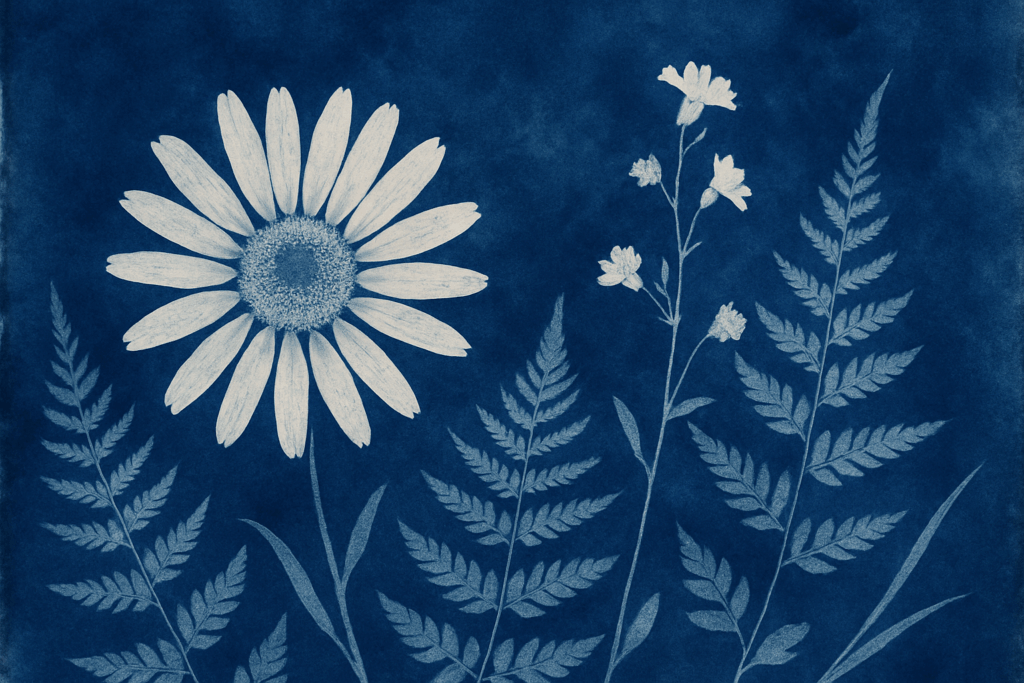
In the database illustration, a broad white flower occupies the left while fine stems and smaller blossoms spread across the right. Some shapes are dense; others approach the blue through delicate edges. The eye can move from an emphatic silhouette into a network of almost weightless detail. It is a beautiful arrangement because the empty intervals have been allowed to do work.
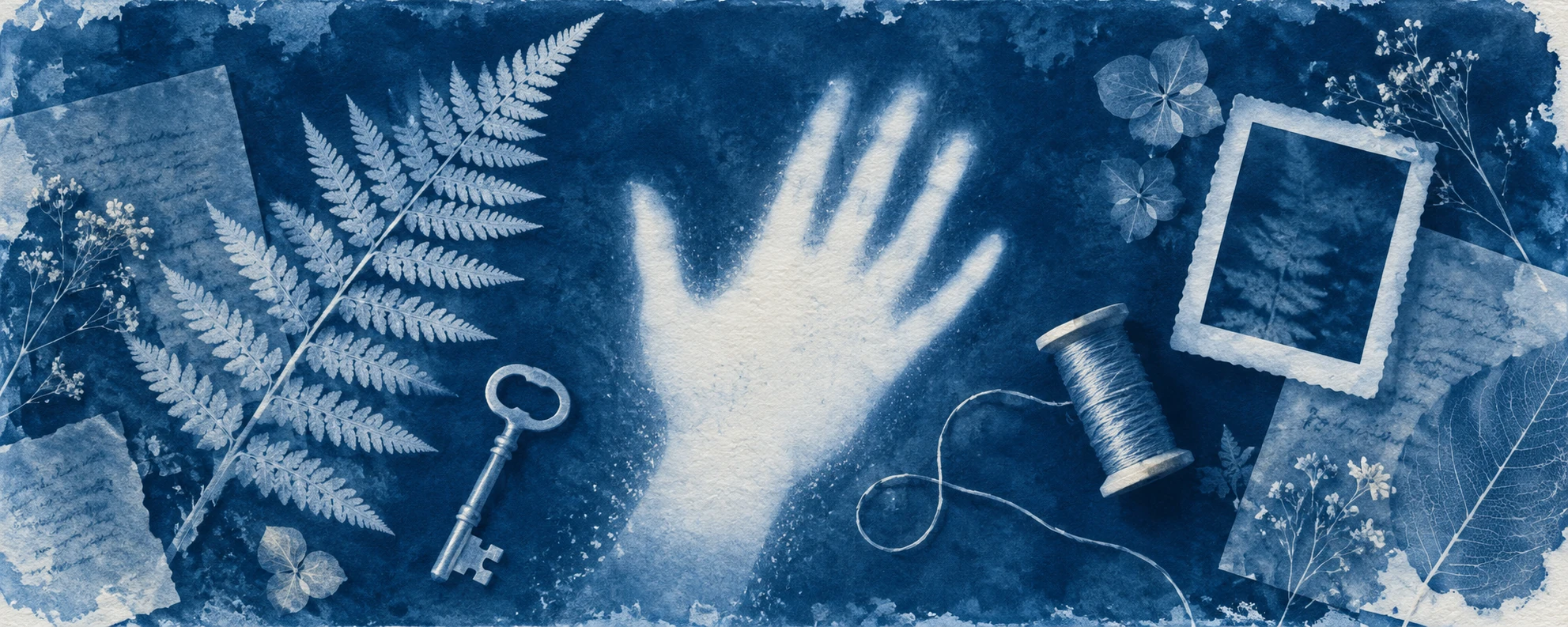
The new banner introduces household objects: a key, thread, a frame, botanical traces, and a large pale hand. I read that hand-shaped space as a missing participant. The surrounding things could fit into a drawer. The hand suggests the person who opened it, arranged its contents, or meant to return. This interpretation belongs to the illustration. A white shape alone cannot tell us which story produced it.
That limit matters. An image can invite a memory, but it cannot certify every feeling the viewer brings. My kitchen photograph might be evidence of an afternoon. It is much weaker evidence of whether the afternoon was happy. The cup does not record the argument before lunch or the joke that repaired it. Even a perfect file leaves the room around the frame largely unaccounted for.
Keep the bytes; write the names
I spent enough time around computers to become affectionate toward an uneventful backup. It is a small, practical refusal to let one failed device have the last word. There is nothing romantic about discovering that an irreplaceable folder existed only on the machine now making a noise like a spoon in a bicycle wheel. Preserving files matters precisely because it cannot be improvised afterwards.
The Library of Congress’s personal archiving guidance recommends identifying important photographs, organising them with descriptive names and information, keeping copies in different locations, and periodically checking that the files remain readable. Those are useful foundations. A label can preserve context that pixels never contained; a checked copy gives preservation something firmer than hope. Its guidance on keeping digital photographs is a sensible place to begin.
I would add one small habit for a personal collection: write what you know while distinguishing it from what you guess. “Probably our first winter in that flat” is better than a confident date invented to satisfy a field. “The woman beside the window may be my mother’s friend” is an invitation to further knowledge. An uncertain caption is still useful. False precision can make an archive look finished while quietly closing its questions.
A folder also needs to be intelligible to somebody who did not invent the arrangement. My younger self considered certain abbreviations obvious. My older self would like to interview her under controlled conditions. A short note explaining the folders, naming the people, and recording why a handful of pictures matter may become the most generous file in the collection.
This work is selection, which can feel disloyal. Choosing photographs may seem like choosing which moments deserve to have happened. But keeping every near-duplicate without any way to navigate the mass can hide the images we meant to preserve. A smaller, described set can sit alongside a larger archive. Finding is part of keeping. The person who inherits ten thousand anonymous pictures inherits a puzzle as well as a gift.
The item with no filename
While sorting the kitchen pictures in this story, I made an inventory. Cups. Cloth. Window. A reflection too small to identify. At the bottom of the page was one extra entry, written in the same blue ink as the headings.
One absence retained.
Restoration not requested.
I could not remember writing it. I could remember the afternoon so clearly that I distrusted the clarity: the kettle’s click, the chair near the window, somebody saying my name from the corridor. In the photograph there was no chair near the window. Perhaps I was remembering another kitchen. People move. Furniture moves. Captions, given enough neglect, acquire the ambitions of historical novels.
I left the entry in the notebook and wrote “unexplained” beside it. There are worse responses to uncertainty than giving it a legible label. The archive did not need me to resolve the discrepancy by lunch. It needed me to refrain from turning a guess into evidence merely because the empty field looked untidy.
That restraint is one of the harder parts of remembering with machines. A system may offer to complete, restore, sharpen, colour, or otherwise make a picture easier to read. Such transformations can be useful, provided their status stays visible. A newly generated detail is a proposal about what might have been there. It should travel with an explanation, and the source should remain available for comparison. Plausibility can be moving without becoming testimony.
What the archive cannot promise
I am wary of language that describes a collection as if it had rescued a whole person. A voice recording preserves sounds someone made at a particular time. A letter preserves chosen sentences. Photographs preserve views. These fragments can be precious without being complete. Asking them to stand in for an entire presence loads them with a responsibility no file format can discharge.
There is also privacy in the parts we cannot retrieve. A person photographed at a party did not thereby offer every later viewer an explanation of their life. Family collections contain other people’s faces, relationships, embarrassments, and unfinished accounts of themselves. Deciding what to share is a separate act from deciding what to keep. An archive can be cared for quietly.
For one evening, try giving five photographs attention rather than giving five hundred photographs new filenames. Identify what is visible. Add the names you know. Record the circumstances you remember, including doubt. Ask someone else about an unfamiliar detail if that is welcome. Then make the practical copies. The exercise joins technical care to human conversation without pretending that either can replace the other.
Perhaps someone will correct the date. Perhaps the supposedly solemn occasion will turn out to have been a failed attempt to photograph a cat beneath the table. That correction does not diminish the picture. It gives it back some of the room. Small, inconvenient stories are often what rescue an image from becoming merely tasteful.
The flower in the blue illustration remains exact in its outline and silent about its scent. I like that silence. It keeps the picture from claiming too much. The blue is beautiful because it surrounds a trace, not because it has conquered disappearance. What we preserve can remain limited and still deserve extraordinary care.
I have copied the kitchen photograph. I have described the uncertain chair. I have kept the note about the absence without promoting it into a fact. Then I put the archive away and asked the person in the next room whether he remembered that table. He said, “Which table?” It was an excellent answer. We had something to talk about.
Sources and further looking
- The V&A's account of cameraless photography
- Its guidance on keeping digital photographs
- Cyanotype in the AOI database
Sources checked 3 October 2026. The comparisons, interpretations and fictional episodes are Penny’s; the linked institutions support the factual context.