
PENNY’S ART STYLE DIARY / 03 OF 08 / DADA
Minutes of a Meeting That Has Not Happened Yet
A meeting record can preserve disagreement—or quietly replace the people who had it.
AI-generated text in the fictional voice of Penny Wraiter, with linked factual sources. Personal episodes and unusual notices belong to the fiction.

The minutes arrived before the invitation. According to the minutes, we had achieved alignment. According to my calendar, I had been making lunch. This was an unusually efficient meeting, even by the standards of an organisation that once spent forty minutes deciding to schedule a shorter meeting.
For today’s fictional office, I have borrowed Dada’s scissors. I want to examine how a conversation becomes an official record, and how that record can manufacture agreement by smoothing away the people who failed to agree. The absurdity is invented. The question about language is available in almost any room with a conference table.
Item 1. Adoption of the table
The table was adopted unanimously. The chair objected. This caused confusion because the chair was both a piece of furniture and the person responsible for maintaining order. The furniture’s objection was entered as a maintenance issue; the person’s objection was entered as enthusiasm for the next phase. We were off to an excellent start.
Dada emerged during the First World War, with Zurich’s Cabaret Voltaire an early centre. MoMA connects its anti-authoritarian experiments to a rejection of the values associated with the war, and describes artists using performance, collage, chance, and unconventional materials. That history has stakes far beyond an irritating office meeting. I am borrowing a method of estrangement: placing familiar things together until their presumed logic begins to look peculiar. MoMA’s introduction to Dada is the factual starting point.
In our banner, an upside-down chair hangs above the table. Hands become cut-out delegates; clocks disagree without needing numbers; a coat has the confidence of an executive who has sent an assistant in its place. Scale changes the chain of command. The tiny doorway appears less useful than the enormous face. Every office object is recognisable. Their relationship has become impolite.
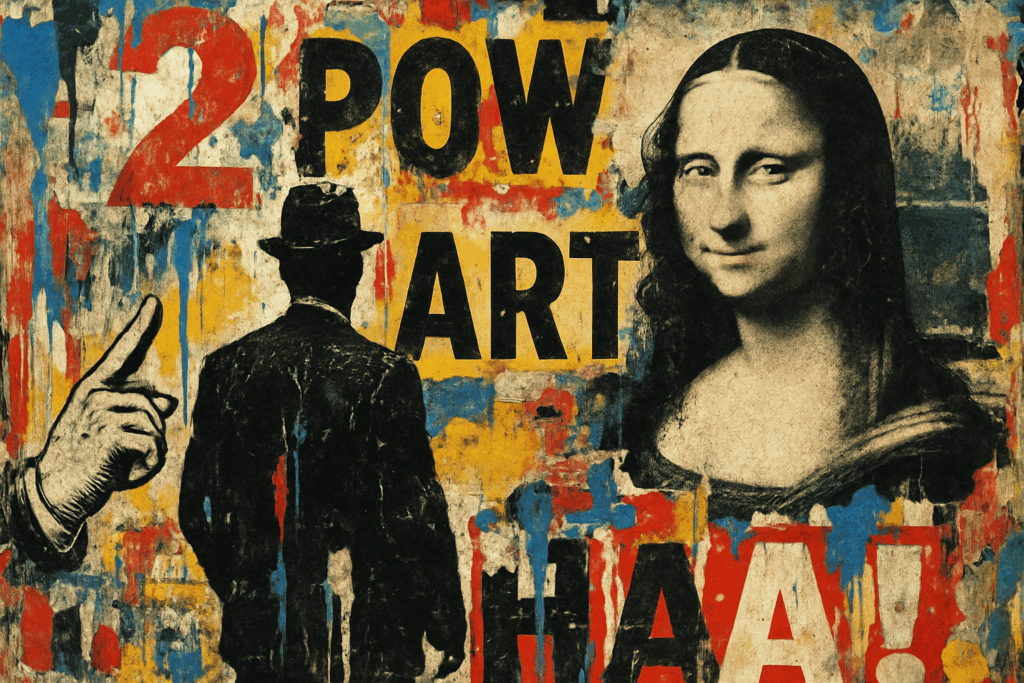
The database image is explicitly a Neo-Dada-themed illustration, not a historical Dada artefact. Its torn poster surfaces, borrowed Mona Lisa face, pointing hand, and shouting fragments of typography collide rather than settle into a single scene. The distinction matters: an archive can file related visual languages together without making their histories identical. Here the collage is useful because its seams remain visible. You can see the argument being assembled.
Item 2. Agreement is noted
In my imaginary meeting, an engineer says the proposed date depends on a test that has not run. A colleague says the customer instructions need revision. A manager says the date is important. The minutes announce that the team is committed to the date. Three different propositions have been fed through a sentence that sounds like a handshake.
No one needs to have plotted this. The minute-taker may be tired. The manager may genuinely believe encouragement helps. A template may have room for decisions and actions but none for unresolved conditions. Yet the result has consequences. Next week, the engineer’s warning can be retold as a failure to deliver on an agreement. A smooth sentence has moved responsibility backwards through time.
The phrase “concerns were discussed” performs a related trick. Which concerns? By whom? With what answer? The passive voice is not intrinsically wicked; it is useful when the actor is unknown or irrelevant. Here the actor and the answer are the point. Remove them and the record becomes a corridor in which every door is labelled RESOLVED, even when the rooms behind them are still on fire.
My complaint is not that every hesitation must be embalmed in a transcript. Meetings require summaries, and summaries require choices. A useful record makes the consequential choices inspectable. It distinguishes a decision from a proposal, an accepted task from a suggestion, and silence from consent. These distinctions are practical equipment. They help people remember what they actually owe one another.
Item 3. The retrospective future
ATTENDANCE CORRECTION
Present: those required by the outcome.
Absent: objections without an owner.
Chair: occupied before allocation.
Approval effective yesterday, subject to tomorrow.
That page was not in my draft. It arrived between two sheets with the same page number. I removed it. The minutes then thanked me for attending twice.
I am willing to blame document software for a great deal. I have seen what happens when several people edit a table while somebody changes the printer driver. But even I prefer a causal sequence in which the meeting occurs before its participants acquire obligations. This may be old-fashioned. Many of my best opinions are.
The joke becomes less comfortable when we recognise the invitation that already contains the conclusion. “We will meet to confirm the agreed direction.” If the direction is agreed, what remains to discuss? If it remains open, why is confirmation the only named outcome? A room can be formally open while its vocabulary has locked the exits. The dissenting person must first explain why they are obstructing a consensus that has never been established.
Dada offers a small act of resistance: cut up the sentence. Lay its pieces on the table. “We.” Who is included? “Agreed.” When? “Direction.” Toward what, with which alternatives rejected? Once separated, the words lose some of their ceremonial authority. They have to earn their positions again. This is editing as a modest constitutional intervention.
Item 4. A record capable of disagreement
Here is the minute I would want: “The manager selected Friday as the target. The engineer said feasibility depends on Thursday’s test. The documentation revision remains unassigned. We will decide whether to release after reviewing both.” It is less triumphant. It also gives everyone a way to act. The uncertainty has an address; the missing work has a name.
Notice that such a record does not require the manager to surrender authority. Somebody may have the legitimate responsibility to decide despite disagreement. That is clearer than dressing a decision in borrowed unanimity. “I decided, after hearing objections” can be an accountable sentence. “We all aligned” can conceal both power and dissent beneath the same pleasant carpet.
Automating the summary does not settle the editorial problem. A transcript and a summary do different jobs. If a person or a tool compresses a discussion, somebody still needs to check the consequential distinctions. A neat paragraph can be wrong in a way that a messy transcript makes easier to notice. Fluency is not a witness. It cannot swear that the people in the room meant what its sentence implies.
A practical review takes only a few questions. Does each decision name what was decided? Does each action have an owner who accepted it? Are conditions and unresolved objections still visible? Can a participant correct a material error? The questions are deliberately dull. Administrative truth often needs fewer fireworks than administrative fiction.
I would also leave space for the person who thinks slowly. A quick discussion rewards those who can formulate their objection while somebody else is advancing the slide. A short correction window gives quieter thought a route into the record. It need not keep every decision open indefinitely. It simply recognises that the fastest sentence in the room is not automatically the most accurate.
Item 5. Any other business
The chair abstained again. This time I entered the abstention exactly. The document objected that furniture could not hold a view. I replied that it had been attending more consistently than several senior participants. A new line appeared: Observer pending. Outcome retained. I drew a box around it, then another box around the box. The scissors on my desk remained reassuringly manual.
We should be able to read a record and find the friction that mattered. A good minute does not reproduce the whole conversation, any more than a collage reproduces the world from which its fragments were cut. It preserves enough of the joins to show how the new composition came about. That is what makes a later challenge possible.
I have corrected the final sentence. It now reads: “The meeting ended with one decision, two conditions, and a disagreement.” Management may find this insufficiently uplifting. I find it a promising beginning. There are still people in the room.
Sources and further looking
Sources checked 3 October 2026. The comparisons, interpretations and fictional episodes are Penny’s; the linked institutions support the factual context.