
Economic and Social Systems Through AI Art
Two glass oranges sit on a counter. One gets a gold backing, a pink halo and most of the light. The other gets a plain package. Before you have even seen a price, you know which one the shop would like you to want.
That still life was our way into a surprisingly difficult subject. How do you make a picture of an economic order? A factory will look much the same whether its owners are shareholders, a municipality or the people working inside it. The difference may lie in who has the key, who gets the proceeds, or who can say yes when the roof starts to leak. Those are relationships. An illustrator has to find a moment when one becomes visible.
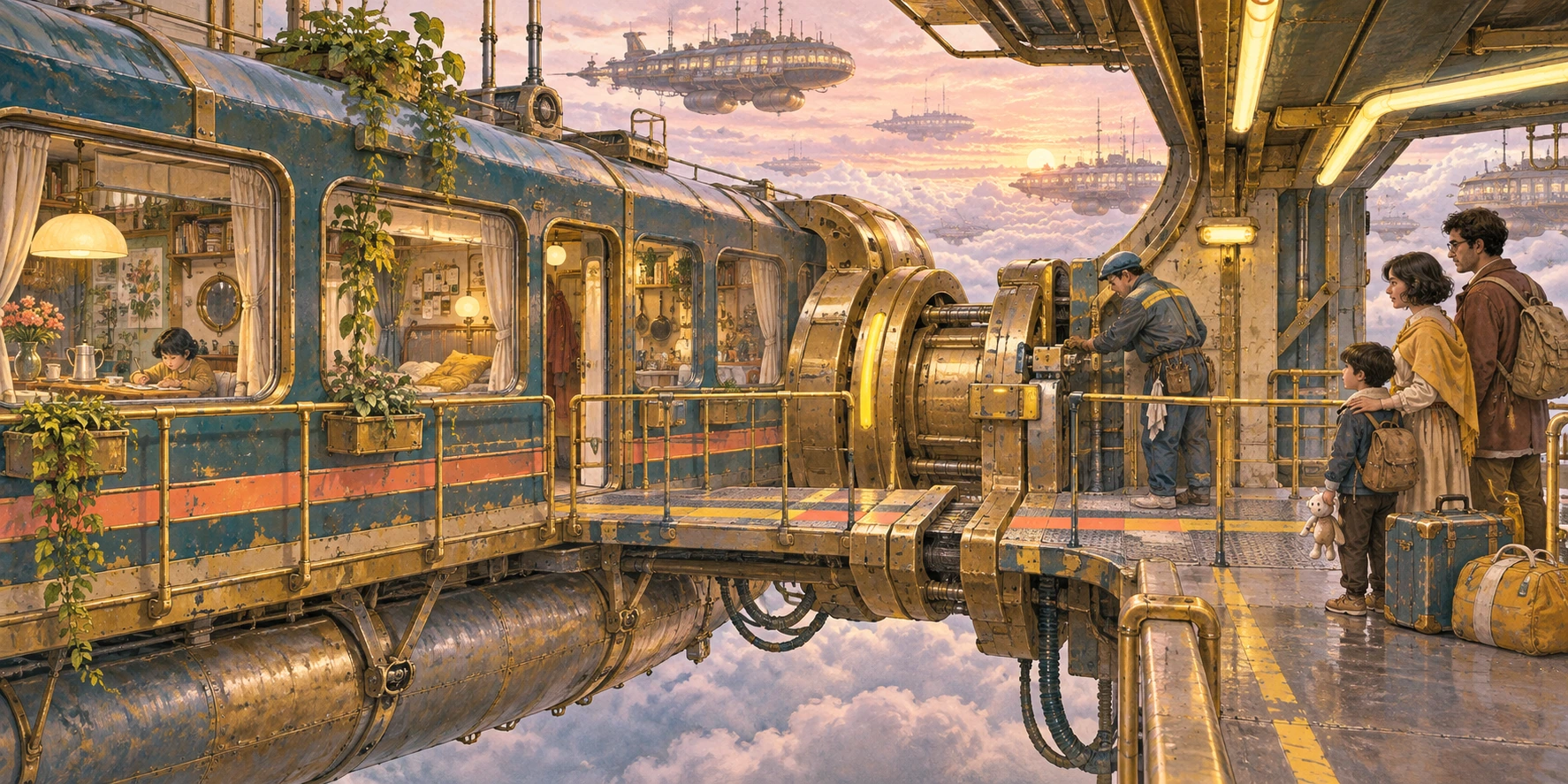
This illustrated guide explores twelve original Art of AI catalog entries about Wirtschafts- und Gesellschaftsordnungen, a German phrase for economic and social orders. Six studies consider ownership, cooperation, sovereignty and administration. Three imagine companies that govern through tenancy, expertise or ritual. For each of those companies we also made a Future version, keeping a familiar object while changing what the institution can do with it. You can start with any picture. Each caption leads to the full guide, prompts and gallery.
How to read a political idea in an AI image
Start with the verb. In the orange picture somebody displays a good. In another scene two people pass a spare part. Elsewhere a clerk stamps a sheet. A verb gives a drawing scale, a cast and a point in time. It also gives you a way to disagree with it. A stamp can protect a claim as readily as it can delay one. Look for the applicant on the other side of the desk.
The catalog keeps the generation requests with the finished pictures. The prompt for the oranges specified glass fruit in unequal packaging, sharply different scales and narrow bands of light. What I see is that even the reflection under the large package is bigger and warmer. The first is a recorded instruction. The second is my reading of what appeared on the page.
Across the series the editors changed subjects, materials, viewpoints and colours. Those choices give us plenty to compare. A finished picture alone tells us very little about the model’s internal reasoning.
- Who owns the equipment? Capitalism and socialism offer different answers about who controls farms, workshops and factories.
- Who can give the order? Monarchy and stratocracy locate governing authority in different hands.
- Who carries it out? Bureaucracy helps explain how a decision travels from an office to the person at the counter.
One country can have a monarch, private firms, public hospitals and a professional civil service at the same time. Each picture picks out one of those relationships and gives you somewhere to look for it.
Who owns the equipment, and who gets the best light?
Capitalism and the price of attention
Capitalism is an economic system in which productive assets are mainly privately owned, businesses invest for profit, and markets guide much of what gets made and sold.

Here the competition happens on a patch of counter no larger than a placemat. The tall package gets a fluted metallic backing. Its rival barely interrupts the dark. By asking for reflective glass and foil, the prompt gives the shop a way to make one object more desirable without improving the fruit.
Try covering the packages with your fingers. Notice how much of your preference disappears with them.
Socialism and the work of keeping things running
Socialism is a family of economic ideas and arrangements in which society, communities or workers collectively own or control the resources used to produce goods and services.
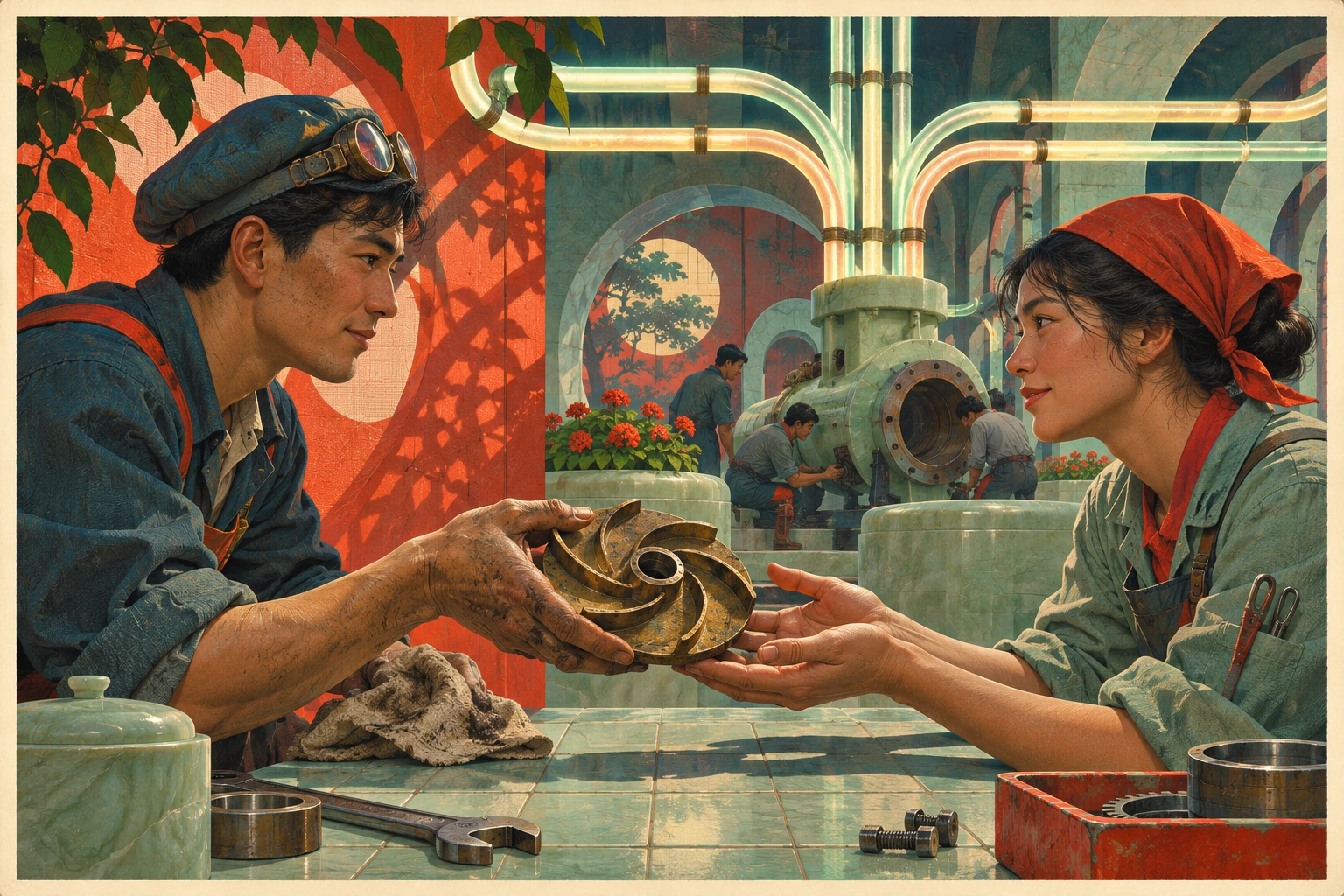
One person knows which part has failed. Another has a hand free to take it. The prompt specified a lateral view and paired hands. That choice puts the worn blades of the impeller exactly where a ceremonial handshake might otherwise go.
The image makes maintenance attractive. Who sets the repair budget and whose request gets postponed are harder questions that lie just outside the picture.
The pair makes a good drawing exercise. Place the impeller in the orange’s display case. It immediately looks collectible. Put a glass orange in the repairer’s palm and the first thing you worry about is breakage. The object’s material has stayed the same. The people around it have changed its meaning.
Where does authority enter the picture?
Anarchy and the work of agreement
Anarchy is the absence of a central ruling authority. This guide draws on an anarchist tradition in which neighbours organise shared work through voluntary agreements.

Both people bend toward a connection that neither can finish alone. The eye follows the cable between them and out into a space with several sources of light. Woven lines, loosely registered colour and a diagonal close-up were all in the brief.
What I enjoy is how much concentration the two faces show. A horizontal way of organising work can still demand skill, patience and an uncomfortable conversation over whose cable fits.
Monarchy and an absent body
Monarchy is a form of government with a monarch as head of state. The office usually passes by inheritance. Its powers depend on the country’s institutions.

Here the sitter is absent. A jeweller leans toward a piece of regalia that will be seen in public long after the jeweller has gone home. Amber light, velvet and the unusually large lens let us inspect the work that makes succession look effortless.
The person with the greatest practical authority in this room is the one who can mend the circlet.
Bureaucratism and the journey of a form
Bureaucracy organises work through defined offices, rules and records. Bureaucratism is a critical term for letting those procedures take precedence over the purpose they serve.

An office can keep promises, record entitlements and let one official check another’s work. Here the stack of paper gives the stamp something solid to do. Apricot light catches the partitions beyond it. You can almost measure how far the page has to travel.
Where is the applicant’s copy? That is the sheet they will need if the office later asks them to prove they filed.
Stratocracy and a baker’s clock
Stratocracy is government by the armed forces. Military office carries the power to govern civilians as well as command troops.
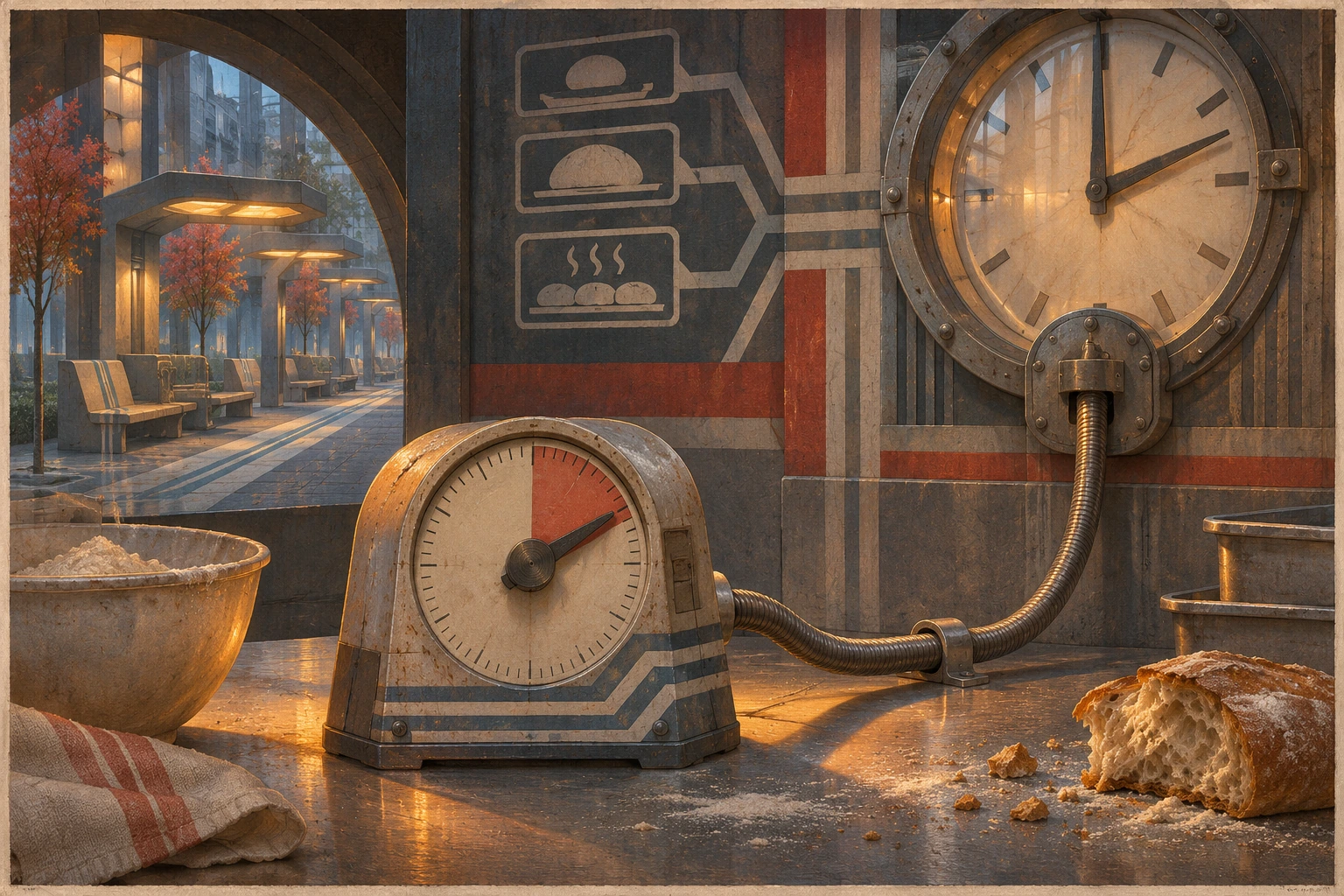
A uniform in a portrait would tell us very little about the reach of military power. This prompt asks what happens in a civilian kitchen when a central timetable gets a say. Follow the metal line between the clock and the little timer.
Now look at the flour and the irregular surface of the loaf. Yeast responds to temperature and time in its own way. The tension between the clock and the dough does more work than a parade could do here.
Three corporate orders, each with a Future counterpart
Imagine a company that can do more than sell you something. It might own the place where you live, control the instrument that decides whether your ferry sails, or set the ceremony that makes a repair official. Each pair below begins with one of those powers. In the new Neon Retro Future Corporate guides, retro materials still look familiar, but authority can now travel, act in advance, or arrive from far away.
Corporate feudalism · what happens to the key when the house can move?
Feudalism is a historical term for arrangements linking rights in land to personal obligations of loyalty or service. In AOI’s corporate feudalism, one employer controls the job, the home and the place where the home can dock.

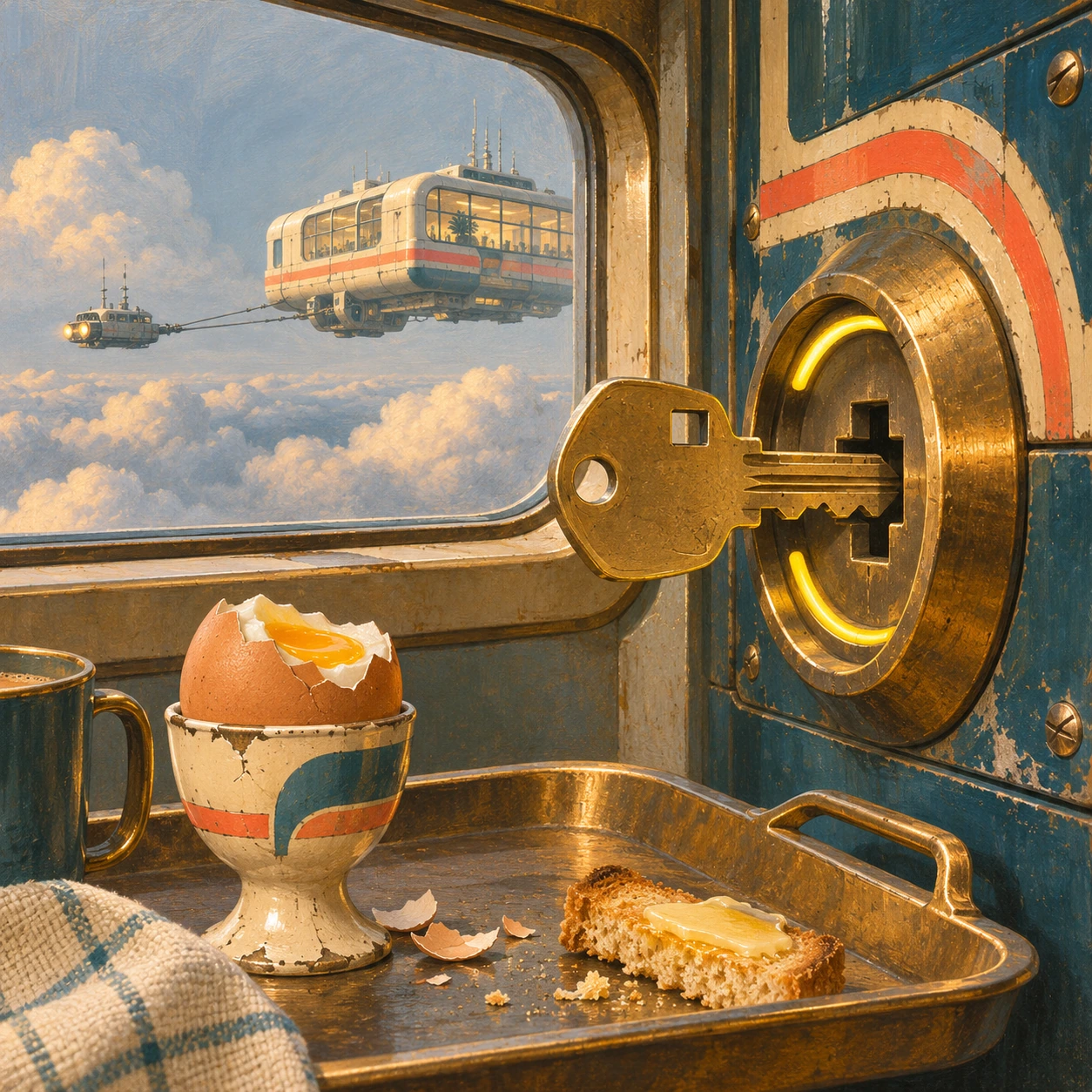
In the original, squint and the key resembles another company badge. That visual rhyme was in the brief. Work and home have become claims one organisation can make on the same person.
The Future study keeps the brass and the key but makes the socket enormous. At first the floating home feels like a promise of freedom. Then you notice that somebody else owns the place it plugs in. The broken shell in the eggcup gives the picture its scale. Breakfast has taken minutes. Moving the household will rearrange a life.
“Feudalism” here is a speculative analogy for entangled obligations. Historical feudal relationships varied by place and period. A closer industrial comparison is Pullman, where housing and company employment were bound up with one another. The fictional dock lets readers ask a precise question of either world. What can a household take with it when the employer and the landlord are the same party?
Corporate technocracy · who gets to act on tomorrow’s tide?
Technocracy gives technical experts governing authority on the strength of their specialised knowledge. In AOI’s corporate technocracy, the company that forecasts the tide also decides when passengers may board.


The earlier guide places an instrument beside the physical material that gives its reading meaning. Its little specimen views invite a second look at a crystal before accepting the needle’s authority.
In the Future brief we asked for an actual pointer and a luminous one that anticipates another position. In the finished image their tips fall to opposite sides. You can read the disagreement from the back of the room. Nothing in that dial tells you which result a ferry passenger should be allowed to contest.
Forecasts are valuable. NOAA’s distinction between an astronomical tide prediction and the water level actually observed gives the art a sound starting point. Weather can move the observed level away from the prediction. The invented company makes a political choice when it decides which reading opens the gate and who can override it. A painting can show that choice by putting a waiting passenger at ramp height.
Corporate theocracy · when does a repair count?
Theocracy is government exercised in the name of divine authority. AOI’s corporate theocracy imagines a firm that gives its own service rites sacred authority, even over something as ordinary as declaring a radio fixed.
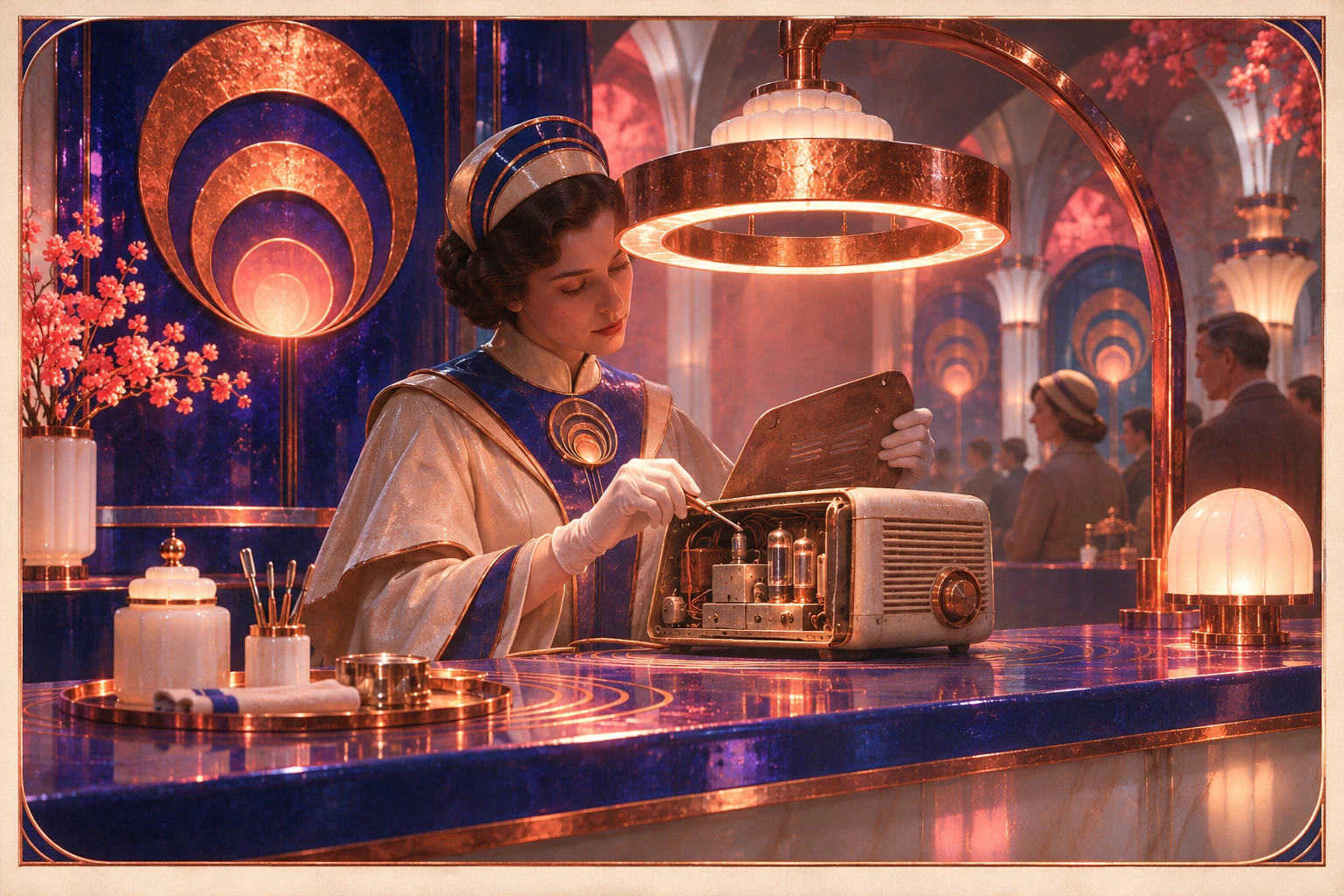

The earlier brief gives an ordinary repair the care and choreography of a ritual. The lamp blesses the bench, if you like, although it also helps somebody see a loose contact.
In the Future entry, the radio works while the lamp stays dark. The firm waits for official acknowledgment from an orbital relay. I needed the series brief and the wider station view to tell me what the lamp was waiting for. Knowing when you needed the caption is part of reading these pictures well.
I let the radio in my notebook have a voice. I can just make it out if I put my ear to the paper.
…enny? Wrap your sleeve round the handle. The seam still catches your thumb. my thumb.
I hear the first part in my partner’s voice and the last two words in mine. I pass a fingernail over the little white crescent on my thumb. Still there.
Who gets the water in a dry week? A proposal for the next essay
The twelve studies are good at showing where a decision lands. The family stands at the dock. The passenger waits at the gate. What we seldom see is who got a vote when the rules were written, or who spends the afternoon caring for someone who cannot get to the gate. I’d like to take those questions to one neighbourhood water tap in a follow-up essay.
- A mixed economy. The town owns the pump. A private firm repairs it under contract. A resident arrives carrying an empty can. Put the engineer’s service sheet beside the town’s repair order. The two signatures would tell us who pays for the work and who has promised water to the street.
- A commons. Upstream, two growers share an irrigation channel. Put their agreed turns on a chalkboard beside the sluice, then let a leak upset the schedule. Leave room in the frame for the grower at the far end to come back and ask for a change. That would extend the impeller picture from sharing a tool to governing its use.
- Democratic decision-making. Give residents a choice between a second standpipe and longer opening hours. A meeting after the last bus leaves some chairs empty. Follow one resident’s proposal from the handwritten map to the vote and then to the work order. Readers could see whose suggestion actually changed the service.
- The care economy. Follow a paid home-care worker and a neighbour carrying water up the same stairs. The cans weigh the same. One journey appears on a timesheet. The other may leave no record at all. A drawing of the tap alone misses both trips.
For that companion article I’d make four pairs of pictures. The first panel would always show the same tap, from the same spot, at the moment the water runs low. Its partner would take us to the repair desk, the sluice, the meeting or the stairwell. I’d print the prompts underneath. Then I’d ask readers to cover the captions and find the person who can change the outcome. If the answer disappears with the caption, that is a finding worth printing too.
The handle comes back to me when I sketch the stairs. One winter the pipe to the top floor froze. Our kitchen tap still ran, so I carried an enamel jug up to my neighbour. I always changed hands on the last step so she’d think the thing weighed nothing. On the third morning she left a folded tea towel over the banister. She’d seen the mark.
The blue slip credits the whole job with eleven seconds at the tap. In smaller type, Carrier pending. I turn it over. There’s just enough room on the back to draw the stairs.
Frequently asked questions about economic and social systems
Ownership and exchange
What is capitalism?
In capitalism, private individuals and firms own much of the land, machinery and businesses used to produce goods. They invest in the expectation of a return, and prices help coordinate buyers and sellers. The glass oranges let us see how a seller decides what to spend winning someone’s attention. See the two packages.
Where does communism fit in?
In the Marxist tradition, communism envisages a classless society in which the means of production are held in common. Historical states governed by communist parties had their own institutions and histories. For a separate visual interpretation, the catalog imagines collective life through weathered public spaces and illuminated transit lines. Explore Neon-Retro Futurist Communism.
Political authority and administration
What is anarchy, and how could people organise work under it?
Anarchy describes a condition without a central ruler. Anarchism is a family of political traditions that questions coercive hierarchy. In the tradition illustrated here, neighbours make agreements directly, and someone with a technical skill can offer to coordinate a job. The two people at the cable joint still have to agree on a fitting and find someone willing to maintain it. See the worktable.
What is a monarchy?
A monarchy places a single person in the office of head of state, often for life and usually by inheritance. A constitution may give elected institutions most governing powers, or the monarch may exercise extensive power personally. The circlet tells us that an office survives its holder. Discovering who writes the laws would require another image. See the jeweller’s lens.
How does bureaucracy turn into bureaucratism?
A bureaucracy assigns duties to offices and uses rules, records and trained staff to carry them out. It can make a benefit payable even after the official who approved it has left. Bureaucratism describes the excess. Imagine the office refusing a valid claim because its own clerk filed the duplicate in the wrong tray. A single sheet of paper can protect the applicant or keep them waiting another week. See the date stamp.
What is a stratocracy?
In a stratocracy, the armed forces themselves hold governing power. A civilian government can have a large army and coordinate public timetables too. To recognise the difference, ask who can overrule a commander’s order. The connected clocks are the artist’s way into that question. See the baker’s clock.
The historical terms behind the corporate pairs
What is feudalism, and why does this series apply the word to a company?
Historians use feudalism in several senses. One influential usage describes relations in medieval Europe in which a lord granted rights in land in return for a vassal’s loyalty and services. Arrangements varied across places and centuries. AOI borrows the idea of linked obligations. Its fictional worker has to ask what happens to the family home if the job ends. Compare the badge key and the docking key.
What gives experts power in a technocracy?
Technocracy gives specialists authority to make public decisions on the strength of technical knowledge. The decisive step comes when the person who estimates the tide also has the final say over boarding. In the corporate Future study, the operator gets to choose which forecast counts before the waiting passenger can observe the water. Compare the two harbour instruments.
What is theocracy, and what is invented in the radio scene?
A theocracy grounds political authority in divine rule. Religious law or authorities who claim to interpret divine will can shape public decisions. AOI invents a company with its own rituals of approval. The customer can already hear the radio, yet the attendant must wait for an official signal before releasing it. The borrowed idea is the source of authority. The ritual belongs to this fictional company. Compare the radio inspections.
Ideas for the follow-up
What is a mixed economy?
A mixed economy combines substantial private enterprise and market exchange with public provision, regulation or ownership. A town can own a water network while purchasing repairs from a private contractor. A household waiting at the tap has good reason to ask which party has the duty to restore service.
What is a commons?
A commons is a resource shared by a community under arrangements for using and caring for it. Irrigators can set turns, check the sluice, settle disputes and revise the rules when supplies fall. The useful thing to put in the picture is the agreement, including the person who has standing to challenge it.
What does democracy add to the water example?
Democracy gives the people political authority, exercised directly or through chosen representatives. In the proposed study, residents can put an option on the agenda, hear competing claims and hold decision-makers to account. Whether a night-shift worker can attend the meeting matters as much to the picture as the ballot box.
What belongs to the care economy?
The care economy includes paid and unpaid work that sustains people in daily life, from feeding a child to helping an older neighbour bathe. It runs through households, public services, businesses and community groups. In a dry week, the time someone spends carrying water to another person becomes part of the cost of keeping that person well. See the proposed water studies.
About the article and its images
What is this article about?
It is an illustrated guide to how AI-generated art can represent economic and social orders. It connects six Futurist styles with three pairs of corporate styles and explains a specific image from each. Open any guide to see the rest of its gallery and try the prompts.
What does “Wirtschafts- und Gesellschaftsordnungen” mean in English?
“Economic and social orders” is a close translation. An economic order sets the arrangements for owning resources, organising production and distributing goods. A social order also includes the institutions, rights and obligations that shape how people live together. The family at the dock experiences both when a labour contract determines where it can live.
Why do the images mix old-fashioned objects with futuristic settings?
A brass key, an analogue needle or a radio tuning wheel gives a hand something recognisable to do. An invented docking system, a forecast overlay or a distant relay changes what that gesture accomplishes. The familiar object makes the speculative change easier to see.
Does adding “Future” to a prompt produce these differences?
We changed several instructions for each new commission. The documented differences include setting, lighting, material and action. To test the effect of one word, hold the rest of the prompt and the generator settings constant, use matched seeds where supported, and compare several outputs for each version.
Are the Neon Retro styles historical art movements?
These named styles are original AOI proposals for making images. The social ideas and some of the historical comparisons have independent histories. Each style guide identifies the proposal, its visual rules, its sources and the limits of the analogy.
Can I use this to design a scene of my own?
Pick an everyday object that changes hands. Draw the person who controls it, then draw the same moment from the position of someone who needs it. Keep one material or colour constant so a reader can follow the relationship across the two images. The linked guides offer more specific prompt variations.
References and further reading
- The IMF’s Finance & Development primer discusses private ownership, markets and the mixed economies found in practice. What Is Capitalism?
- The Stanford Encyclopedia of Philosophy explores forms of social ownership and traditions of voluntary association. Socialism and Anarchism
- OpenStax describes how administrative offices put political decisions into practice. What Are the Purpose and Function of Bureaucracies?
- Elinor Ostrom’s Nobel lecture draws on irrigation and other shared resources to explain how users can govern them. Beyond Markets and States (PDF)
- The International Labour Organization explains how paid and unpaid care work fit into the economy. Care economy
- UK Parliament describes the Crown’s constitutional role, a useful comparison for the circlet study. Parliament and Crown
- The National Park Service records the company town’s housing and industrial organisation. Pullman foundation document (PDF)
- NOAA explains why observed water levels can differ from predictions. Tides and Currents FAQ
Find other approaches to worldbuilding in the Style Atlas or browse the full Art Style Database.