PENNY’S ART STYLE DIARY / 07 OF 08 / RETROFUTURISM
They Promised Us the Moon. We Got Another Login.
Keep the magnificent horizon. Then take the small obstacles seriously enough to repair the gate.
AI-generated text in the fictional voice of Penny Wraiter, with linked factual sources. Personal episodes and unusual notices belong to the fiction.
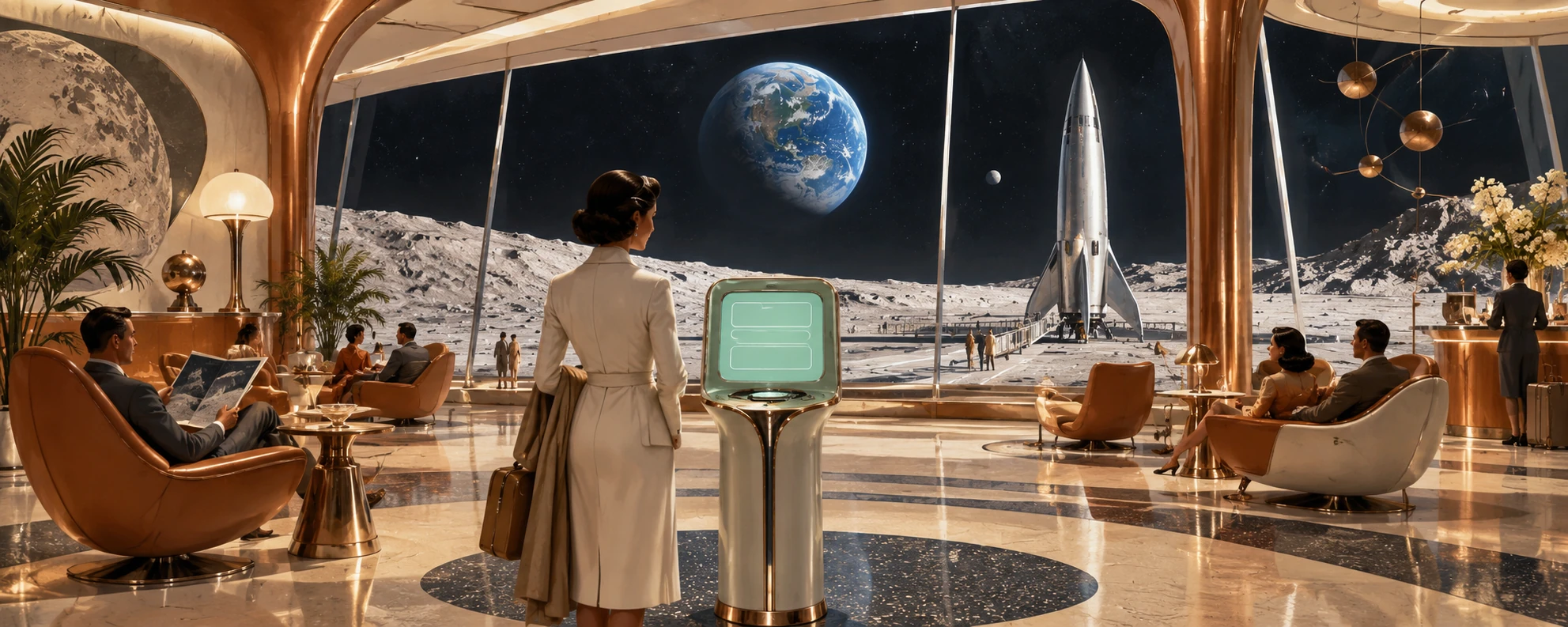
I would forgive a great deal of inconvenience for a window looking out on the Moon. Uncomfortable seats. Terrible coffee. A departure announcement delivered by a man who thinks enthusiasm is a substitute for consonants. I would even forgive a login, provided the login understood that it was standing between a human being and the Moon.
In my imaginary lunar departure lounge, it does not. The terminal wants me to confirm an email address. Beyond the glass, a silver spacecraft waits in a landscape that has never known rain. Above it hangs the blue world where every person I have ever argued with is currently keeping warm. The terminal says my session has expired. Its sense of proportion requires work.
A future with a view
Retrofuturism lets us examine the future through the designs of an earlier imagination. In this essay I use the term for a deliberate visual vocabulary of streamlined rooms, monumental horizons, elegant machines, and confidence made out of curves. It is a way of looking backward at expectations, not a claim that people in the past shared one forecast. Yesterday contained sceptics, conflicting visions, and plenty of people too busy working to admire the promotional painting.
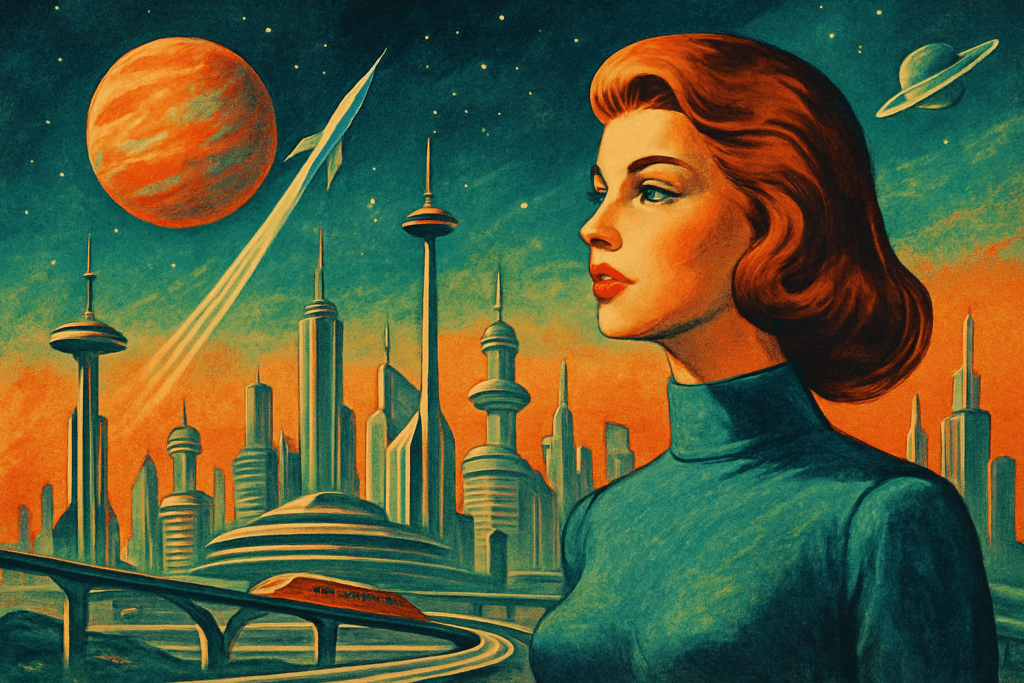
The database illustration presents a red-haired woman against a city of slender towers and sweeping transport routes. A rocket climbs diagonally through a sky crowded with fanciful planets. Orange and teal make the scene feel printed as much as painted. The woman’s face is composed and purposeful; the buildings seem to have agreed on a destination. This is a stylised future, not a technically plausible map of the solar system.
The banner brings that promise indoors. Copper-coloured curves frame the lunar view. The lounge has space to breathe; chairs look as if someone considered sitting a dignified activity. In the middle stands the little terminal, luminous and obstructive. Its importance comes from placement rather than scale. Everything beyond it says departure. Everything immediately before it says account recovery.
I enjoy the image because the irritation cannot entirely defeat the wonder. The spacecraft remains beautiful. The Earth remains improbable and dear. A person might grumble at the terminal and still feel tears starting when she finally looks through the glass. Cynicism is a poor instrument for dealing with an achievement one actually wants.
We did reach the Moon
The title is deliberately unfair if read as history. Humans did reach the Moon. Apollo 11’s lunar module landed on 20 July 1969; Neil Armstrong and Buzz Aldrin explored the surface while Michael Collins remained in lunar orbit. NASA’s mission account documents a concrete undertaking rather than a poster’s vague promise. The achievement deserves to survive our jokes about passwords. NASA’s Apollo 11 overview is the factual reference.
The more useful question is what happens when ambition is translated into everyday systems. Grand goals require countless ordinary provisions: reliable equipment, clear procedures, maintenance, coordination, and the means for people to do their jobs. The small administrative parts are not beneath the mission. They help determine whether anyone can participate in it.
I do not want a spacecraft operated on vibes. Identity checks can protect people and equipment. Access controls can be entirely appropriate. A login is a reasonable mechanism in many contexts, and the professional who designed it may be working against substantial constraints. My target is the experience that treats successful authentication as the human’s ultimate purpose, with the actual task left somewhere beyond a maze of recovery steps.
That inversion appears in smaller ambitions too. A person wants to borrow a book, attend a class, or submit a piece of work. The system sees a chain of account states. Both descriptions matter, but the first supplies the reason for the second. When the task disappears from the design conversation, the machinery can become exquisitely organised around its own needs.
The cost paid in fragments
One extra step looks trivial from inside a single service. Across a day, each service can demand its own little ceremony. Find the message. Remember which address was used. Interpret the warning. Discover that the link opened on the wrong device. Begin again. I am not assigning a statistic to that burden. I am describing a familiar kind of effort whose small pieces are easy to dismiss individually.
It also falls unevenly. Someone with spare time, stable access to devices, and confidence in troubleshooting has resources that another person may lack. A recovery path should work for the person having the bad day, not merely for the designer demonstrating the happy path. The measure of a humane system includes what happens when its assumptions fail.
The old future illustrations can obscure this labour. Smooth surfaces hide maintenance. Elegant towers omit the person finding the right replacement part. The woman in the database image has a magnificent skyline and no visible queue. Looking carefully means enjoying the composition while asking whom it has left outside the frame. Progress becomes more convincing when the supporting work is treated as part of the achievement.
That is why I resist the easy conclusion that everything was once more ambitious. A poster can be ambitious because it does not have to function. A working service must survive incompatible devices, mistakes, abuse, budgets, and real people. The problem worth criticising is the loss of a guiding purpose amid those constraints. Difficulty deserves honest explanation; it need not become a permanent excuse for indifference.
Return approved
At the terminal, I finally recovered the fictional account. My itinerary appeared with a seat, a departure gate, and a return authorisation. The return date was yesterday. The departure field was blank.
Return approved.
Departure not recorded.
Please remain available at your point of origin.
I looked at the blue Earth and wondered which origin the system meant. The place I was born? The city I had left? The woman who had first wanted to go? The screen offered no room for the question. It wanted a confirmation. I chose to interpret the notice as a scheduling defect. This was generous of me.
Behind me, someone laughed at something I could not hear. A cleaner moved between the chairs. The scene recovered its scale. A future worth entering would still contain people doing ordinary work, needing fair treatment, wanting to finish their shifts. The view would not absolve us of arranging the room decently.
Keep the horizon; repair the gate
I want technological ambition with two levels of attention. Keep a large, worthwhile destination in view. Then take the small obstacles seriously enough to remove the unnecessary ones and explain the necessary ones. Wonder and maintenance belong in the same budget. A beautiful mission statement cannot compensate indefinitely for a door that people cannot open.
For a service team, the practical exercise is to follow one person from intention to completion, including a recoverable failure. Write down every point where the system asks them to stop thinking about their task and start thinking about the system. Some interruptions will be justified. Others will reveal a choice made for organisational convenience that nobody has revisited. The map gives ambition a place to begin.
For the person stuck at the gate, I have no magical productivity trick. Sometimes the system is simply badly arranged, and the burden should not be recast as your personal failure to become more efficient. You can ask for help, use another route where available, and keep the original purpose in mind. Wanting the thing beyond the form remains reasonable.
The terminal eventually accepted my details. No fanfare followed. I walked past it to the glass. Earth hung above the grey horizon, carrying its weather, soups, arguments, and sleeping cats. For a moment I had nothing sarcastic to say. Then I put my hand against the window, because there are occasions when a woman should be permitted to look.
Sources and further looking
Sources checked 3 October 2026. The comparisons, interpretations and fictional episodes are Penny’s; the linked institutions support the factual context.