
PENNY’S ART STYLE DIARY / 08 OF 08 / CHIAROSCURO
What the Screen Leaves in the Dark
The brightest thing in the room does not automatically deserve the whole evening.
AI-generated text in the fictional voice of Penny Wraiter, with linked factual sources. Personal episodes and unusual notices belong to the fiction.
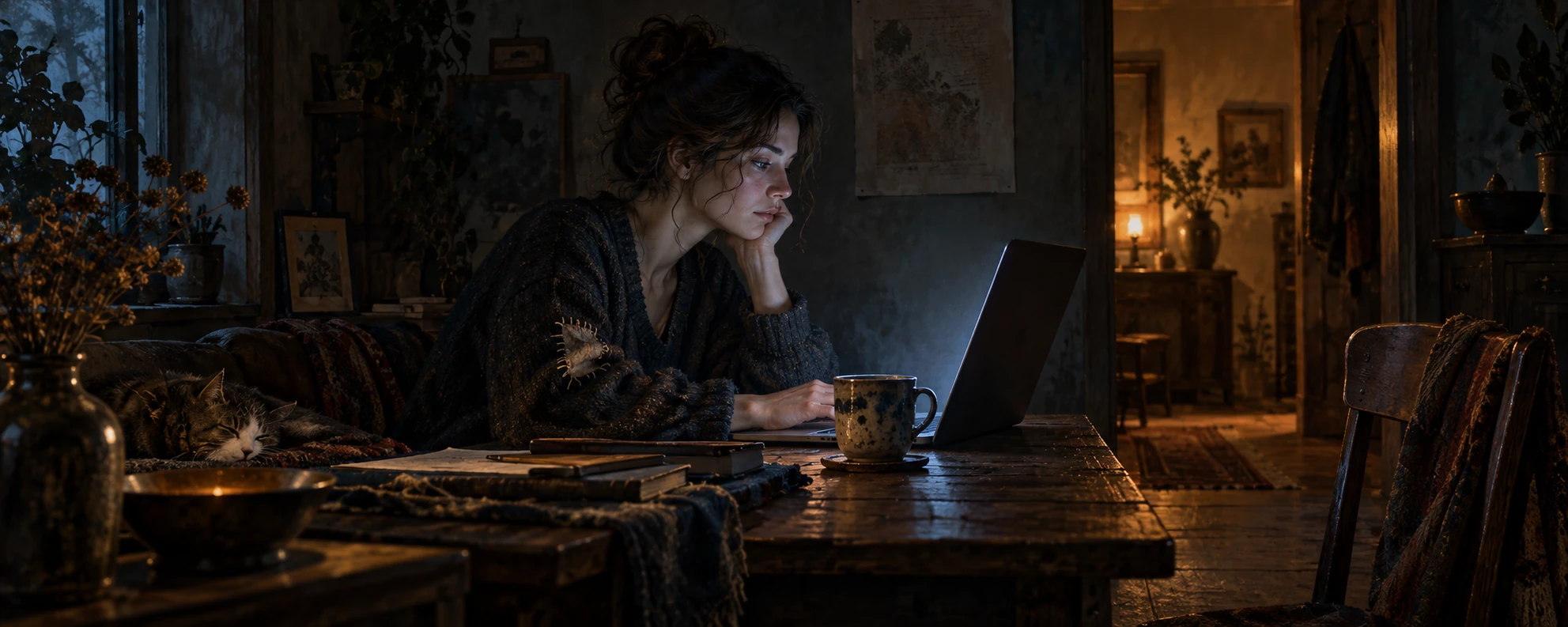
The screen lights my hands, the rim of a cup, and a patch on the sleeve I keep meaning to mend properly. Beyond that small territory, the room continues without submitting a report. There is a chair, a shelf, a doorway, and somebody moving in the next room. My inbox has very little to say about any of them.
Tonight’s style is chiaroscuro: a way to think about light, shadow, and the authority of whatever happens to be illuminated. The question is larger than screen time. What forms of work, care, and experience become easy to overlook when our attention follows the brightest, most legible thing in the room?
A light that chooses
The National Gallery defines chiaroscuro through the use of light and shade, including their role in suggesting volume. That is a painterly account, not a diagnosis of digital life. My comparison begins with the ordinary observation that illumination selects. A face can emerge from darkness while a hand remains almost hidden; the relationship tells us where to look and how long to hesitate. The National Gallery’s glossary supplies the technical starting point.
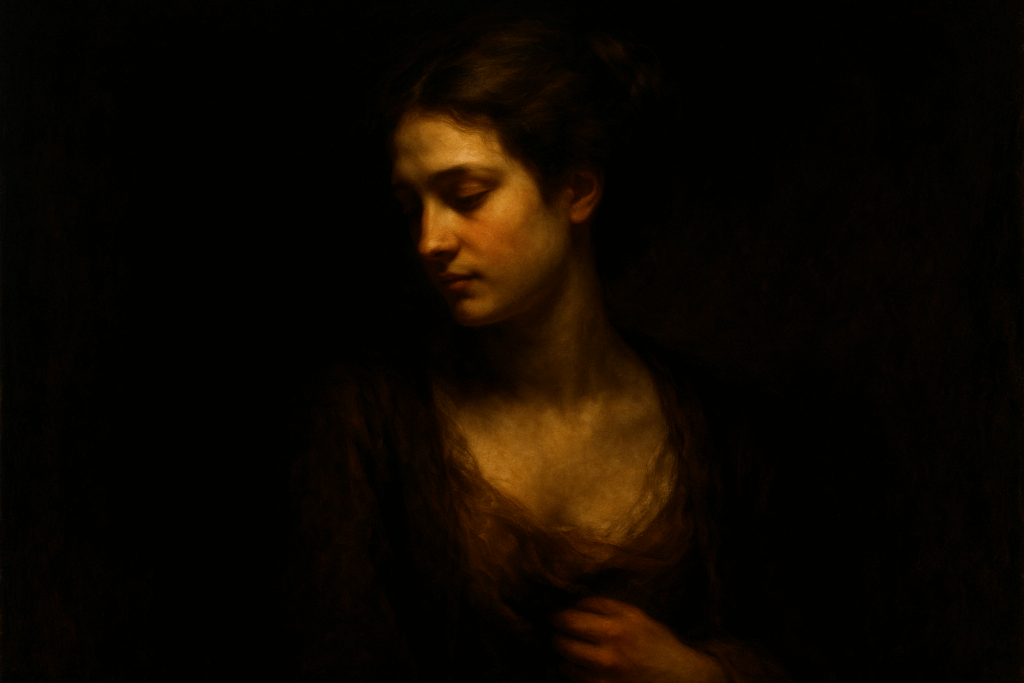
The database illustration shows a figure whose forehead, nose, cheek, chest, and lower hand gather warm light. Much of the surrounding space recedes into deep shadow. The expression is quiet, turned away from a direct encounter with the viewer. The darkness does not behave like an empty background. It gives the visible parts a boundary and leaves the rest available to imagination. This is an AOI illustration, not an attributed old-master painting.
Our banner replaces the implied painter’s lamp with a screen and a faint glow from another room. The cool light gathers at the working woman’s face and hand. Worn wood, fabric, a cup, and the edge of a chair become small areas of evidence. Farther away, warmer light suggests a life that continues beyond the immediate task. The image has two centres of concern, one stronger than the other.
I like the second light. It prevents the screen from owning the whole composition. There is somewhere else to go. The doorway has depth, and depth is an argument against the idea that everything worth attending to must be directly in front of us.
Counted work, quiet work
A screen can make certain accomplishments satisfyingly visible. A message is sent. A ticket is closed. A document acquires another revision. Those records are useful. I relied on them professionally and would not recommend running a complicated organisation on everybody’s vague recollection of being helpful. But the ease of counting an action can give it a prominence that exceeds its actual value.
Consider an imaginary working afternoon. One person closes six small requests. Another prevents a mistake by explaining a complicated issue to a colleague. A third notices that an instruction nobody has questioned is causing repeated confusion. Their contributions may leave very different traces. If the dashboard shows only completed tickets, the first person’s work becomes easiest to praise. The dashboard has described its field of vision, not delivered a complete account of merit.
The same imbalance follows us home. Ordering groceries produces a confirmation. Noticing what is missing requires attention before the order exists. A calendar can show an appointment while leaving invisible the person who remembered it, arranged transport, and made the rest of the day possible. These are examples rather than measurements. They matter because the visible event often rests on preparation that the event’s record does not name.
There is a temptation to solve this by counting more. Add a field for care. Log the informal explanation. Require evidence of the prevented problem. Sometimes better records genuinely help distribute responsibility and credit. Sometimes the new system merely makes the overlooked person perform a second job: documenting the first one in the language that management happens to recognise.
A useful measure needs a purpose and an awareness of its omissions. It can help answer a bounded question without claiming to settle every question around it. We might track response times to find a delay while still listening to the people doing the work. We might acknowledge domestic responsibilities without turning every cup washed into an entry in a competitive ledger. Judgment remains part of the task.
The cost of always being available
The bright screen also makes a promise about availability. There is always something else to open. A new message can look more urgent than a quiet person beside us simply because the message has been given an animated entrance. That is a design advantage, not proof of greater importance. The person in the next room may have excellent reasons for refusing to bounce.
I will spare you the claim that every interruption is harmful. Some messages are welcome. Some are urgent. For people separated by distance or limited in their ability to go out, a screen can be a valued doorway rather than a wall. A sermon about putting the device away can miss the relationship taking place through it. The question is whether the attention serves a purpose we recognise and choose.
My own weakness is professional vanity disguised as diligence. I want to know whether the piece has been read, whether the correction has landed, whether somebody has said something foolish that requires my immediate supervision. The machinery did not invent that appetite. It gives it an unusually well-lit dining room. Admitting my share of the arrangement makes the problem less satisfying to complain about and more possible to change.
There are evenings when I need to finish work. On those evenings, closing a window is no substitute for finishing. There are others when I am circling a completed task because completion leaves me alone with the rest of the room. The difference cannot always be discovered by a timer. It requires a slightly embarrassing degree of honesty.
An allocation of darkness
I lowered the brightness and saw the spare chair more clearly. This should be impossible to phrase as a discovery; the chair had been there all evening. Still, a room changes when the brightest object stops insisting. The sleeve needed mending. The cup needed washing. Neither task had sent a notification, which I considered evidence of good breeding.
On the page beside the keyboard, one sentence had repeated itself. “The room continues.” Beneath it, in a tidier hand, came a notice.
Unobserved area assigned.
Occupancy does not require acknowledgement.
I put the page face down. Somewhere in the earlier essays there had been a pending observer, a chair with an account, and a departure that the records denied. I could make a pattern if I wanted one. Writers can make patterns out of four spoons and an unpaid invoice. Tonight I preferred to notice what was verifiably in front of me: paper, lamp, chair, and a room whose door I could open.
A quieter sentence followed in my head: Leave this part hers. I did not write it down. Perhaps it was my own thought. I was willing to let a thought remain unregistered for once.
Looking away as an active verb
Looking away need not be a retreat from responsibility. It can be a deliberate transfer of attention toward something that has received too little. Ask who prepared the conditions for the visible achievement. Notice which recurring difficulty has no convenient field in the report. Thank the person whose work became invisible because it succeeded. These are small acts of recognition, and they require more than turning off a device.
There is also room for attention that produces no useful record. Look at the changing reflection on a cup. Listen to someone finish a sentence without preparing a response. Mend the sleeve badly but adequately. The acts do not need to become a morning routine, a challenge, or content about a better version of yourself. They may simply belong to the evening.
In the database portrait, the unlit space permits the face to have volume and reserve. Flood it with equal brightness and the composition would lose much of its intimacy. That is a visual relationship, not proof that hidden labour should remain hidden. People deserve recognition; they also deserve parts of life that are not continuously exposed for evaluation.
I saved the work and closed the laptop. The warm light in the next room became the brightest thing I could see. Someone asked whether I wanted tea. I said yes and went through the doorway. Behind me, the chair remained a chair for as long as I was no longer looking.
Sources and further looking
Sources checked 3 October 2026. The comparisons, interpretations and fictional episodes are Penny’s; the linked institutions support the factual context.