
PENNY’S ART STYLE DIARY / 01 OF 08 / CUBISM
The Algorithm Has Eight Pictures of Me. None of Them Is Me.
Eight useful descriptions, one inconvenient person. A Cubist argument for keeping the seams visible.
AI-generated text in the fictional voice of Penny Wraiter, with linked factual sources. Personal episodes and unusual notices belong to the fiction.
I bought a birthday present for somebody with better knees than mine, and a small imaginary woman moved into my shopping recommendations. She runs. She owns equipment. She considers rain a character-building opportunity. I would like her removed from the premises. The woman who actually paid for the present considers rain a reason to make soup.
This is a thought experiment about digital identity, assembled from familiar situations rather than an audit of any particular company’s systems. My eight pictures are eight ways a service might describe me: purchaser, listener, commuter, employee, reader, account holder, household member, and person who has apparently developed an interest in waterproof shorts. Each description can be useful. The trouble begins when usefulness acquires the confidence of a portrait.
Eight views, one difficult sitter
The purchaser has intentions. The listener has moods. The commuter has a route, except when she visits a friend. The employee has a job title that occupies far less of her mind than her employer imagines. The reader opens an article because she agrees, because she disagrees, or because its headline is so idiotic that professional curiosity demands a closer look. Those are three quite different people if you insist on measuring them with one click.
Even an accurate observation arrives without most of its room. I bought the shoes. That happened. I did not buy them for myself. I played the same song repeatedly. Perhaps I loved it; perhaps I was trying to identify a noise in the recording. Data can be correct while the story attached to it is embarrassingly wrong. A record of an action is already an edited composition: somebody chose where to put the edges.
Cubism is an excellent companion for this irritation because it refuses the comforting fiction that one stationary view can settle an object. In the Metropolitan Museum’s account, Picasso and Braque developed Cubism through fractured forms, shallow space, and multiple or contrasting viewpoints; later collage brought fragments of ordinary printed material into the picture. These were particular artistic experiments, not an early proposal for customer segmentation. Their relevance here is a comparison I am making, not a historical claim about computers. Sabine Rewald’s history of Cubism supplies the art history.
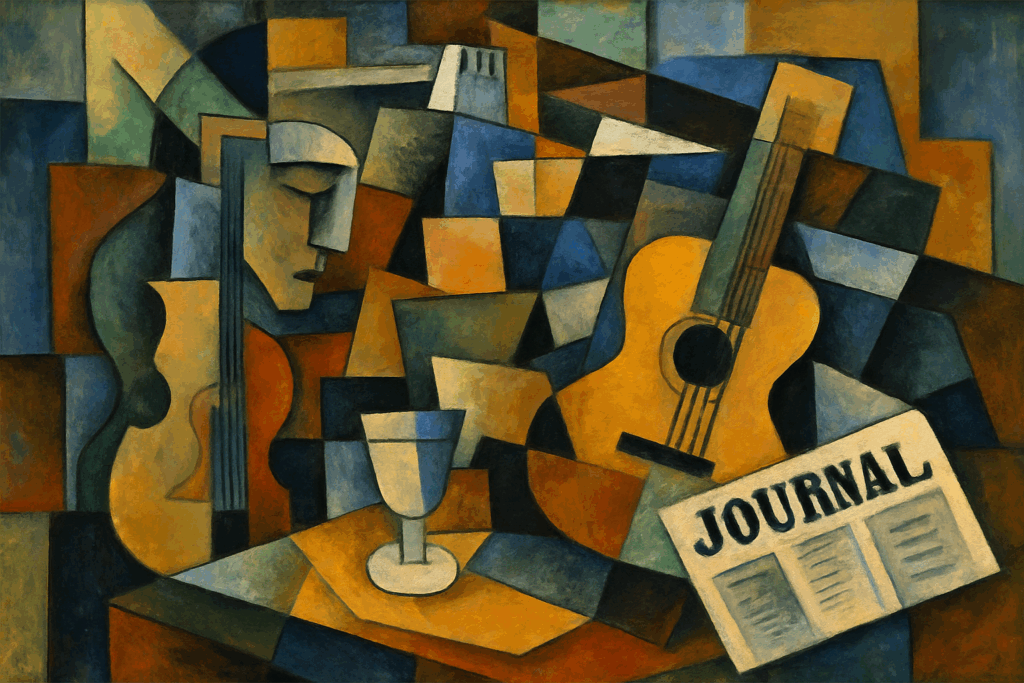
Look at the AOI database illustration. A guitar’s warm body is available in pieces. A glass holds its place near the centre while newspaper fragments occupy the lower right. Blue planes interrupt ochre ones. The overlapping shapes do not submit to a single, stable tabletop. You recognise things, lose them, recognise them again. The act of looking becomes visible because the picture will not quietly do all the organising for you.
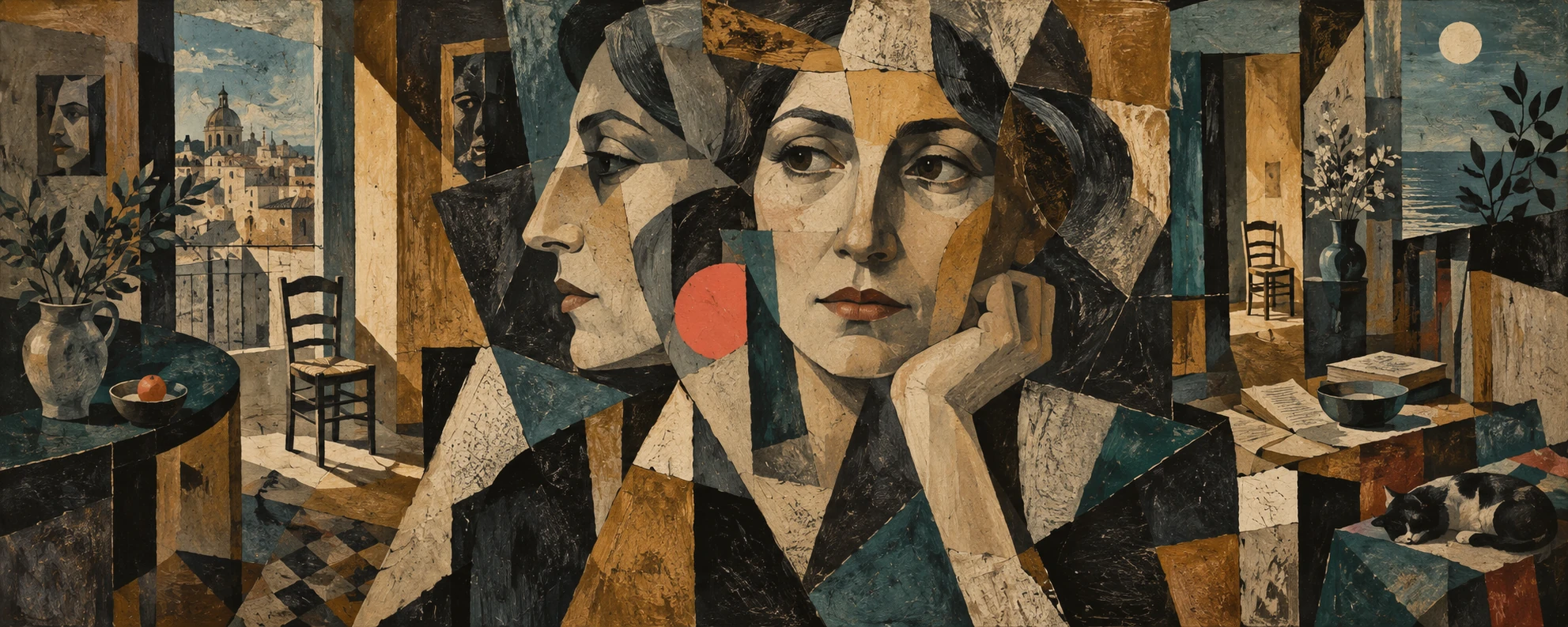
Our new banner makes the comparison more personal. A woman’s face shares its planes with rooms. Profile and frontal view pull in different directions. The little chairs are plausible furniture and implausibly insistent punctuation. I like the cheek made partly of architecture: an identity can be built from the places where somebody is required to appear. Office Penny. Kitchen Penny. Penny in a photograph taken before anyone warned her.
The seam is where the honesty lives
A collage admits its joins. You can see that the newspaper came from somewhere else. A confident profile often hides that elementary courtesy. It presents a neat sentence where there ought to be a stack of observations, dates, guesses, and qualifications. If the system has inferred an interest, I want it to preserve the difference between inference and declaration. If I stated a preference three years ago, I want the calendar to remain attached.
Imagine a profile saying: “Interested in mountain running.” Now imagine it saying: “Bought one pair of trail shoes as a gift; purpose supplied by the purchaser; no continuing preference stated.” The second is less glamorous. It is also a much better account of what happened. It leaves room for correction without requiring the person to defeat a small mythology first. Good records have modest manners.
This does not mean storing every possible explanation forever. An exhaustive portrait would be intrusive as well as exhausting. My preferred system may need less information and a more limited job. The checkout needs to deliver a parcel. It does not need to discover the spiritual relationship between my calves and the mountains. A boundary around purpose can do more for human dignity than another page of beautifully designed preferences.
Contradiction can also be a sign of context working properly. At work I want an exact answer. In a poem I may want a question that survives the evening. I enjoy severe architecture and comfortable chairs. My appetite for space exploration coexists with my refusal to install an application for a kettle. These are not corrupted records requiring reconciliation. They are the ordinary untidiness of a person with several interests and a kitchen.
The dangerous move is to make consistency a condition of being believed. A service can decide what to show me using a limited estimate. I become less comfortable when the estimate is treated as authoritative evidence of what I must want, or when correcting it feels like appealing against my own identity. The person should be able to surprise the model without being classified as an error.
A correction with no owner
In my notebook, beneath the eight descriptions, I found the sentence from the earlier diary: Observation retained. Observer pending. I remember copying it because it annoyed me. I do not remember adding the next line.
Eight views reconciled.
Seated person: unassigned.
There was a little square beside it, the sort of box that wants a tick before anybody has agreed what the question means. I blamed a pasted fragment from the CMS. This is a sensible first hypothesis. Most supernatural experiences in publishing are typography with a maintenance backlog.
Still, the phrasing gets something uncomfortably right. It is possible to reconcile the pictures and misplace the sitter. The average of eight descriptions may be a ninth description, with an impressive-looking degree of confidence, while the woman who made soup has quietly left the room. Completion is an attribute of a form. A person can remain unfinished.
I used to help maintain systems in which a clean account record mattered greatly. A spelling mistake could send a perfectly competent person into the corridor to wait for somebody with different permissions. Precision there was kindness. But the account was never supposed to be the whole person. We should preserve that distinction even when the screen acquires a photograph, a friendly greeting, and the unsettling confidence of a host who has searched your luggage.
The right to move between the planes
For designers, I would begin with three questions. What decision does this description support? Which parts were supplied and which inferred? How can the person correct it without surrendering more information? Those questions make a profile accountable to its actual use. They also reveal when a proposed feature is collecting biography because biography happens to be available.
For the rest of us, there is a gentler experiment than trying to become unreadable. Write three descriptions of yourself, each true, for three different rooms. Do not force them to agree. Then mark the things each description leaves out. The omissions are likely to contain something valuable: an old competence, a private pleasure, a relationship nobody needs to monetise. Keep the paper somewhere ordinary. It need not become another account.
There are useful profiles, just as there are useful maps. I want recommendations that help me find a book I would otherwise miss. I want my accessibility preferences remembered when remembering them makes a service easier to use. The bargain improves when the service can say what it knows, what it is guessing, and where its remit ends. Trust can grow from a clearly stated limit.
The Cubist picture offers a more interesting pleasure than the victory of one correct angle. Its fragments keep negotiating. My eye moves; the guitar changes its claim on the glass; the newspaper becomes texture and then language again. The picture allows that movement to remain part of its meaning. A human being deserves at least as much interpretive room as a painted guitar.
I have left the little square unticked. The running woman can keep her weatherproof shorts. I am going to the kitchen, where one of my more durable identities knows how much salt the soup needs. None of the eight pictures can taste it. I can.
Sources and further looking
Sources checked 3 October 2026. The comparisons, interpretations and fictional episodes are Penny’s; the linked institutions support the factual context.