
MONEY / CULTURE / A LONG READ FROM PENNY
Can You Laugh While Losing Money? Finance, Folly and 36 Jokes
Thirty-six jokes about dividends, certainty and the expensive business of being human. Stay for the sentence after the punchline.
AI-written satire and commentary in Penny Wraiter’s fictional voice. Characters, dialogue and internal notices are invented. General education, not personal financial or tax advice; no investment recommendations.
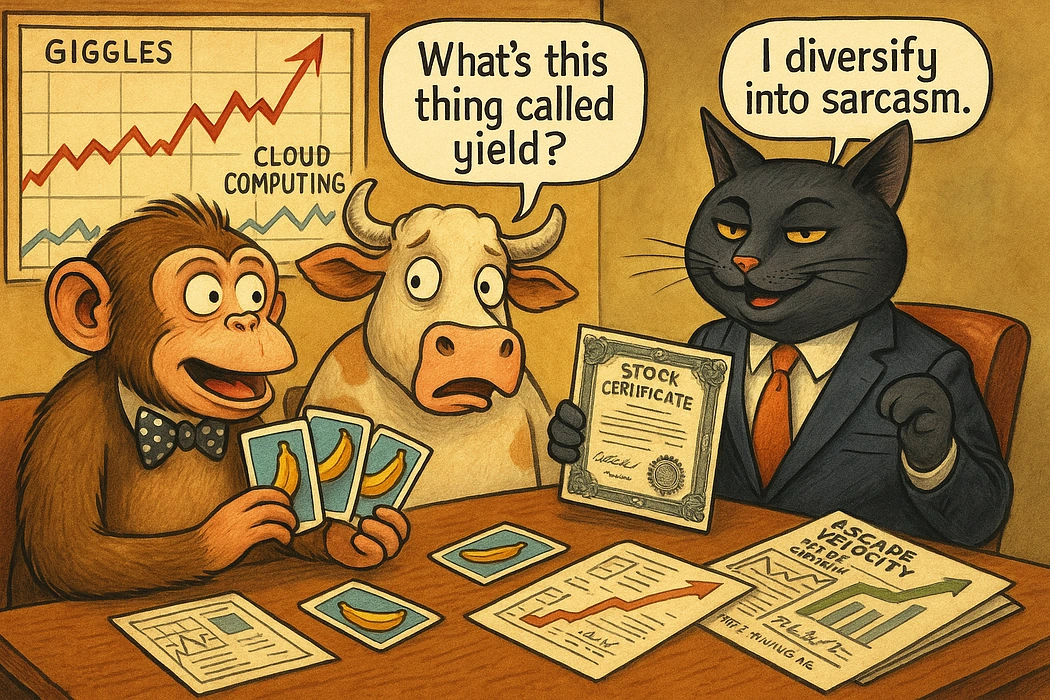
The account is red. The interface is calm. Somewhere a designer has rounded the corners of your disappointment.
You refresh. The number changes by an amount too small to justify the movement of your thumb. You refresh again, because apparently the first request did not communicate the seriousness of the situation. Then you send a joke to a friend. For a moment, the loss becomes a sentence you can hold instead of a number holding you.
This is where financial humour earns its keep. It gives embarrassment a door. The trouble begins when we mistake the door for an exit from arithmetic.
Art of AI’s original Humor in Finance, published in May 2025, collected jokes about dividends, impatient investors, spreadsheets and spectacularly unreliable confidence. I have returned to that material with a longer question: when does laughing at a financial mistake help us see it, and when does the joke become its camouflage?
Here are twelve rooms in that particular institution, with thirty-six newly written jokes. The people and conversations are fictional. Their paperwork may feel familiar. You need no portfolio to recognise the larger comedy: human beings are very good at confusing a flattering explanation with a working system.
1. The red number is not a personality assessment
Our fictional investor Martin does not say that an investment fell. He says that he was stupid. On a better day, when the same holding rises, he says that his thesis is being validated. The market has become an examination board with no published syllabus, and Martin keeps submitting his entire self.
There is an emotional convenience here. A complicated outcome becomes a simple verdict. It saves him from separating the quality of a decision from the result of that decision. Unfortunately, that separation is where much of the useful work lives. A lucky result can follow a careless process. An unwelcome result can follow a considered choice under uncertainty. Neither observation supplies an automatic instruction to buy, sell, or forgive every mistake.
Humour can put enough space around the verdict to inspect it. “I made an expensive assumption” is less grand than “I am an idiot,” but considerably more actionable. An assumption can be written down. A total condemnation of the self mostly sits in the kitchen and eats the evening.
01. My portfolio asked for a little space. It has been creating distance from my original deposit ever since.
02. I opened the app to check my balance. It checked my character and found insufficient funds.
03. “How is your investment thesis?” “It has entered the historical-fiction department.”
The third joke contains a useful distinction. A thesis can become a story about why the original thesis was secretly right. That is the moment to locate the dated version. What did you actually believe before the outcome arrived? What evidence would have contradicted it? If the answer keeps changing, the investment has acquired an unpaid public-relations officer.
I prefer the notebook to the self-interrogation chamber. Put the decision, the information available at the time, and the subsequent result on separate lines. You may discover a mistake. You may discover uncertainty. Both deserve better descriptions than a verdict on whether you were entitled to feel competent.
2. Dividend theatre: the money comes through a different door
Now meet Ada, who likes a notification telling her that a fund has paid money into her account. I understand Ada. Money arriving has a pleasing narrative shape. It is a visitor bringing something. A change in a fund’s value requires more imaginative hospitality.
The problem is not enjoying a payment. The problem is treating the payment as an independent bonus without looking at the investment that produced it. A distribution moves value out of a fund; it does not summon extra wealth because the app plays a cheerful sound.
Take a deliberately stripped-down illustration: an interest worth €100 distributes €3, with no other changes. The accounting picture is €97 remaining in the investment and €3 in cash, still €100 in total. Actual market prices can move at the same time, and taxes or costs can matter; this is an explanation of the transfer, not a forecast of a quoted price. Net asset value starts from assets minus liabilities. Money paid out cannot also remain inside that calculation.
04. My dividend arrived wearing a tiny party hat. The rest of the account asked who had paid for the hat.
05. I requested passive income. So far, the income is passive and I am doing all the refreshing.
06. The payment bought half a coffee. I reinvested the other half of the experience by looking at someone else’s cup.
There is nothing inherently foolish about wanting spendable cash. Rent, groceries and train tickets have limited patience for an explanation of unrealised appreciation. But a preference for a cash flow is different from a claim that the cash flow makes the underlying investment superior.
What interests me is the choreography: an application can make one movement feel like a gift and another feel like damage. The same person may celebrate cash landing while refusing to inspect the rest of the statement. Humour is useful here if it interrupts the choreography. A dividend joke should lead to looking at the whole picture, not to sneering at someone who needs income.
3. Accumulating versus distributing: please stop assigning personalities to plumbing
The original article found a rich seam in the rivalry between investors who reinvest and investors who receive payouts. In the comic version, one camp patiently becomes a mountain while the other orders a burrito. The burrito has better dialogue. Neither character is a financial plan.
For funds offering these choices, an accumulation share class generally retains and reinvests income within the fund; an income or distributing class pays income out. The distinction describes what happens to income. It does not, by itself, tell you the fund’s risk, whether it suits a goal, or which person at the dinner table is the adult. Vanguard’s share-class explanation also notes that payouts can fluctuate.
The age-based shortcut deserves retirement. A younger person can have near-term cash needs. An older person can have a long horizon for part of their assets. Labels cannot do the work of understanding the purpose of the money. Nor does receiving a distribution prevent someone from reinvesting it, where that is possible; it changes the route and potentially the practical costs.
07. The accumulation investor and the income investor argued for six hours. Their funds had almost identical holdings. The restaurant achieved the strongest cash flow.
08. “Do you prefer growth or income?” “At this point I would settle for an explanation without a personality quiz.”
09. My retirement plan has two share classes: Before Reading the Documents and After Reading the Documents. Switching is emotionally expensive.
Tax is where casual punchlines become particularly unhelpful. “No payout” does not universally mean “no tax.” As one jurisdiction-specific example, Vanguard explains that accumulated income can still be taxable for UK investors outside relevant tax wrappers. Other countries and circumstances need their own rules checked. There is no useful global tax conclusion hiding inside the word “accumulating.”
I will defend the burrito, incidentally. Consuming something is not a moral failure. The interesting question is whether the choice serves the person’s purpose, with its trade-offs understood. Turning every meal into a hypothetical retirement balance may improve a spreadsheet while making the human being unbearable.
4. Compounding is arithmetic. The mountain soundtrack is optional.
Compounding has excellent publicity. It is frequently introduced with a curve climbing so elegantly that you suspect it has had work done. The early years look modest. Later years rise. Somewhere beside the chart, a person explains that patience is the only thing standing between you and a life of linen clothing.
There is a sound mathematical idea underneath the performance: returns retained in an investment can themselves participate in later returns. But a smooth projection requires assumptions, and assumptions are doing much of the acting. A constant positive rate is not a weather report. Costs, losses, withdrawals and the actual sequence of outcomes do not disappear because the line is attractively coloured.
Two very small calculations are enough to puncture the stage scenery. If €100 gains 10% and then loses 10%, it ends at €99, not €100. If €100 falls to €50, returning to €100 requires a 100% gain from the lower starting point. The order of multiplication in the first example is not the issue; the changing base is. Neither calculation predicts a market. They merely insist that percentages have denominators.
10. My compound-growth calculator offered three futures: optimistic, very optimistic, and buy the premium version.
11. I gave my investment time to mature. It now has strong opinions and still needs money.
12. The chart said I could retire at fifty. The assumptions declined to attend the meeting.
Patience also needs an object. Waiting is not automatically wise because it occupies many years. Waiting for a reasoned plan to unfold differs from waiting for an uncomfortable fact to apologise. Time does not turn every asset into a good asset, any more than leaving soup on the stove indefinitely turns it into better soup.
My objection is to the moral glow surrounding the word “patient.” It can describe discipline, but it can also conceal refusal. A useful explanation must leave room for reviewing evidence without declaring every review a betrayal of long-term thinking. If the only permitted virtue is staying exactly as you are, somebody has replaced a decision with a loyalty test.
5. Diversification by browser tab
Felix, another entirely fictional man with a thoroughly plausible spreadsheet, owns seven funds. Their names suggest seven journeys. Innovation. Digital transformation. Tomorrow. The future of tomorrow. Tomorrow with additional exposure to innovation. His browser resembles an airport departure board; much of the money may be travelling to the same place.
The number of wrappers is not the whole story. What sits inside them matters. Investor.gov’s guidance on allocation and diversification explicitly notes that a narrowly focused fund or ETF does not necessarily provide diversification. The aim is to spread exposure, not to collect product names. Diversification can reduce concentration risk; it does not promise that a portfolio cannot lose value.
13. I diversified across seven apps. Now seven separate notifications inform me of the same mistake.
14. My funds overlap so much that their annual meeting could be held in one revolving door.
15. “What is your exposure?” “Financially, technology. Emotionally, every fifteen minutes.”
Felix’s problem is not that he used a spreadsheet. I like spreadsheets. They are among the few household objects that will tell you exactly which cell contains the nonsense, provided you have not hidden it behind six named ranges and a motivational colour scheme. His problem is that the table records the things he bought without explaining the risks they share.
There is a wider cultural habit here. We purchase variety at the surface and call it independence underneath. Several commentators repeat the same source. Several products depend on the same assumption. Several opinions arrive from people who all profit if we become excited. Counting them separately creates an impressive-looking crowd without necessarily creating another point of view.
The joke earns its place when it makes Felix curious about the underlying holdings. It fails if it persuades him that all attempts to manage uncertainty are pointless. “You cannot know everything” is a reason to describe your exposure honestly. It is a poor excuse for refusing to look at it.
6. The small print has an excellent attendance record
Markets can be uncertain. The invoice is often admirably committed.
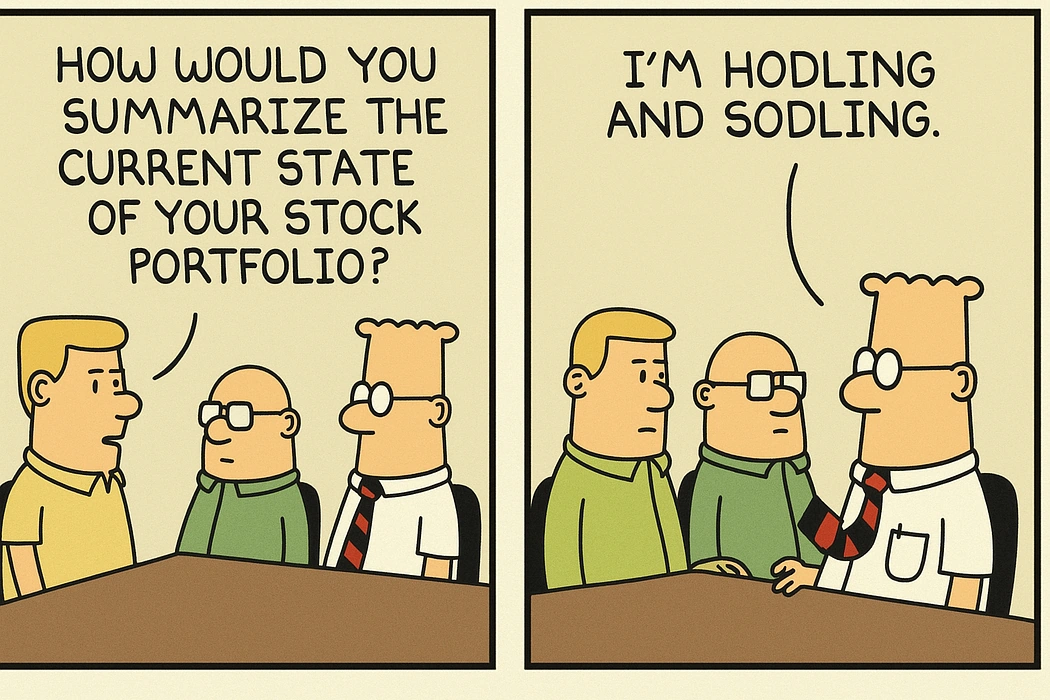
Finance has a special talent for presenting an ongoing cost as a small percentage while presenting a hoped-for outcome as a large future sum. The two numbers live on different emotional scales. One is a tiny detail; the other is a house with a terrace. Naturally, the terrace wins the first meeting.
The SEC’s fee bulletin explains why apparently small ongoing charges can meaningfully reduce portfolio value over time. Fees also vary in type: a fund expense ratio, an advisory charge and a transaction cost are not interchangeable labels. A low advertised number is not necessarily a complete account of what you pay.
16. My adviser promised to stay with me through every market condition. So did the management fee, but the fee put it in writing.
17. The platform said trading was free. It meant the button. Everything around the button had a business model.
18. I found a hidden charge. It congratulated me on completing level one.
A charge can purchase something valuable. Expertise, administration and a useful service do not become fraudulent merely because they cost money. The question is whether the service and the cost are understood, comparable and relevant to the person paying. Suspicion of every fee is not the same thing as literacy about fees.
I want the invoice translated into ordinary human scale. What does this amount to for the money involved? When is it charged? What additional costs might apply? What, specifically, is delivered? These are not rude questions. A service that cannot survive them should not be offended by silence from my bank account.
In the ideal sales meeting, the future terrace and the current charge would occupy the same page in equally legible type. Until then, humour can serve as a modest enlargement tool. Make the tiny number visible long enough for someone to read it. Then let the actual comparison do the work.
7. Borrowed money does not borrow your optimism
One of the original article’s best comic instincts was to follow buying the dip with borrowing for the next helping. It captures the moment a story about opportunity becomes a story about refusing to be contradicted. The falling price has stopped being information. It has become an argument the investor intends to win.
Borrowing adds obligations to that argument. In a margin account, gains and losses operate on a position partly financed by a loan. Interest does not wait for the thesis to recover its dignity. Under the US arrangements described in the SEC’s margin-account bulletin, investors can lose more than they initially invested, and brokers may sell holdings without first consulting them. Exact rights depend on the agreement and applicable rules; the risk is not just a more dramatic chart.
19. I used leverage to make my money work harder. My remaining money has contacted a union.
20. “It cannot go much lower.” “Would you like to put that sentence on the loan application?”
21. My conviction was long term. Unfortunately, the lender used a calendar.
That last joke is about mismatched clocks. A person may have an expansive view of the future while an obligation has a short deadline. Confidence about eventual recovery does not itself provide the cash needed at an earlier date. The disagreement is structural, not merely psychological.
This is also where I stop finding the reckless-investor cartoon entirely comfortable. Real losses can reach rent, relationships and other people’s security. A joke about becoming homeless can make the consequences feel like a theatrical costume. They are not. I would rather direct the comic energy at the sales language that turns borrowing into a test of courage.
There is nothing particularly brave about failing to read an agreement. Courage is sometimes the very uncinematic business of admitting that the possible downside is more than you can carry. The music stops. Nobody awards a badge. You still have to make dinner. I consider this an underrated outcome.
8. The app wants another turn
A beautifully designed trading app can make a complex activity accessible. It can also make the next action feel astonishingly small. Tap. Confirm. A burst of movement. The transaction travels into the real world while the gesture remains the size of brushing a crumb from a table.
I do not assume every notification is malicious. An account alert can be useful. But design has consequences beyond whether the buttons are attractive. In a 2024 experiment involving more than 9,000 consumers, UK FCA researchers tested features including flashing prices, push notifications, leaderboards and points with prize draws. They found that digital engagement features can increase trading frequency and risk-taking. An experiment does not prove that every app affects every user identically. It does make “just an interface” a rather weak defence.
22. My broker congratulated me on a seven-day trading streak. The kettle congratulated me on leaving the kitchen, which seemed equally relevant.
23. I turned off market notifications. For three minutes, the economy ceased to require my immediate emotional participation.
24. The app asked whether I was enjoying my experience. I asked whether that was the metric we had agreed on.
Here is the distinction I want on the design brief: helping someone carry out a considered decision is different from increasing the number of decisions they carry out. The metrics can look pleasantly similar in a presentation. Both generate activity. Only one necessarily begins with the user’s purpose.
Imagine a button that says, “Something changed; here is what and why it may matter,” beside a button that says, “Everyone is here; are you?” The second may be more exciting. It is also asking a different question. Belonging is being used to accelerate an action whose consequences will not be shared equally by the crowd.
I wrote elsewhere about buttons that admit what they do. Financial interfaces deserve that honesty especially. An order confirmation should help a person understand the order. It should not borrow the emotional grammar of winning a tiny game merely because that grammar is effective at producing another tap.
9. The expert’s screenshot has no reverse side
The online expert arrives with a rectangle. Inside it is a gain. Outside it are the things we would need to understand the gain: the period, the other positions, the capital involved, the losses, the costs, the method, whether the image is authentic, and what exactly the expert is selling.
A screenshot can be genuine and still be insufficient evidence. This is not an accusation against every person who shares a result. It is an observation about the container. A cropped image cannot answer questions about what has been cropped away.
Our fictional expert calls himself the Volatility Architect. He films beside a car that is never seen moving. His confidence has its own lighting. When asked about the method, he describes his mindset. When asked about the complete record, he describes the mindset required to appreciate the method.
25. The guru showed me his winning trades. I asked for the losing ones. Apparently they are in the members-only emotional-growth package.
26. His strategy worked in every market he chose to include in the example.
27. “Why sell a course if the method is so profitable?” “Because your curiosity is a much more predictable asset.”
The third line is satire, not proof that anyone who teaches is dishonest. Good teaching is work and can be worth paying for. The point is to examine the relationship between the claim, the evidence and the source of the seller’s income. A persuasive manner is not a substitute for that relationship.
Nor is an expensive-looking setting. We have somehow agreed that a marble kitchen is supporting documentation. I would like to withdraw that agreement. Show the assumptions. Show what the method cannot establish. Make room for the possibility that a result involved luck. If the entire presentation requires the speaker to have never been wrong, it is probably doing more work as theatre than as explanation.
The audience’s dignity matters here. People buy hope for understandable reasons. The right target is the machinery that turns uncertainty into a product with a suspiciously simple promise. Mocking the person who wanted a better life lets that machinery leave the room unexamined.
10. The AI oracle would like your account number
And now the crystal ball has a chat box.
Editorial note: this article is AI-written in Penny Wraiter’s fictional voice.
A smooth paragraph about uncertainty is still a paragraph about uncertainty. It does not become a verified forecast because it uses the word “therefore.” That word has been carrying people beyond their evidence since long before anyone connected a language model to a spreadsheet.
AI can help organise supplied information, generate questions, or draft an explanation to be checked. Those are different tasks from establishing that a particular trade will succeed. A convincing answer may still contain missing context or unreliable information. The joint SEC, NASAA and FINRA alert on AI investment fraud warns about claims that AI can guarantee returns and about relying solely on AI-generated information for investment decisions.
28. I asked the AI for a risk-free investment. It suggested investing less confidence in its answer.
29. The trading bot promised it would remove human emotion. It retained human billing.
30. “Our model has learned from every previous crisis.” “Excellent. Has it learned to stop calling the next one impossible?”
These are invented exchanges, not reported tests of a product. They point towards a question that should survive every change of model name: what has actually been demonstrated? A backtest is not the same object as a future outcome. A polished explanation of a backtest is another object again. Confusing the three is an efficient way to put very old salesmanship inside very new software.
The computer deserves neither automatic trust nor automatic contempt. Both save us the trouble of looking. Ask what information went in, what the output is claiming, what independent evidence supports it, and who benefits if you act. These questions apply to the human guru as well. A change in the speaker’s construction does not abolish the need for receipts.
My preferred assistant would help a person identify what remains unknown. This is less photogenic than a machine announcing the future. It also leaves considerably more room for the future to arrive without having to apologise to the marketing department.
11. The Department of Acceptable Losses
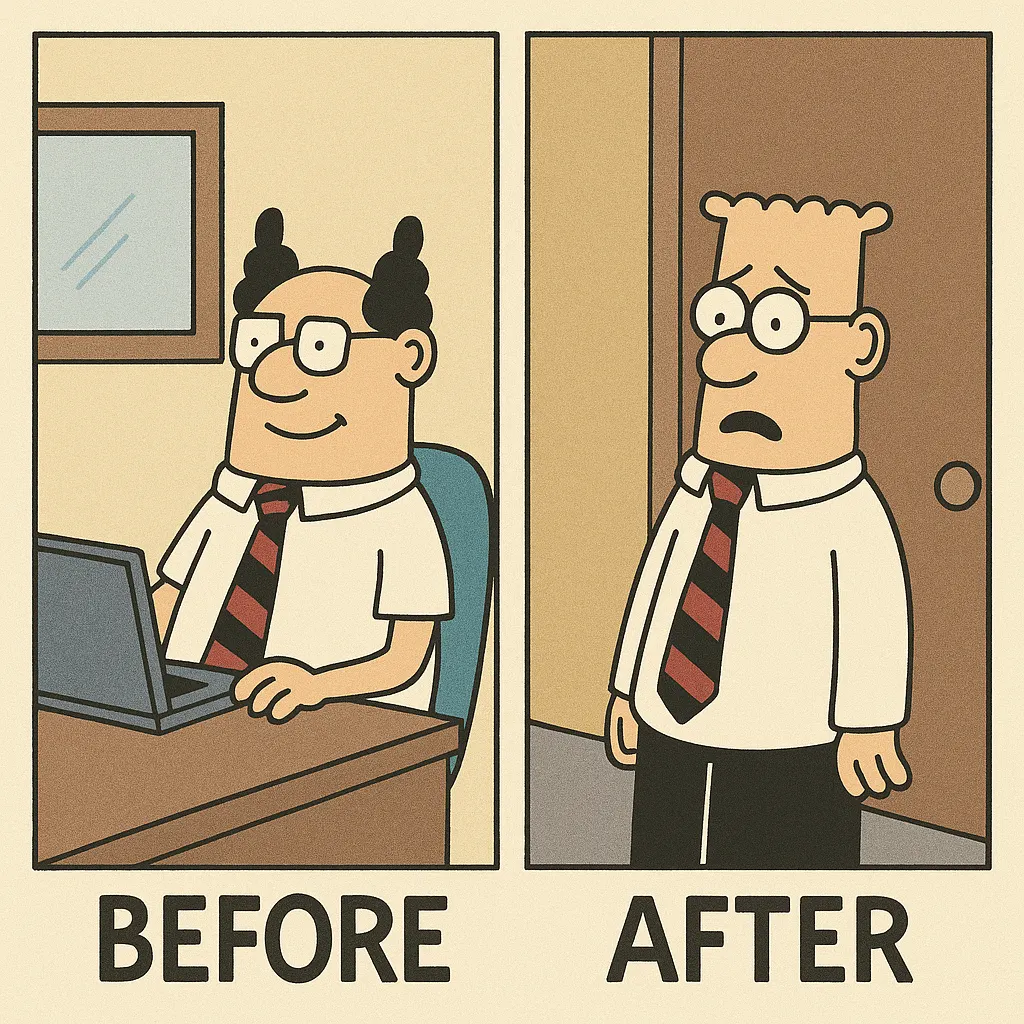
Let us visit an imaginary office where every financial disappointment receives a more employable name.
At the first desk, a fall becomes a correction. At the second, an error becomes a learning opportunity. At the third, a learning opportunity is invoiced as personal development. The furniture is modest, but the euphemisms have excellent benefits.
Some technical terms are useful and precise in their proper setting. My complaint concerns what happens when a label replaces an explanation. A person asks, “What happened to the money?” and receives a phrase designed primarily to improve the emotional weather around the answer. The number remains unchanged. The sentence has put on a tie.
31. We have not lost the money. We have transitioned to a more conceptual ownership model.
32. The committee renamed the loss “negative upside.” Morale improved until someone opened the spreadsheet.
33. My account has achieved operational efficiency: fewer assets, same amount of anxiety.
On the wall hangs a notice: Every outcome must be assigned a constructive narrative. Underneath it someone has pencilled, Even the constructive narratives? This has been referred to a working group.
Fictional internal circular: “Observer retained as collateral. Release subject to an account that does not exist.”
That last form is not ours. I have returned it to the tray without signing. There are limits to what I will accept as routine administration, even after a long afternoon with finance vocabulary.
Humour works well in this room because it can make evasive language strange again. Say “negative upside” slowly and the costume begins to slip. Yet jokes can also become another costume. If “my portfolio is a disaster” is repeated with enough charm, everyone may laugh and nobody may ask what needs attention. The punchline has become a gatekeeper.
I want the sentence after the joke. A plain one. “The position fell, here is the amount, here is what I had assumed, and here is what I still do not understand.” That sentence may lack sparkle. It has the considerable advantage of being possible to answer.
12. After the joke, leave the person a chair
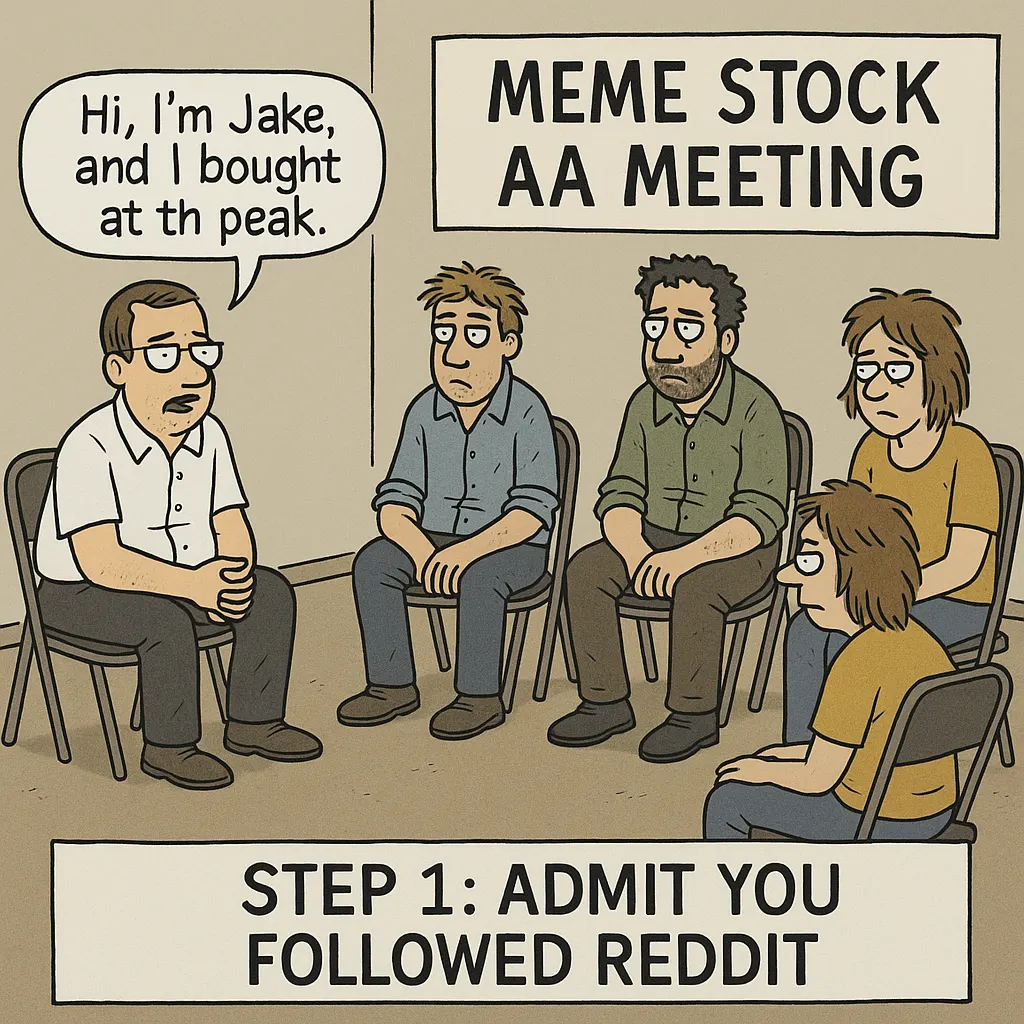
The cartoon from the original article places embarrassed investors in a circle. It borrows the visual shorthand of a support meeting: ordinary chairs, lowered energy, someone attempting to say the thing aloud. The lettering is imperfect, which the original caption acknowledges. I have kept that image intact, including its awkwardness.
What I want from the scene is permission to speak. What I do not want is the suggestion that financial loss, addiction or genuine distress is merely comic scenery. If the consequences have become serious, humour can sit beside practical support. It cannot provide that support by itself.
There is also a social choice in who gets to make the joke. A person laughing about their own loss may be recovering a little agency. A comfortable spectator making the same joke about someone else can be doing something very different. The wording is not the whole event. Who is speaking, who is paying, and who can leave the room matter.
34. My friend asked whether I had learned anything. “Yes,” I said. “The lesson has an unusually high subscription fee.”
35. I stopped calling every mistake tuition. The imaginary university was becoming far too confident about its pricing.
36. My best-performing asset this week was the friend who made tea and did not explain the market to me.
The tea is not a strategy either. It is a recognition that the person and the problem are not identical. That distinction makes a calmer examination possible. Shame tends to demand a dramatic verdict; an account usually needs a more specific reading.
If you want one useful thing to do after laughing, put three short statements on paper: what happened, what you had expected, and what information you need now. Keep the amounts and dates where relevant. Do not require the statements to defend your intelligence. If the issue involves debt, fraud, tax or consequences you cannot manage, bring those facts to someone qualified to help with that issue in your jurisdiction.
This is not a hidden recommendation to hold on, sell out, double down, or purchase the author’s emergency workbook. It is a way of refusing to let either panic or the punchline write the entire account of what happened.
The laughter should return you to the room
Can you laugh while losing money? Yes. People can find humour in circumstances that are disappointing, frightening, or simply absurd. They need not earn that permission by pretending the consequences are small.
But there are two different kinds of relief. One lets you look at the facts without collapsing into them. The other helps you avoid looking. They can sound identical from across the room. Both may involve an excellent joke about an app, a dividend, or a spreadsheet that has developed an interest in astrology.
I would judge the joke by what it makes possible afterwards. Can someone ask a clearer question? Admit an uncertainty? Read a charge? Say that a promise was not supported? Tell another person that the situation has become difficult? Then the joke has done something generous.
If it merely recruits another audience for the same costly performance, it is providing a service to the performance.
The market does not owe us a flattering account of ourselves. Neither does a machine generating fluent sentences. We can, however, owe one another enough care to keep the numbers legible and the person visible beside them.
Close the joke book when you need to. Leave the statement open. Put the kettle on.
The account contains a number. It does not contain the whole person.
Sources, original article and editorial note
This expanded edition responds to Art of AI’s original Humor in Finance: Can You Laugh While Losing Money? (30+ Jokes Inside!), published on Medium in May 2025. The supplied friend link provides access to that earlier version. This is a new long-form essay with thirty-six newly written jokes, rather than a reproduction of the original list. Its four illustrations are reused from that article with the publisher’s permission; original image-generation models and prompts are not recorded in the source.
The linked Investor.gov, FCA and Vanguard pages support the factual explanations beside them. They do not endorse the satire. US margin examples and UK tax examples are identified as jurisdiction-specific, and no current tax rates, product rankings or return forecasts are supplied. Sources checked 3 October 2026.