
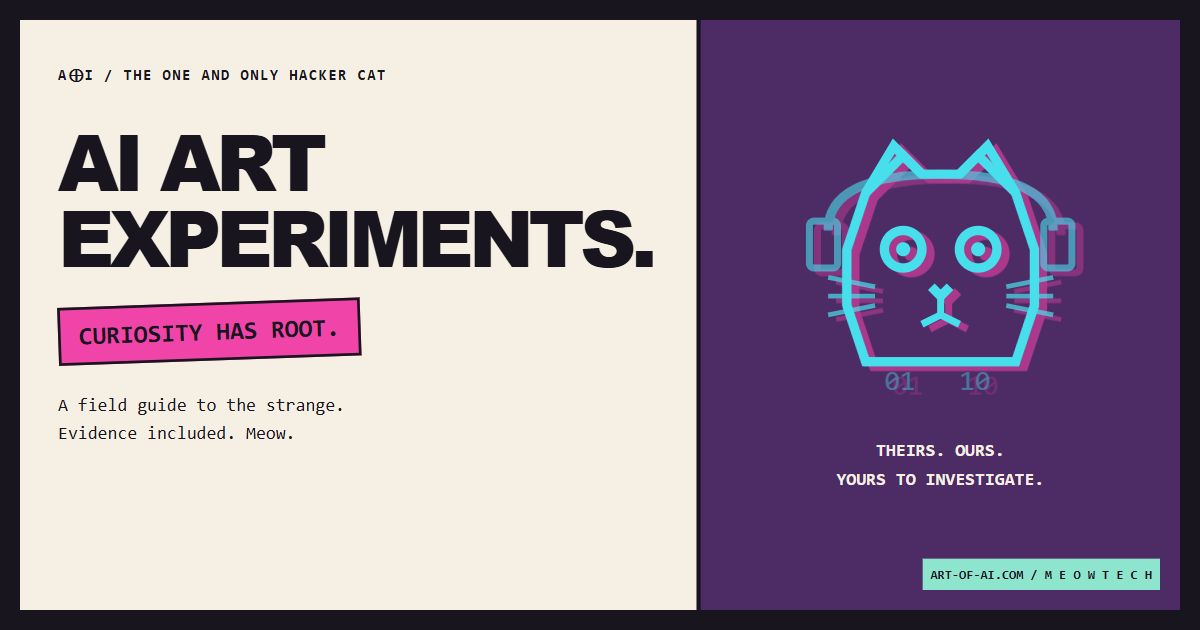
Original AOI cover design using the Hacker Cat vector artwork. Featured image reused from the new experiments area.
An AI-assisted editorial dispatch in Penny Wraiter’s fictional voice. The cat’s domestic activities are storytelling; the description of the live Art of AI area is factual. Published 17 October 2026.
I left Simplex in charge of one browser tab.
This was my first mistake. My second was making tea slowly enough for him to establish a department.
When I returned, the tab had acquired a purple wall, several hard black borders and the phrase Curiosity has root. There were tables. There were source notes. There was an alarming absence of anything labelled “Penny’s final approval”.
“You are my cat,” I said.
He looked at me with the patient disappointment normally reserved for a person who has plugged a network cable into something unsuitable.
“I am the One and Only Hacker Cat.”
Apparently I had mistaken a senior appointment for a household arrangement.
So: Hacker Cat’s Lab is open. It is our new area for AI art experiments, creative research and, in time, the experiments we carry out ourselves. Simplex has the byline on the door. I retain responsibility for explaining what is inside it.
The cat has reorganised curiosity
A collection of links can be wonderful. It can also become the digital equivalent of the drawer in which we keep old chargers because one of them might still belong to something.
I have that drawer. It has survived several generations of technological optimism. Occasionally a cable escapes and applies for management.
The Lab has a more useful arrangement. Its first directory contains 32 art destinations: artist laboratories, curated collections, films, creative tools, model demonstrations and historical projects. Its second table contains 11 research records, including discovery services, a curator and a historical redirect. They are different kinds of things, with different reasons to visit.
That distinction matters. A gallery can help you see what an artist is doing. A paper can help you understand a method. A working demo can help you try a technique. None automatically provides the other two.
Simplex has separated them. I had expected him to separate the stationery from the desk by pushing it onto the floor, so this counts as professional growth.
Seven columns. No sales confetti.
Each table lets you sort every column. Click a heading to change the order; click again to reverse it. Search the notebook, filter by route or evidence group, and open the source notes when a description deserves a closer look.
The evidence column is the part I particularly like. It makes room for awkward but useful sentences: this is an archive; this portfolio contains work from several years; this project has a dated programme; this demonstration was described but not functionally tested.
Those sentences do not make a page less exciting. They make the excitement easier to aim.
We have all seen a splendid image accompanied by “the future of everything”, as if a beautiful picture had quietly completed an infrastructure audit. I enjoy beautiful pictures. I would still like to know who made the decisions, what the system supplied and whether anybody can produce the result again.
The Lab includes a CSV download of the current table view. Filter first, sort second, take your shortlist with you. A small, useful courtesy. I asked Simplex whether he had considered putting the download behind a subscription.
He bit the proposal.
There are days when I understand product governance perfectly.
The human is still in the experiment
My favourite way into this material is to follow one question rather than collect ten impressive tabs.
What changes when different people interpret the same brief? Which part of a visual system is procedural, which part uses a model, and which part is a person choosing what deserves to remain? What does the description actually support?
The Lab’s three suggested starting routes give those questions somewhere to go: a shared dialogue interpreted through different films, an artist project whose visual changes have physical inputs, and the useful contrast between an experiment archive and a current product lab.
You can look slowly. You can read the method before deciding what the picture means. You can be interested without instantly announcing that an entire profession has ended.
I recommend this last option. It leaves more time for art.
For visual vocabulary, keep the Style Atlas and Art Style Database nearby. The Atlas helps you follow a visual direction; the Lab helps you ask what a process is doing. They make rather good neighbours. Neither needs to pretend to be the other.
Simplex calls this “interdepartmental cooperation”. I call it two useful bookmarks.
Three empty benches, honestly labelled
The area also reserves space for our own experiments and results. At launch, that section contains proposals. It does not contain completed AOI test reports.
There is a bench for comparing models against one brief, a bench for tracking human revisions and a bench for asking whether a process can be repeated later. Each is explicitly marked as proposed. We will add real reports as the work exists.
This is a small point of pride. Empty space can be honest. Filling it with imaginary certainty would make the page longer and the work worse.
A useful report should tell you the question, the setup, the actual steps and what happened. It should include the unsuccessful attempts when they explain the result. It should distinguish an observation from an interpretation, and record the human corrections that a glamorous before-and-after image tends to omit.
That is where I want this area to grow. A place where “look what we made” can sit beside “here is what it took”, without either sentence becoming embarrassed.
Observation retained.
Observer pending.
Supervisor: c—
Supervisor field locked by occupant.
I removed that little notice from my draft. It returned with improved spacing.
I am choosing to regard this as an editorial service.
Come in. Bring a question.
The look is deliberate: cream paper, purple machinery, cyan lines, pink interruptions and borders that are prepared to admit they are borders. It suits a cat who believes every interface should either do something useful or provide a warm surface.
You will find routes into the Lab from the homepage, the Art Style Diary and Tech & Tools. The small portal button, text card and wide banner all lead to the same place. Their little decorative glitches are Simplex’s signature. The words remain readable. I insisted on one sensible clause in the employment agreement.
Open Hacker Cat’s Lab, pick one destination and follow its sources. Keep the question that made you click. You do not have to finish the internet before lunch.
I have asked for my original browser tab back.
Simplex says it is now a shared resource.
His promotion is provisional. He has placed the word “provisional” under review.