
Original AOI concept · technology and AI-inspired art direction
Paper trees contain dark carbon-like seams that follow their folds and collect at shared roots. An original AOI visual concept explored through a delicate paper forest on a pale plinth and a palette of ivory, charcoal and muted green.
An AOI creative concept, not an established historical movement.
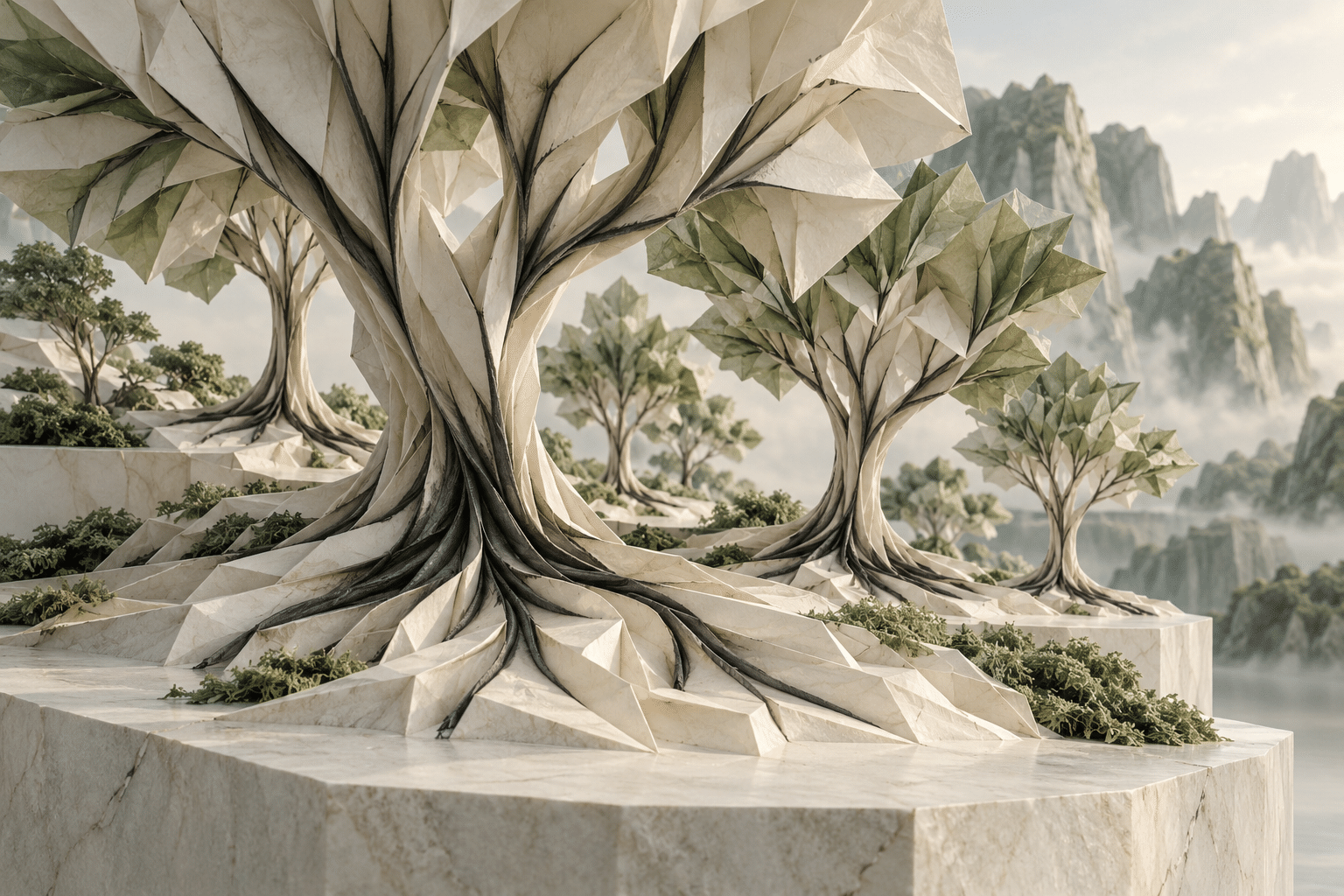
A closer look
Paper trees contain dark carbon-like seams that follow their folds and collect at shared roots. Keep the seams tied to folds and roots instead of adding smoke or environmental claims.
The visual idea
Carbon Trace Paper Forests is an original AOI art-direction proposal inspired by the imagery and vocabulary of technology and AI. It is a creative concept, not an established historical movement or a literal illustration of a technical process. Its defining construction is specific: paper trees contain dark carbon-like seams that follow their folds and collect at shared roots.
The starting scene is a delicate paper forest on a pale plinth. The palette combines ivory, charcoal and muted green. These choices establish a practical visual target: a viewer should recognize the relationship between the forms before noticing small decorative details. Keep the seams tied to folds and roots instead of adding smoke or environmental claims.
Build a convincing image
Begin with the largest silhouette in the scene and establish the main overlaps. Then develop the materials and the changes in scale. For this concept, the most useful editing instruction is: keep the seams tied to folds and roots instead of adding smoke or environmental claims. Apply that constraint to the foreground, the focal subject and the background; a beautiful isolated detail cannot rescue a composition that loses its governing pattern.
Try the motif at two distances. In a wide composition, use the overall arrangement of a delicate paper forest on a pale plinth; in a close study, concentrate on one junction, edge or material transition. Keep the colors in the ivory, charcoal and muted green family while changing the lighting. This makes it easier to judge whether the structure, rather than a particular color effect, carries the idea.
Variations and critique
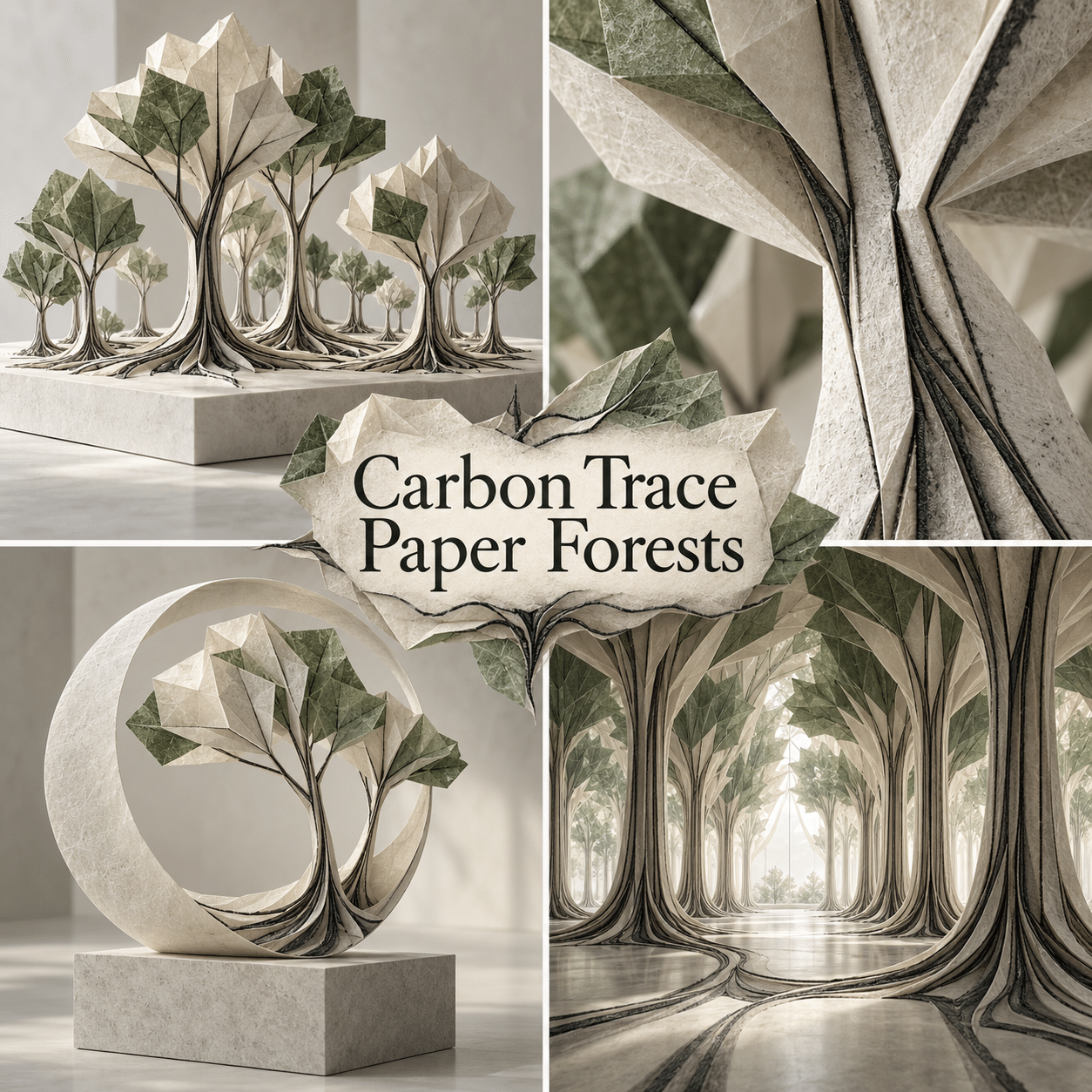
The prompt workshop offers a complete scene, a close material study and an installation variation. Change one major decision at a time: scale, surface finish, spacing or the direction of light. Compare the results at thumbnail size and then at full size. The thumbnail should retain the main visual rule; the larger view should reward inspection with credible edges and consistent materials.
The example and the titled collage are AI-generated interpretations of this proposed style. The collage tests the same construction across several compositions. A result belongs in this family when it preserves the rule "paper trees contain dark carbon-like seams that follow their folds and collect at shared roots". A different subject can fit; a superficially similar image that abandons that rule is better treated as a new experiment.
Technique notes
Keep the seams tied to folds and roots instead of adding smoke or environmental claims.
Keep the visual rule recognizable when the image is reduced to a small thumbnail.
Use the supplied prompts as starting points; generated outputs can vary and need visual review.
The prompt workshop
Original creative exercises. These prompts create new illustrations, not documentary evidence.
A complete scene
Use case: stylized-concept. Asset type: beautiful finished featured artwork for the original AOI concept "Carbon Trace Paper Forests". Create one coherent landscape artwork of a delicate paper forest on a pale plinth. Defining visual rule: Paper trees contain dark carbon-like seams that follow their folds and collect at shared roots. Palette: ivory, charcoal and muted green. Art direction: Keep the seams tied to folds and roots instead of adding smoke or environmental claims. Exceptional material definition, elegant light, strong large-scale composition and controlled fine detail. The concept is an invented artistic metaphor, not a technical diagram. No text, lettering, logos, watermark, interface overlays or collage. Make the defining visual rule unmistakable.
Look closely at the materials
Carbon Trace Paper Forests: an intimate material study derived from a delicate paper forest on a pale plinth. Paper trees contain dark carbon-like seams that follow their folds and collect at shared roots. Frame a small part of the construction closely enough to reveal how the surfaces meet. Use ivory, charcoal and muted green, a calm background and one directional light. Keep the seams tied to folds and roots instead of adding smoke or environmental claims. Preserve the defining pattern at close range; no text or labels.
A room-sized experiment
Explore Carbon Trace Paper Forests as a room-sized installation with generous empty space. Paper trees contain dark carbon-like seams that follow their folds and collect at shared roots. Restrict the materials to two contrasting finishes drawn from the original concept, with ivory, charcoal and muted green used sparingly. Keep the seams tied to folds and roots instead of adding smoke or environmental claims. Let shadows or reflections repeat the defining structure once, without introducing unrelated decorative motifs. No lettering.
Look closer
Explore the image gallery
Select an image to enlarge it. Browse with the arrows, and press Escape to return.
Your next inspiration
Discover another art style
Follow a visual thread to the next subject.

Query Key Origami
Two interlocking folded-paper forms have complementary cutouts that reveal a bright inner shape only when aligned.

Key Exchange Origami Birds
Two folded birds exchange a single colored paper strip that passes continuously through both bodies.
Commit Ring Trees
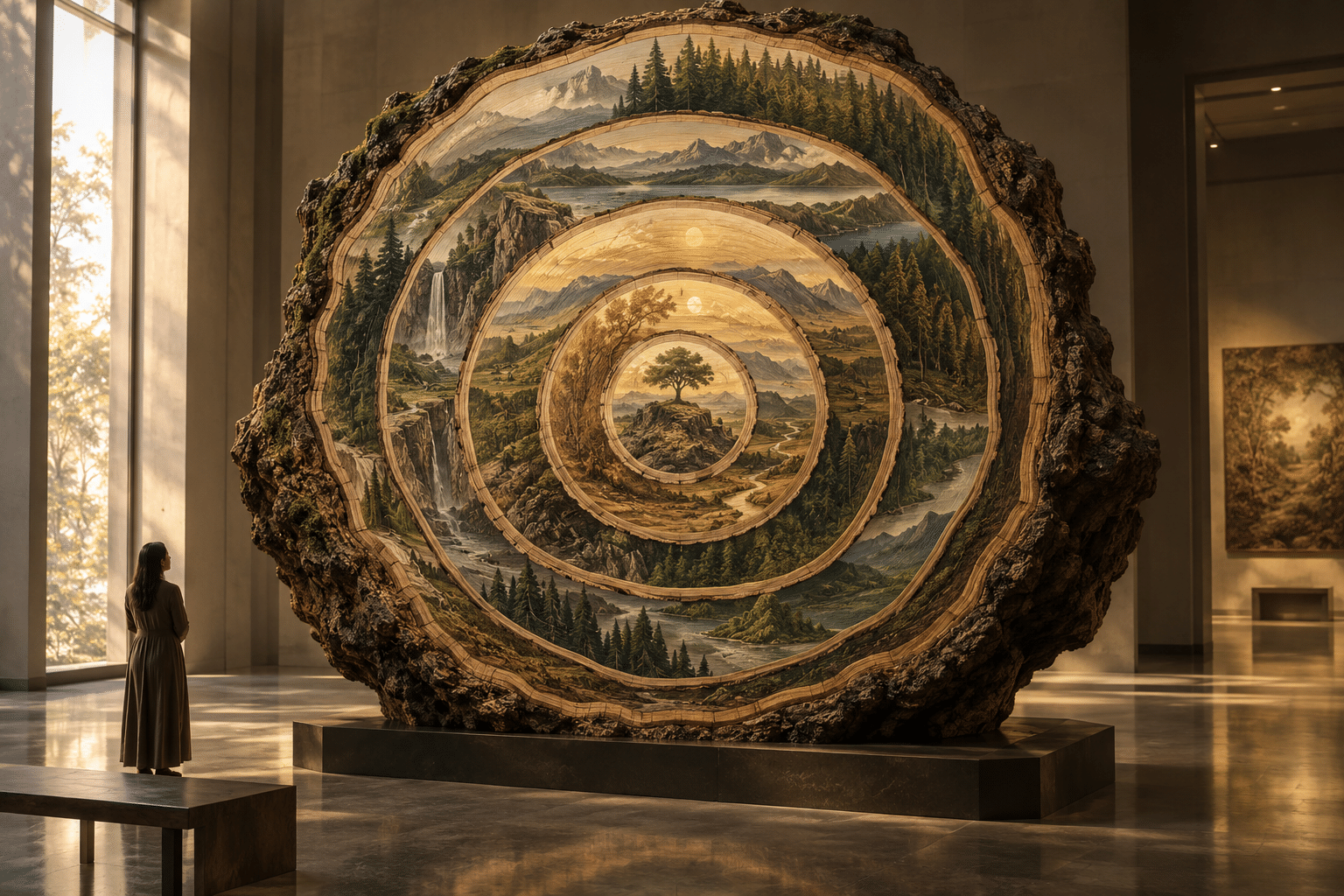
A tree's cut trunk reveals sharply separated rings, each containing a miniature abstract landscape.