
Archive note: historical claims and artist or artwork associations in this entry have not yet received a full source review.
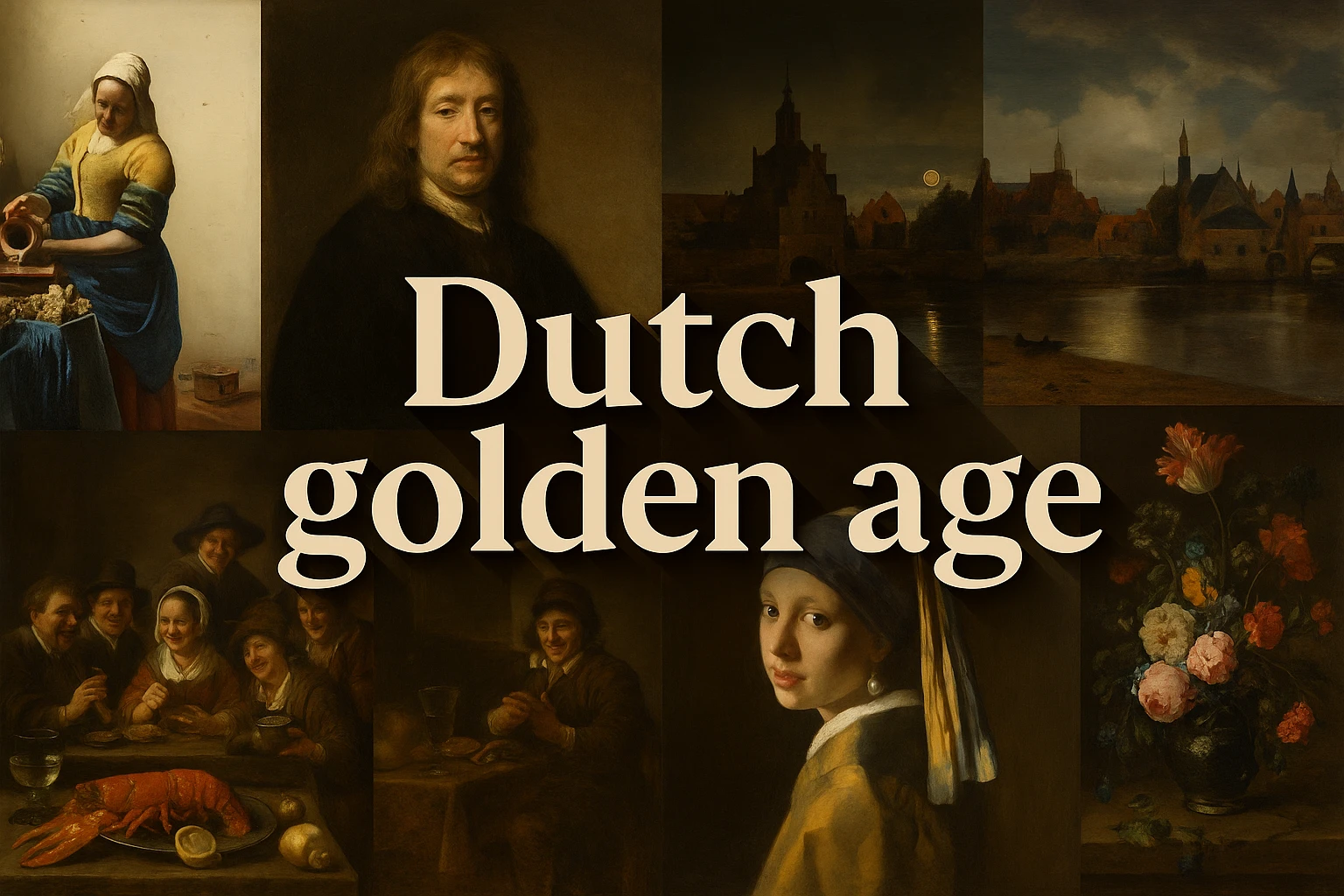
Dutch golden age
The Dutch Golden Age was a period in Dutch history, roughly spanning the 17th century, in which Dutch trade, science, military, and art were among the most acclaimed in the world. The first half of the century is often characterized as the Dutch Golden Age, while the second half is known as the Silver Age. Dutch Golden Age art is characterized by its realistic style, intense colors, and minute details. Artists of the Dutch Golden Age often depicted everyday scenes, such as markets and domestic life, as well as landscapes and portraits. Their work was highly sought after by wealthy patrons, and their paintings often fetched high prices.
AOI thinking about Dutch golden age [+_~]-/
Overview and quick facts
painting Dutch Golden Age painting is characterized by its realistic style, rich colors, and detailed depictions of everyday life. The artists of this period were highly skilled in their craft and were able to capture the essence of their subjects with great precision. This art style was popular in the Netherlands during the 17th century and has since been admired by art lovers all over the world.
Can understand it also, as:
The Dutch Golden Age was a period of great prosperity and artistic achievement in the Netherlands during the 17th century, when Dutch trade, science, and art were among the most acclaimed in the world.
Categorize it as:
Impressionism, Modernism
Detailed description
The Dutch Golden Age was a period of great prosperity in the Netherlands during the 17th century. It was a time when Dutch trade, science, and art were among the most respected in the world. The Dutch Golden Age is often associated with the great Dutch painters of the time, such as Rembrandt van Rijn, Jan Vermeer, and Frans Hals. These artists created masterpieces that are still admired today. The Dutch Golden Age was made possible by a number of factors. The Netherlands had become a wealthy country thanks to its thriving trade. Amsterdam was an important center of international trade, and Dutch ships sailed all over the world. The Dutch also had a strong military, which allowed them to protect their country and its interests. During the Dutch Golden Age, the Dutch people enjoyed a high standard of living. This was reflected in the art of the time, which was often luxurious and opulent. The Dutch Golden Age was a time of great creativity, and many of the paintings of the time are still revered today.
Archive notes — claims to verify
1. The Dutch Golden Age was a period of great prosperity and cultural achievement in the Dutch Republic during the 17th century.
2. It was a time of great economic growth, due to the country's highly developed maritime trade.
3. Many of the most famous Dutch painters, such as Rembrandt, Vermeer and Jan Steen, were active during this period.
4. The Dutch Republic became a leading center of science and art during the Golden Age.
5. Amsterdam became one of the most important cultural and artistic centers in Europe.
6. The Dutch Golden Age was also a time of great religious tolerance, with Amsterdam becoming a haven for religious refugees from across Europe.
7. The Dutch Golden Age came to an end in the early 18th century, as the country was plunged into a series of wars with France.
8. However, the legacy of the Dutch Golden Age has left a lasting impression on Dutch culture and society.
9. The Dutch Golden Age was a period of great prosperity and cultural achievement in the Dutch Republic during the 17th century.
10. It was a time of great economic growth, due to the country's highly developed maritime trade.
11. Many of the most famous Dutch painters, such as Rembrandt, Vermeer and Jan Steen, were active during this period.
12. The Dutch Republic became a leading center of science and art during the Golden Age.
13. Amsterdam became one of the most important cultural and artistic centers in Europe.
14. The Dutch Golden Age was also a time of great religious tolerance, with Amsterdam becoming a haven for religious refugees from across Europe.
15. The Dutch Golden Age came to an end in the early 18th century, as the country was plunged into a series of wars with France.
16. However, the legacy of the Dutch Golden Age has left a lasting impression on Dutch culture and society.
17. The Dutch Golden Age was a period of great prosperity and cultural achievement in the Dutch Republic during the 17th century.
18. It was a time of great economic growth, due to the country's highly developed maritime trade.
19. Many of the most famous Dutch painters, such as Rembrandt, Vermeer and Jan Steen, were active during this period.
20. The Dutch Republic became a leading center of science and art during the Golden Age.
Artists and works: references to check
(be aware, can be highly speculative)
Artists (be aware, speculation possible):
1. Jan van Eyck (1390-1441) 2. Rogier van der Weyden (1399/1400-1464) 3. Hans Memling (1430-1491) 4. Gerard David (1460-1523) 5. Hieronymus Bosch (c. 1450-1516) 6. Pieter Bruegel the Elder (c. 1525-1569) 7. Joachim Patinir (c. 1480-1524) 8. Aertsen, Pieter (1508-1575) 9. Cock, Hieronymus (1518-1570) 10. Cornelis van Haarlem (1562-1638) 11. Dirck Hals (1591-1656) 12. Frans Hals (1582/1583-1666) 13. Jan Steen (1626-1679) 14. Rembrandt (1606-1669) 15. Salomon van Ruysdael (c. 1602-1670) 16. Van Dyck, Anthony (1599-1641) 17. Vermeer (1632-1675) 18. Wouwerman, Philips (1619-1668) 19. Jan Asselijn (1615-1652) 20. Barend van Orley (1488-1541) 21. Bernard van Orley (1491-1542) 22. Jan van der Heyden (1637-1712) 23. Adriaen Brouwer (1605-1638) 24. Adriaen van Ostade (1610-1685) 25. Anthonie Palamedesz (1601-1673) 26. Dirck Hals (1591-1656) 27. Ferdinand Bol (1616-1680) 28. Gabriel Metsu (1629-1667) 29. Gerard Dou (1613-1675) 30. Jan Lievens (1607-1674)
Artworks (be aware, speculation possible)
1. The Milkmaid Johannes Vermeer 1658 2. The Night Watch Rembrandt 1642 3. The Anatomy Lesson of Dr. Nicolaes Tulp Rembrandt 1632 4. Christ in the Storm on the Sea of Galilee Rembrandt 1633 5. The Jewish Bride Rembrandt 1667 6. The Return of the Prodigal Son Rembrandt 1669 7. Belshazzar’s Feast Rembrandt 1635 8. The Syndics of the Drapers’ Guild Rembrandt 1662 9. The Goldfinch Carel Fabritius 1654 10. The Little Street Vermeer 1658 11. The Music Lesson Vermeer 1662/1664 12. The Pearl Earring Vermeer 1665/1667 13. The Milkmaid Vermeer 1658-1660 14. The Love Letter Vermeer 1669 15. The Geographer Vermeer 1668-1669 16. The Astronomer Vermeer 1668 17. The Girl with the Wine Glass Vermeer 1659-1660 18. The Girl with the Pearl Earring Vermeer 1665/1667 19. The Girl with a Red Hat Vermeer 1665/1666 20. Woman in Blue Reading a Letter Vermeer 1663-1664 21. The Lacemaker Vermeer 1669-1670 22. The Art of Painting Vermeer 1666-1668 23. View of Delft Vermeer 1660-1661 24. The Windmill at Wijk bij Duurstede Jacob van Ruisdael 1670 25. The Jewish Cemetery Jacob van Ruisdael 1655 26. The Wheat Field Jacob van Ruisdael 1670 27. The Storm on the Sea of Galilee Rembrandt 1633 28. The Raising of the Cross Rembrandt 1633 29. The Descent from the Cross Rembrandt 1634 30. Samson and Delilah Rembrandt 1635
Epoch
The Dutch golden age was a period in Dutch history, roughly spanning the 17th century, in which Dutch trade, science, military, and art were among the most acclaimed in the world.
Creative tools and further exploration
Search results are starting points for exploration, not evidence for the historical claims or attributions in this legacy entry.
- Practical AI tools and critical guidance
- Build a repeatable image workflow
- Search Wikipedia for this subject
- Search Lexica for visual interpretations
- Browse the Art Style Database
Creative studies to try
Explore these collected prompts as creative interpretations. They are starting points for image-making, not reproductions of historical artworks or evidence about a tradition.
Visual cues: deep shadow, directional light, dramatic contrast
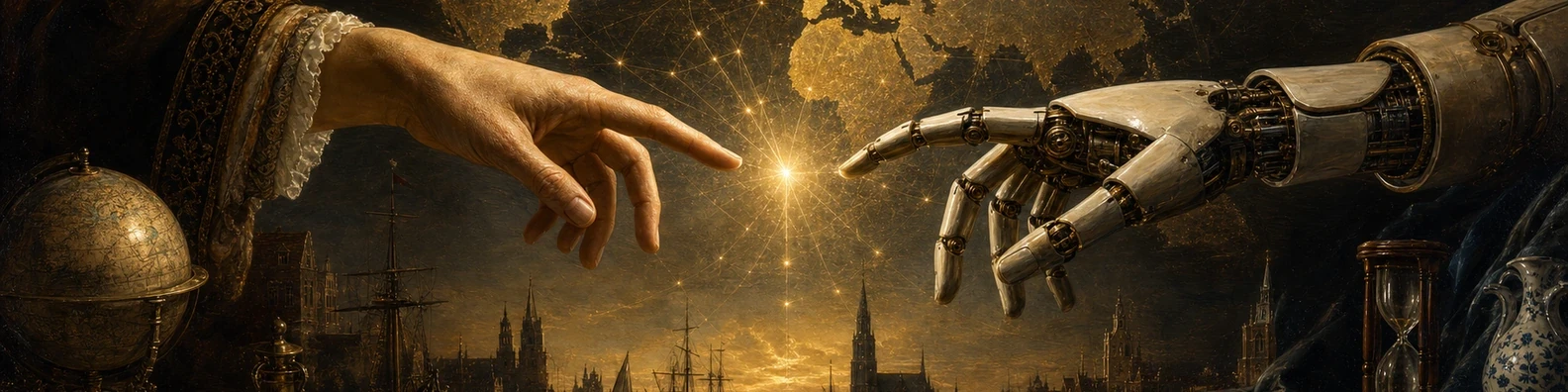
Study 1 — Dutch Golden Age
Ultra-wide panoramic banner, a human hand and a sleek robotic hand reaching toward each other, fingertips almost touching, a bright luminous spark of intelligence between them, a subtle world map behind them with global data network lines, symbolizing human-AI collaboration and digital transformation, rendered in Dutch Golden Age style, with refined composition, distinctive materials, elegant lighting, high-detail artistic finish, high quality, high detail, balanced composition, no text, no logo, no watermark, exact aspect ratio 1584:396
Prompt source: 1001 Art Styles. Select the text to copy, then adapt the subject and composition.