
Painting · urban life, brushwork and selective observation
The Ashcan School is associated with artists who brought the activity of modern city life into American painting around the beginning of the twentieth century. Streets, crowds, entertainment and ordinary encounters offered subjects worthy of serious attention. The name should not persuade us that every picture is a dark report on poverty: pleasure and vitality also belong to the story.
Creative toolbox · take this style further
Choose an input, adjust it, then open a tool. Search links pass your text to the destination. Copy & open copies it for you to paste into the generator; you start generation there.
ChatGPT
Copy your input and paste it into a ChatGPT conversation or image request.
Copy & open ChatGPT (new tab)Claude · Anthropic
Develop an image prompt or explore the style in a new Claude conversation.
Copy & open Claude · Anthropic (new tab)Midjourney
Paste your input into the Imagine bar on the Create page.
Copy & open Midjourney (new tab)Adobe Firefly
Copy your input, open Firefly, and paste it into the prompt field.
Copy & open Adobe Firefly (new tab)Leonardo.Ai
Copy your input, open Leonardo, and paste it into the generation field.
Copy & open Leonardo.Ai (new tab)Lexica
Search AI images and prompts using your selected input.
Search with this input Lexica (new tab)Pexels
Search the photo and video library. Short keywords often work best.
Search with this input Pexels (new tab)Pixabay
Search photos, illustrations and other images.
Search with this input Pixabay (new tab)Unsplash
Search photographs using the style name or your own keywords.
Search with this input Unsplash (new tab)Wikipedia
Search for background reading. A style may not have its own article.
Search with this input Wikipedia (new tab)WikiArt
Copy your input into WikiArt’s search to explore artists and artworks.
Copy & open WikiArt (new tab)Instagram hashtags
Search a hashtag made from your input: spaces and punctuation are removed. Instagram may require sign-in.
Search with this input Instagram hashtags (new tab)A closer look
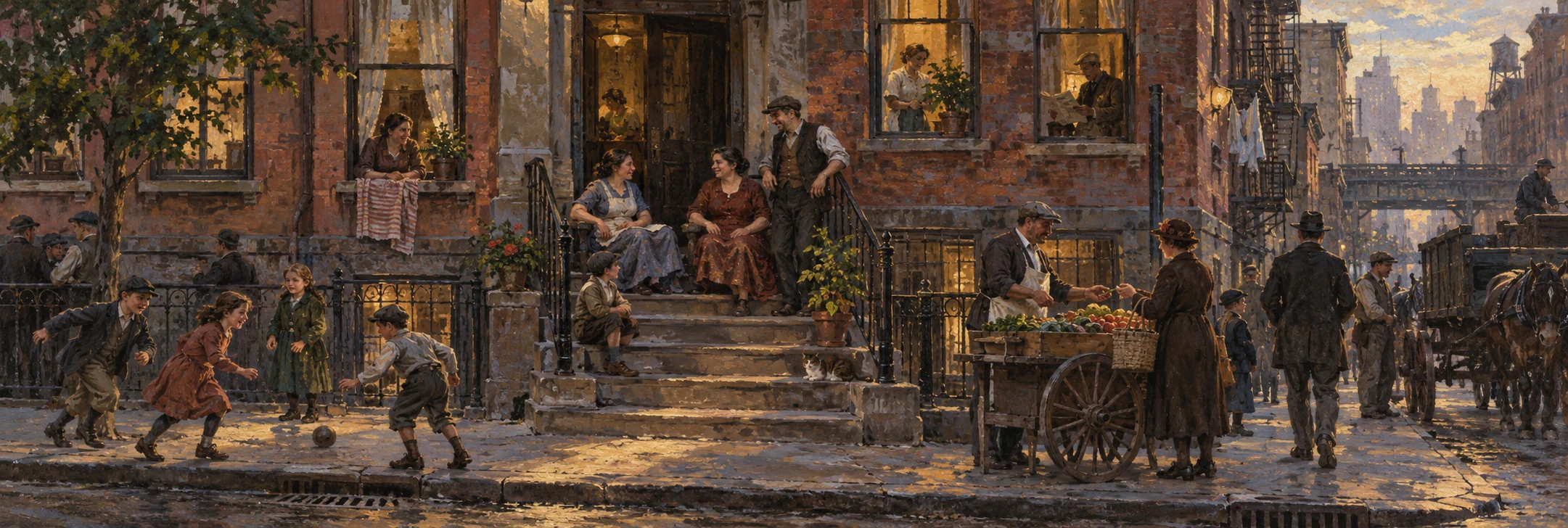
Our original AI-generated banner imagines a street of stoops, a vendor and neighbours in conversation. It explores a social space rather than documenting an actual neighbourhood. Its energetic painted surface is a contemporary interpretation, not a reproduction of an Ashcan artist’s work.
Who belongs to this history?
The Met identifies Robert Henri and his associates William Glackens, George Luks, Everett Shinn and John Sloan as the first generation, with George Bellows among Henri’s later New York students. Their shared context does not erase differences in subject, handling or artistic ambition. [1]
The Eight is a related but different grouping. Its 1908 exhibition included the five senior Ashcan painters alongside Ernest Lawson, Maurice Prendergast and Arthur B. Davies. Treating the two names as exact synonyms turns an exhibition history into a misleading membership list. [1]
The word school is also loose here. A useful introduction follows relationships between artists and their work without inventing one compulsory method or manifesto. Begin with a named picture and ask what this particular artist chose to make visible.
Paint the encounter, not just the buildings
A street scene becomes socially legible through distances and actions: someone pauses at a doorway, a cart interrupts a route, a window connects an interior to the pavement. Architecture supplies a framework, but these small relationships give the city its pace.
Look at how brushwork assigns attention. Broad dark masses may gather buildings into a backdrop while a few light accents pick out faces or movement. A quickly stated figure can still feel specific if its posture belongs to a clear action. More finish is not always more information.
In the banner, the stoop creates a place of rest beside the vendor’s movement. The contrast gives the viewer more than a crowd to count. If every figure hurried in the same direction, the scene would make a different claim about the street.
Urban realism is still selective
The Met’s essay stresses that these artists’ pictures did not amount to a uniform reform campaign. Their interest in urban life included its entertainments and vitality as well as less genteel subjects. That distinction helps prevent the label from becoming shorthand for misery painted in brown. [1]
Ask what the artist leaves outside the frame, but do not fill those absences with invented facts. A lively street picture cannot prove that a neighbourhood was comfortable or equitable. A sombre passage cannot establish the private feelings of a person whose history we do not know.
For a contemporary study, avoid using grime as a substitute for observation. Worn surfaces may establish a setting, but the people need actions and relationships beyond serving as signs of deprivation. Let ordinary pleasure and work coexist when the chosen scene calls for both.
A street study with a readable rhythm
Choose three zones: a place to pass through, a place to pause and a threshold between inside and outside. Sketch how people occupy them. Establish the large value pattern before adding windows, clothing or street furniture. At a distance, the picture should already communicate movement and rest.
For AI-assisted imagery, specify a fictional setting and a small number of intelligible actions. Check bodies, cart handles, steps and pavement edges. A model can produce lively brushwork while leaving a figure unable to stand on the surface beneath it.
Compare a close crop with a wider view. Which one makes the encounter clearer? Finish with a caption that distinguishes your invented scene from historical documentation. The city becomes interesting when its inhabitants do more than decorate the skyline.
A small poetic detour
Original words from the AOI studio.
Poetry
A doorway pauses the street;
the cart resumes its sentence.
The prompt workshop
Original creative exercises. These prompts create new illustrations, not documentary evidence.
Give the street a rhythm
Original Ashcan-informed painting of a fictional early twentieth-century street, neighbours resting on a stoop beside a moving vendor, broad dark forms and selective warm accents, no historic-document claim.
Original AOI exercise; a generated image is not historical or documentary evidence.
Connect three zones
Invented urban scene with passing pedestrians, seated neighbours and an open doorway, energetic oil brushwork and clear spatial relationships, ordinary work and pleasure, no poverty caricature or copied artwork.
Original AOI exercise; a generated image is not historical or documentary evidence.
Compare the crop
Make a wide street study and a closer view of the same fictional stoop encounter. Keep the actions constant and compare whether architecture supports or distracts from the social relationships.
Original AOI exercise; a generated image is not historical or documentary evidence.
People & works to explore
References discussed in this article. Consult the sources below for context.
Artists and practitioners
Robert Henri
William Glackens
George Luks
Everett Shinn
John Sloan
George Bellows
Paintings and other works
John Sloan, Dust Storm, Fifth Avenue, 1906
William Glackens, The Green Car, 1910
Sources and further exploration
Creative studies to try
Explore these collected prompts as creative interpretations. They are starting points for image-making, not reproductions of historical artworks or evidence about a tradition.
Visual cues: broken light, atmospheric color, observed mood
Study 1 — Ashcan School
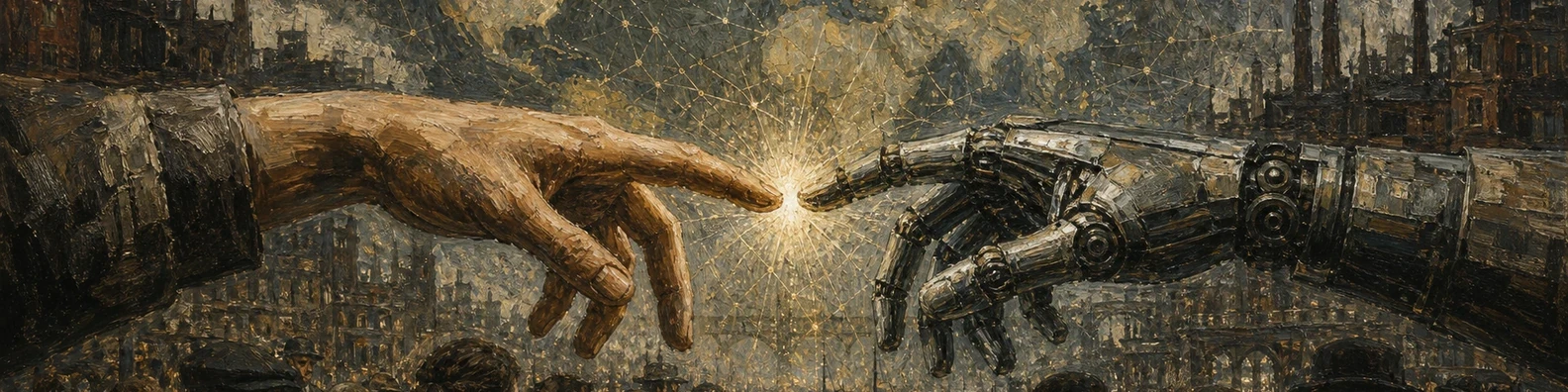
Ultra-wide panoramic banner, a human hand and a sleek robotic hand reaching toward each other, fingertips almost touching, a bright luminous spark of intelligence between them, a subtle world map behind them with global data network lines, symbolizing human-AI collaboration and digital transformation, rendered in Ashcan School style, with refined composition, distinctive materials, elegant lighting, high-detail artistic finish, high quality, high detail, balanced composition, no text, no logo, no watermark, exact aspect ratio 1584:396
Prompt source: 1001 Art Styles. Select the text to copy, then adapt the subject and composition.